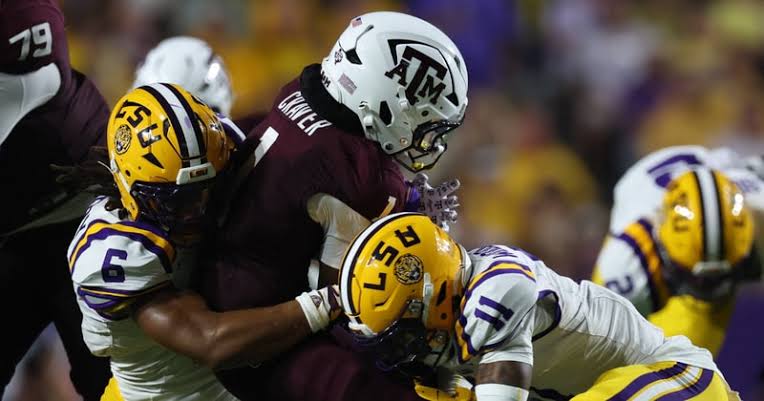
Arkansas righted the ship – at least a little bit – with a 34-6 win over Tulsa that at least gives some hope that Ryan Silverfield is getting this thing turned around after a disastrous start.
Vegas is counting on bettors not buying any kind of turnaround, making Texas A&M 14.5-point favorites for Saturday’s game in College Station. A win for the Razorbacks would be very much “ahead of schedule”, but the Aggies certainly look vulnerable right now.
Once again, I’m back at Best of Arkansas Sports taking a look at this matchup from the perspective of the Aggies’ preparation. Be sure to check out that article. My work there enables this blog to keep running, plus BOAS has several excellent writers offering lots of news and analysis.
- Matchup Analysis: Hopefully Ron Roberts has a trash can handy
- Box Score Breakdown: Texas A&M 34, Arkansas 7

- Matchup Analysis: Who’s going to fix their issues first in College Station?

Meet the Aggies
After years of very flamboyant, arrogant football under coaches Kevin Sumlin and Jimbo Fisher, the Aggies pivoted when they hired Mike Elko, whose blue-collar persona was probably exactly what that program needed. Elko, a successful defensive coordinator with Texas A&M and Notre Dame, had build a crafty, scrappy team that succeeded at Duke.
For a while, Elko could do no wrong. Despite a deluge of outbound transfers from the end of the Fisher era, Elko’s first team went 8-5 against a tough schedule and played disciplined football. The breakthrough came last year: an 11-0 start that locked up a playoff bid by mid-November. Yes, it didn’t end well: a loss to archrival Texas (or should we say “Arch-rival” Texas) and then a 10-3 home loss to eventual runner-up Miami in the playoff.
With several key players returning and recruiting momentum on the Aggies’ side, it seemed likely that the 2026 team was also going to be a top-10 team competing for the playoff.
Instead:

The Aggie playoff hopes failed to survive September. They still have to travel to Alabama, and they host top-ranked Texas in the regular-season finale.
So what went wrong? The most obvious candidate is the same thing that spoiled Sam Pittman’s tenure after a promising start: losing both initial coordinators and then downgrading with the new hires. Elko lost both coordinators in the offseason, and he chose to promote internally rather than hire proven playcallers. Returning players have regressed, and highly-touted transfers have not worked out as expected. It takes a certain humility for a coach to recognize their own weaknesses and their need to keep great coaches on staff, and many (maybe most) head coaches just don’t have that.
Aggie fans are certainly hoping that this setback is temporary, that the new coordinators are actually going to be fine but they just need to adjust. That adjustment needs to start on Saturday or fan anger with Elko is going to get louder.
Expect the Aggies to be hungry for a win after that embarrassing beatdown in Baton Rouge.
When Arkansas has the ball

A major topic of conversation in College Station right now is the fact that Elko calls his own defensive plays. That appears to have been a main reason why veteran defensive coordinator Jay Bateman jumped ship for Kentucky in the offseason. Coaches who call their own plays rarely win big: the last national champion to call his own plays was Fisher with Florida State in 2013, so zero playoff head coaches called their own plays. Once-highly-respected playcallers like Ryan Day and Lane Kiffin gave up playcalling years ago.
Fans can live with a coach calling his own plays if that unit is playing well, and it was last season. But now, suddenly, the Aggies are not doing so well. Both Kentucky and LSU torched them with explosive plays. If Elko gives up defensive playcalling, he’d be giving it up to his new defensive coordinator Lyle Hemphill, who has worked with Elko for years at multiple stops but has limited playcalling experience.
The Aggies turned over a lot of their defense, but the new faces aren’t doing much.

Elko’s basic defensive strategy is to be vanilla on early downs and exotic on passing downs. His teams are usually known for having elite third down defense. As you can see, that’s one of the few things that the Aggies do decently, ranking 47th in third down defense versus expected.
As we’ve been tracking, the Hogs are poor on standard downs because they can’t run the ball, but they’ve been dangerous on passing downs, ranking 26th in marginal third down conversions and 36th in explosiveness.

Is this the game the Hogs are finally able to run the ball? Probably not. The Aggies are very good and keeping all runs against them short: 62% fail to gain four yards.
The guys over at 4th & 5 have done a nice job of tracking Arkansas’ issues with run blocking all season. Here’s DJ Williams’ Tulsa film review:
Arkansas is a zone-run team by design, something we’ve talked about with Tim Cramsey. The zone runs aren’t doing much for the Hogs. They aren’t blocking them well, and the backs are missing holes.
I do not expect Cramsey to meaningfully deviate from his efforts to be primarily a zone-running team, but there are ways to mix it up. The Hogs ran some power with Braylen Russell in the second half against Tulsa and used a fullback. They also swapped out struggling right tackle Bryant Williams for Oregon State transfer Adam Hawkes, who turned in an excellent performance in a quarter-and-a-half, particularly as a run blocker. Don’t be surprised if Hawkes gets the start or enters the game early.
If Arkansas is going to pull this upset, here is the biggest key:

The Aggie secondary has been absolutely lit up this season for explosive plays. Four different Kentucky receivers recorded an explosive (20+ yard pass), while LSU’s Jackson Harris had six catches for 163 yards and two scores. The Aggies’ three FBS opponents are averaging 15.7 yards per completion this year.
The explosives are largely not deep throws: rather, they involve coverage busts underneath or missed tackles in space. The Aggies have already allowed 487 yards after catch this season. That’s 121.8 YAC per game, compared to just 82.6 per game last year.
Elko primarily plays man defense, but his slot coverage guys are not doing too well and have allowed most of the explosives.
Nickel Jordan Shaw has been the most-victimized, allowing opposing receivers to catch 16 of 20 targets for 224 yards and two touchdowns, with 160 yards coming after the catch. Linebacker Noah Mikhail, an excellent run defender, has been a victim in coverage, allowing opponents to catch all eight targets for 112 yards, including 92 after the catch.
Given that Arkansas’ offense is almost entirely dependent on Chris Marshall at this point, the Aggies would be foolish to not focus on him in coverage. But given the issues they’ve had with their nickels and linebackers in coverage, there’s a lot of risk to slanting coverage to an outside receiver. I think that Marshall needs to make some plays himself, but if he ends up drawing the focus of the Aggie defense, this is a major opportunity for Ismael Cisse, Jaden Platt, and Cam Settles out of the backfield to have big games as receivers. It’s notable that the Hogs moved Marshall around a little bit against Tulsa: the deep crosser he caught in the second quarter came when he was lined up in the slot.
Pass rush is another good sign for the Hogs. Elko is not a big blitzer, and although the Aggies routinely got home with their front four last season, the pressure has dried up this year. They averaged 16.7 pressures and 3.6 sacks per game last season, and those numbers have been cut in half to 8.8 pressures and 1.5 sacks this year. They got almost no pressure on LSU’s Sam Leavitt or Kentucky’s Kenny Minchey. They called a lot more blitzes than normal against LSU but only created two pressures in 12 blitzed dropbacks.
Jackson is a bit of a sitting duck given Arkansas’ lack of a run game, but pass protection has mostly held up this season. If the Hogs can protect him, there’s a decent chance they carve up this Aggie secondary.
When Texas A&M has the ball

It’s been quite the fall-off for an Aggie offense that was very strong in 2025. Offensive coordinator Collin Klein called plays for a very crafty attack that utilized a high-efficiency run game to set up a strong play-action pass game. Key players were quarterback Marcel Reed, running back Rueben Owens II, and wide receivers KC Concepcion and Mario Craver.
Of those five names – Klein, Reed, Owens, Concepcion, and Craver – three are back, but the Aggies’ inability to properly replace the two missing ones may be the difference between a good offense and a bad one.
Klein took the head coaching job at his alma mater, Kansas State. Rather than hire a proven playcaller, Elko promoted wide receivers coach Holmon Wiggins, a longtime Justin Fuente assistant at Illinois State, Tulsa, Memphis, and TCU. Although he was on the staff the last couple seasons, his X’s and O’s background is different, and he has basically no prior playcalling experience.
Concepcion was the team deep threat, pacing the Aggies with a 12.3-yard average depth of target and leading the team with 240 receiving yards on deep throws (passes that traveled at least 20 yards beyond the line of scrimmage). The Aggies asked Alabama transfer Isaiah Horton to replace him, but production on deep throws has fallen off badly. Horton has only caught 15 of his 29 targets this season, and while Concepcion recorded more than 400 yards after the catch last year, Horton has 41 YAC through four games.
The returning stars haven’t been able to carry the load, and Reed has badly regressed (more on that below). The result is an offense that failed to generate 300 yards against either Arizona State or LSU. The run game is solid but less consistent than last year, while the pass game is falling apart, leading to cries for Reed to be benched from the Aggie faithful.

We see similar statistical profiles between Tulsa and Texas A&M. Both are going to be conservative, high-efficiency offenses who want to stay on schedule and hit some explosives on early downs. In the Tulsa preview, we discussed how the Golden Hurricane were dependent on those standard downs explosive passes in their upset of Oklahoma State and how Arkansas needed to prevent those.
Texas A&M is pretty much the same. They aren’t as bad as Tulsa on passing downs, but schematically they want to win first and second down or they will find themselves in a rough spot. As with Tulsa, though, those standard downs explosives just haven’t been there this season. If Arkansas can keep it that way they’ll have a good chance to get stops.

The Aggies are going to lean into Owens and the run game. The vast majority of their rushing attempts gain between three and five yards, which keeps their offense in good down-and-distance situations and sets up the play-action pass game.
The vast majority of their runs will be between the tackles, where they’ll use both duo dive (a power concept, often used in short yardage) and slam (inside zone read). They were more power-heavy in their first two games but, struggling with that, have used more zone runs over the last two weeks. Most zone runs are attached to a run-pass option (RPO). The throws off those have been unsuccessful, but the zone handoffs on RPOs have been their best offensive plays against FBS competition.
The single biggest issue for Texas A&M this season has been the passing game. That’s a surprise given that the Aggies have a veteran quarterback in Marcel Reed.

The Aggies have been terrible through the air generally, but the lack of explosive passes (135th) is particularly concerning. Arkansas will happily cede short, underneath completions in order to avoid surrendering explosive passes. Utah’s gadget plays were really the only time anyone has been able to consistently throw downfield on the Hogs this year.
Texas A&M’s offensive goal is to use the run game to stay on-schedule and the play-action pass game to create explosives. They generally want to avoid true dropback passes.
There’s a reason they want to avoid true dropbacks:

Per SEC Stat Cat, Reed’s 56% raw accuracy last season was dead-last among SEC starters.
The Aggie offensive scheme protects him by running the ball and having about 30% of his pass attempts be on play-action. But the production on play-action has sharply declined this season:
- 2025: 73% completion, 10.7 yards per attempt, 10% sack+scramble rate
- 2026: 59% completion, 7.8 yards per attempt, 15% sack+scramble rate
So Reed is now 50% more likely to keep the football and the passes he does throw are generating a full three yards less per attempt. What’s going on here?
Part of is certainly the loss of KC Concepcion, their downfield star last year. As you can tell from the numbers in the personnel chart above, the new guys around returning starter Mario Craver are struggling. Now Craver, the highest-graded Aggie receiver, is listed as questionable on the SEC injury report for this game:
Reed seems less confident in his first read and is showing a concerning tendency to abandon clean pockets.When Reed comes off his first look and tries to be a playmaker, he’s well outside of his skillset, so bad things usually happen:

It’s notable that he was pressured on 30% of his dropbacks last year and 31% this year, so it’s hard to blame the Aggie offensive line for this.
When there is pressure through the middle, he’s showing a tendency to drift backwards. When a quarterback does that, all kinds of bad things happen: it increases the likelihood of a sack (his sack-to-pressure ratio has risen from 11% to 20% this year), it makes the sacks bigger in terms of lost yardage, and it greatly decreases the likelihood of completing anything down the field.
Here’s what I mean. Watch how far Reed drifts back, and how there’s no way he’s going to be able to complete a pass here:

The end result is a massive increase in Reed’s time from snap to throw. He averaged 2.99 seconds last year, and that’s up to 3.22 seconds this year, despite no major changes to X’s and O’s and no change in his average target depth (exactly 9.1 yards both seasons). That number should go down for a veteran quarterback, not up.
The biggest shift has come on play-action: the ball was out of his hands in a lightning-quick 2.70 seconds on play-action passes last year, and that’s up a half-second to 3.26 seconds this year. Long-developing plays are part of the problem, and Reed trying to make something happen is also a part of it.
Because he holds onto the ball too long, pressure is having more of an impact:
- 2025: 43% completion, 6.1 yards/pass, 11% sack rate
- 2026: 29% completion, 4.5 yards/pass, 20% sack rate
Again, his overall pressured pass rate is the same from last year to this year.
The strategy seems to be to blitz him. Here’s how he’s looked against the blitz over the last three weeks:
- LSU: 46% blitz rate, 50% pressure rate, 3 of 12 for 22 yards, one interception, three sacks
- Kentucky: 32% blitz rate, 44% pressure rate, 7 of 14 for 58 yards, one interception, zero sacks
- Arizona State: 23% blitz rate, 43% pressure rate, 3 of 5 for 21 yards, one touchdown, two sacks
As you can see, word is out. The blitz rate against Reed has increased each week. Just under half of them actually cause a pressure, but Reed’s tendency to abandon clean pockets means that him seeing the blitz might be enough to make him come off his progressions and make a mistake.
That was not happening last year, when Reed punished the blitz to the tune of 8.8 yards per pass attempt with 14 touchdowns, only one interception, and only eight sacks in 13 games. This year, he’s at just 4.5 yards per attempt with two interceptions and six sacks already. Personnel and playcaller matter a lot.
Unfortunately, while I like the Razorback secondary’s ability to take away Reed’s first option, Arkansas’ ability to cause problems with the blitz is questionable at best. The Hogs blitzed Tulsa’s Dexter Williams 15 times on Saturday and only created two pressures. The caveat is that Williams was extremely quick to get the ball out against the blitz (2.31 seconds to throw on blitzes), while Reed tends to hold onto the ball much longer (3.00 seconds to throw on blitzes this year). That could get him in trouble on Saturday.
Keys to the game
Make Marcel Reed uncomfortable. Texas A&M wants to protect their beleaguered quarterback with an efficient run game and lots of play action opportunities. The more Reed is forced to drop back in high-leverage situations, the worse the A&M offense gets. Arkansas needs to contain the run just enough to force Reed to make key throws. Taking away his first option and/or getting pressure are keys to baiting him into mistakes and inaccurate throws.
Win the battle of explosives. Arkansas is going to have to get some big pass plays down the field. Chris Marshall is probably going to need to be on the receiving end of some of them, but I suspect the Aggies will give him enough attention that someone else is going to have to step up. Ismael Cisse seems like a candidate for that. He’s been very inconsistent, but he’s flashed the potential to be dangerous after the catch in the open field. The Aggies will probably give him some chances to make plays.