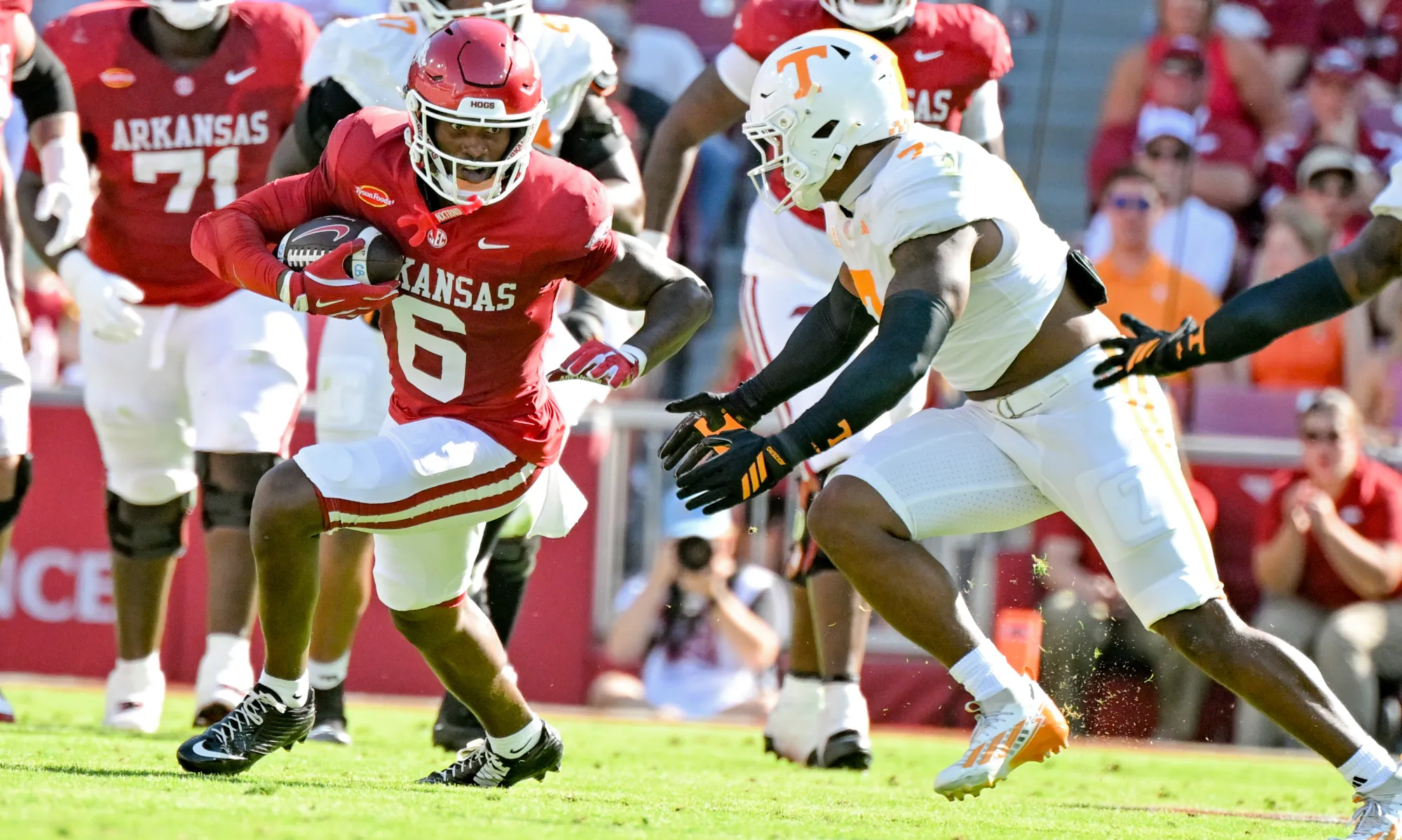
Arkansas’ long SEC losing streak continued Saturday with a 24-17 home loss to Tennessee.
There’s plenty to be positive about, as the Razorbacks showed signs of life. Tennessee started a new quarterback, George MacIntyre, and he struggled throughout the game. The Hogs stacked the box and largely contained the vaunted Vol run game until the fourth quarter.
The teams traded empty possessions until Tennessee finally punched it in the second quarter to go up 7-0. They threatened again at the very end of the half, but a wild sequence saw MacIntyre fumble and Quincy Rhodes scoop it up and rumble 60 yards with three seconds left in the half. Unfortunately, former Vol Max Gilbert was no good on a 37-yard field goal try as the half ended, leaving the score 7-0.
In the second half, Arkansas swapped struggling center Caden Kitler for Kash Courtney and doubled down on the run game. The Hogs marched down the field on consecutive drives. Braylen Russell punched in a touchdown to tie the game, and then KJ Jackson found Jaden Platt for a red zone score on the next drive to go up 14-7.
Sadly, the rushing renaissance proved short-lived. Tennessee cut the lead to 14-10 and then went up 17-14, using several explosive plays and the late arrival of their rushing attack. The Hogs tied it at 17-all on a 55-yard redemption field goal by Gilbert, but the Hogs had earned their final first down of the game. A 59-yard run by DeSean Bishop set up a late Tennessee touchdown, and then the Hogs punted the ball away on 4th-and-10 with 1:45 to play and all three timeouts. They would not get it back as Tennessee picked up a first down and then kneed it out.
The attitude in the stadium and across Razorback Nation turned from encouragement over the improved performance to outrage over the overly-conservative way the coaches handled the final two drives. Fans in the stadium could be heard loudly booing on the broadcast as the game ended.
My take will probably make no one happy, but here goes.
First, the offensive playcalling and decision-making late in the game was terrible. Arkansas ran the ball on a 3rd-and-10 and then punted on a 4th-and-10 on the next drive, so they never actually ran a do-or-die play where they were trying to pick up a first down and keep the game alive. There’s a certain cutthroat mentality you have to have to survive as a coach in the SEC, and in his first real opportunity to show it, Silverfield went with the most mind-numblingly conservative option. That’s fairly consistent with recent Arkansas football history: Bobby Petrino was aggressive, every head coach since has coached scared. But at Arkansas, you have to win on the margins: you’re not better than Tennessee over a 120-play game, so you have to be better on the five highest-leverage plays. Winners go and convert a few fourth downs and win the game.
Second, the Hogs punted because Silverfield doesn’t trust his offense, and he was correct in that moment to not trust them. He even mentioned after the game that he gave it a “5% chance” that they convert that fourth-and-10. If we assume that’s correct, then the analytics absolutely favor his decision. The decision wasn’t “playing not to lose” – punting it away down seven in the final two minutes is the definition of playing to lose – it was delaying the defeat by trying to shift the burden to make a high-leverage play from the offense (picking up the fourth down) to the defense (forcing a turnover or, at least, getting a three-and-out). The “5% chance” line is hopefully a signal to Silverfield that he needs to rethink his approach to Arkansas’ offense, certainly this offseason if not over the rest of the year. As we’ve discussed on this blog before, you can survive bad defense here and there, but you cannot win at Arkansas in the modern era without a very good offense. This level of offensive production is just not acceptable, even for a first-year staff.
Third, I have not seen any evidence that these kinds of coaching decisions in the first year of a coaching tenure have any bearing on how that coach’s tenure plays out. Your first instinct may have been like mine – “see, this proves he’ll never win here” – but there’s not really any evidence that’s true. In fact, first-year coaches often lose most of their close games. People are contrasting Silverfield’s decision with the decision of Kentucky’s Will Stein to go for two in overtime for two consecutive games (getting both and winning both), but the clear difference is that Stein has a much better offense and could trust them to go make a play. If Silverfield doesn’t work out at Arkansas, it won’t be because he failed to go for it on that fourth-and-10, it will be because he never put together an offense he could trust to go for it on fourth-and-10.
Fourth, we’re going to have to keep talking about why this offense is so bad. Kentucky also has a first-year coach and spent about the same on its NIL. There’s just no excuse for this. This was an improved offensive performance and the Hogs had 287 yards of total offense.
Fifth, it’s easy to let the frustration at the game’s end overshadow the fact that Arkansas was massively improved in this game. Tennessee is far from perfect – their quarterback situation is quite dire – but they have a ton of talent on both sides of the ball and the Hogs went toe-to-toe with them for the entire game. The defense played particularly well, but the offensive line looked improved for stretches, and I thought the running backs ran with more conviction. Vanderbilt, Auburn, and South Carolina are among the teams left on the Razorbacks’ schedule that are worse than Tennessee in terms of talent, although the matchups will be a little bit different for all three.
Sixth, to that end, I think Arkansas now has a very good chance to build on this performance and go beat Vanderbilt next week. I could easily see two SEC wins. That’s hardly the standard, but it’s acceptable for a Year Zero situation like this one. We talked in the preview about how the sixth game needs to be the breakthrough, the Hogs sort of got that, although they didn’t win the game. But Chad Morris’s first team in 2018 also righted the ship in October, but they failed to actually finish a win despite numerous opportunities. This one was a miss, but Vanderbilt is even more beatable.
So the stuff that matters more for the long-term is mostly positive, even though the short-term feeling is negative. No wonder everyone feels complicated after that one.
- Box Score Breakdown: Tennessee 24, Arkansas 17

- Matchup Analysis: Hopefully Ron Roberts has a trash can handy

- Box Score Breakdown: Texas A&M 34, Arkansas 7

Advanced stats

It was a tale of bad quarterback play. Both offenses stayed on schedule and mostly moved the chains before third down. When forced to pass, both offenses were horrible. Tennessee won by creating more explosives on standard downs (7 versus 4).
Arkansas’ standard downs offense has been decent for three straight games after getting off to a horrific start to the season. That’s a positive sign, as success rate on standard downs is highly-correlated with offensive improvement.

The run game keeps steadily improving. I’m anxious to get the playcall breakdown from SEC Stat Cat, because we’re seeing a move toward more boom-or-bust running rather than the three-yards-and-a-cloud-of-dust scheme the Hogs opened the year with. Six runs were stuffed (not great), but 17 of 31 gained at least four yards, and the Hogs turned in a season-high 70.5 highlight yards (highlight yards = yards beyond four gained on opportunity runs).
On the other side, no puking in the press box for Ron Roberts, but the Hogs were very close to completely stopping the vaunted Tennessee run game. Most of Tennessee’s best runs – including more than half of their 91 highlight yards – came in the fourth quarter against a tired Razorback defense.

And here’s the problem with the offense.
It sort of stinks. KJ Jackson played decently against Georgia and Tulsa in games where his rushing attack didn’t help him out at all. And now that the run game has gone from “historically awful” to merely “below average”, it’s Jackson and the pass game who are dragging things down. Arkansas had some success throwing short on early downs. Offensive coordinator Tim Cramsey did a good job of dialing up easy throws to Chris Marshall on standard downs to try and get his quarterback into a rhythm. But in must-pass situations, Jackson was horrible.
Failing to bring in a veteran quarterback feels like a major error at this point. It didn’t feel like a major error three weeks ago, when everything on the offense was broken, but Arkansas was a good quarterback away from winning this game.
Does Arkansas consider a quarterback change? It seems unlikely that AJ Hill is going to offer much more. But maybe the Hogs could try it. I’m seeing more calls for Hank Hendrix. The logic is that if the staff thinks he’s the future, you might as well give him a shot now when all your options are bad.
If we assume Hendrix has shown any indication that he could play – and that’s a stretch, honestly – I think the logic for Hendrix really comes down to whether Silverfield thinks Cramsey is going to be his offensive coordinator next year. You risk a lot by putting in a freshman (who should be a senior in high school right now) before he’s ready, and that’s a dumb risk if he’s going to be asked to learn a different offense and work with a different coordinator next year.
I’m still leaning toward a belief that Silverfield is going to need a new offensive coordinator next season. I don’t think this scheme as it is currently run is going to work. It doesn’t produce nearly enough explosives to give the Hogs a chance against decent teams. Upgrading the talent – which is necessary no matter who the OC is – would only help so much.
Up next
Arkansas is at Vanderbilt on Saturday. The Commodores are 3-3 and 0-3 in the SEC. This is a very winnable game. If the Hogs are going to avoid the 2018 Chad Morris trap, this is a prime opportunity for a breakthrough win.