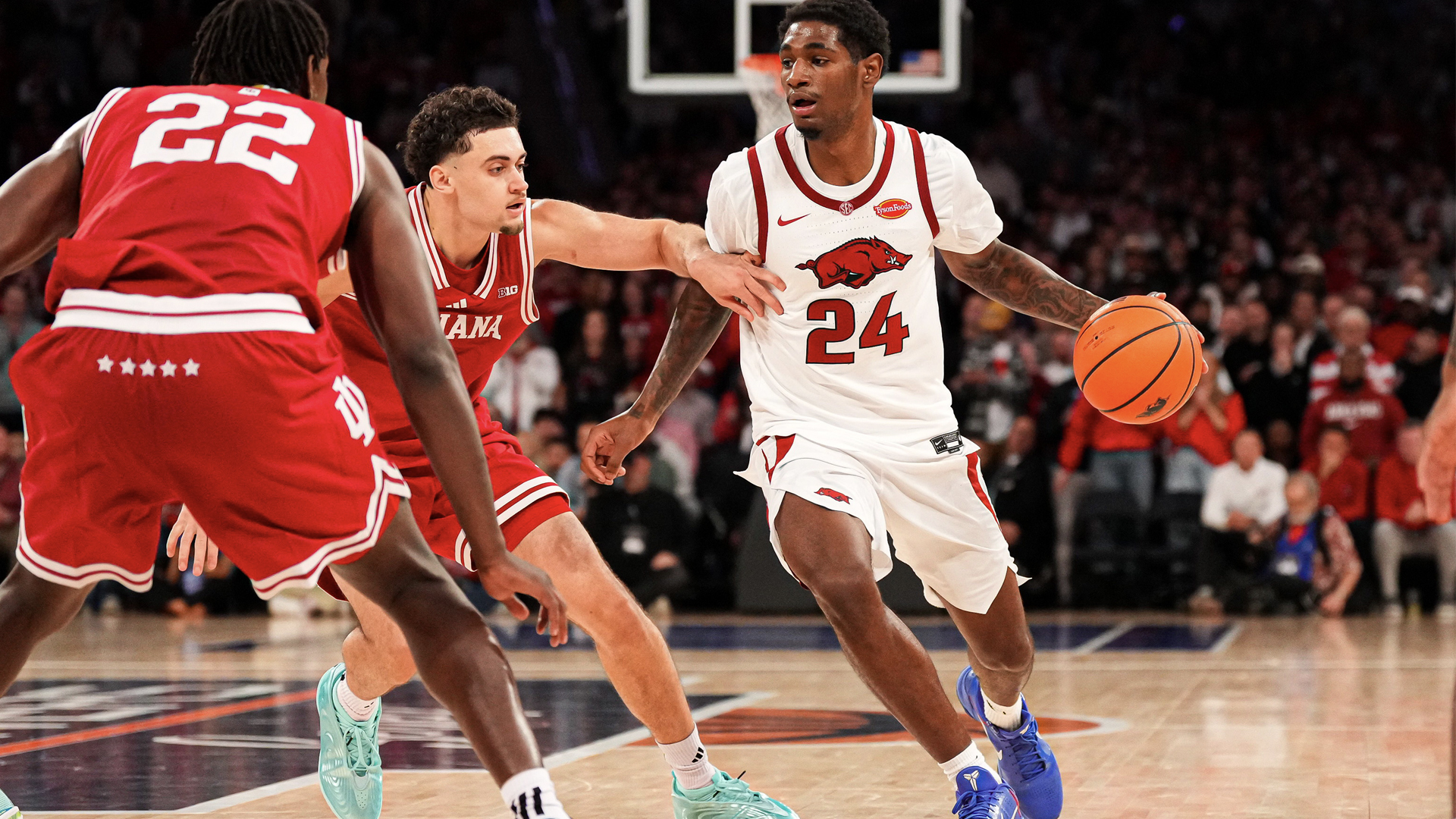
For the third straight year to open the John Calipari era, Arkansas starts 0-2 against power conference opponents.
You can take that as a negative or a positive. On the positive side, the last two teams still made Sweet 16s, so November losses don’t exactly doom seasons. On the negative side, Arkansas is paying a ton of money and garnering a ton of national attention to keep losing games like this.
Ultimately, you’ve got a young team – eight freshmen – and some of the freshmen simply don’t look comfortable yet. That continued in Tuesday’s 81-76 loss to Indiana at Madison Square Garden. You’ve also got yet another team assembled by Calipari without a dominant post presence, so the Indiana bigs dominated much of this game, as we’ll see in the stats.
If you want to be optimistic, there were a lot of positives even in this game, before you consider what this team could look like once some of its struggling young players gell a bit. If you want to be pessimistic, the Hogs already have two losses and still have to play Michigan State and Arizona, plus a road game against North Carolina, and all that is before SEC play even starts. The Hogs could waltz into the New Year with four losses and a 5/6 seed as their realistic ceiling.
I do sort of wonder if we’re going to two-year cycles under Calipari, where every other team (his first and this one) are extremely young, start slow, underacheive in the regular season, but at least finish the year strong, while his even-yeared teams (last year) feature veteran players and are major contenders.
We don’t want to look ahead too much, but there was big news with the commitment of 5-star point guard Cayden Daughtry. More information may come out, but it certainly appears that the Hogs pivoted away from Beckham Black and chose Daughtry instead. We don’t do much recruiting on this blog, but recruiting analysts have been wowed by Daughtry’s offensive skills, particularly his ability to attack the rim, find his spots, and draw contact, all while playing under control. One has to wonder if, given a roster that potentially returns Davion Thompson, Abdou Toure, JJ Andrews, Maper Maker, and Caleb Ourigou, Daughtry could me more of an immediate-impact player, sort of like how Darius Acuff and Meleek Thomas plugged right into a more experienced roster last year. That would continue the peak/trough cycle.
For now, though, this team still has a ton of potential, although they have two guys who really need to figure things out.
Advanced stats

A common theme in both losses is losing second-chance points. That’s a pretty big problem right now. Ourigou has good potential, but he’s really young and isn’t able to offer much at the moment in terms of proven ability to keep opponents off the glass.
For now, Arkansas’ offense is going to be dependent on dominating transition opportunities, but Darian DeVries-coached teams typically don’t allow much in transition, and that was the case in this one. The Hogs only got 11 transition points and five fast break points, and Indiana proved slightly better in a halfcourt game.

Despite Indiana’s 15 offensive rebounds, it was the Razorbacks who created four extra shot chances. The problem? Those shots just didn’t quite go in at a high enough rate. Indiana didn’t actually shoot that well in the paint, but their 63% paint usage created a ton of free throws (0.67 free throws attempted per field goal attempted), and that’s where this game was really won. Indiana shot better than 80% at the line on more opportunities, and Arkansas shot just 69%. Ballgame.

Cooper Bowser was +13 but fouled out in 16 minutes. Obviously, this game was lost in the other 24 minutes, where a combination of Ourigou, Maker, and Miika Muurinen really struggled. Bowser has been a pleasant surprise this year, but he needs to be able to give more minutes than that without fouling out.
As you can tell from this table, Arkansas’ issue right now is that they have too many guys that are just dead weight. Jeremiah Wilkinson, Muurinen, Andrews, and Thompson have all been poor defenders, but only Thompson is providing enough on offense to balance that out.
For the season, we use a formulation of regularized adjusted plus minus (RAPM) called Player Impact Plus-Minus, or PIPM. It calculates a prior based on their box score stats and efficiencies and then feeds that prior to a ridge regression, which regresses the prior over every possession that player was on the floor, accounting for the other nine players on the floor at all times. The result is a comprehensive look at the net contribution per 100 possessions on the floor that player provides.
Key caveat: we’ve played five games. It’s really early to be doing this. These numbers will change, possibly dramatically. But at least we can get an idea of each player’s total contribution so far.
#1 | Davion Thompson | +6.1. You probably didn’t expect this before the season, but Thompson grades as Arkansas’ best player so far. His offensive PIPM of +5.1 easily paces the team, while he also happens to be one of just five Razorbacks who is a net-positive defender. He’s shooting a decent 58% true shooting while assisting on 30% of Arkansas’ made baskets during his time on the floor, which is incredible. He’s also sitting at a turnover rate of just 13%.
#2 | Billy Richmond III | +4.1. Also unsurprising, as Richmond sits at an elite 68% true shooting with a miniscule 9% turnover rate. He’s Arkansas’ second-best offensive player and fourth-best defender. As a critique, I’d say his 19% usage rate is low considering he’s an efficient veteran on a team that seems to lack offensive playmaking. I’d like to see him take more shots.
#3 | Jeremiah Wilkinson | +2.8. Thompson’s rise has cut into Wilkinson’s minutes, but is that fair? Wilkinson is shooting 59% true shooting with a low 12% turnover rate, and he’s doing it on very high usage (26%). Yes, he’s a net-negative defender, but only barely, thanks to a solid 3.1% steal rate. He was +3 against Virginia and leads the team in plus-minus per 100 possessions for the season. Yes, he shot poorly against Indiana, but he’s been the third-best player despite ranking fifth in minutes.
#4 | Cooper Bowser | +0.6. Many thought Bowser was a weak point on this team, but he’s exceeded expectations so far. He’s doesn’t offer much offensively (shooting 67% TS on very low volume), but he’s pacing the team with a +1.6 defensive PIPM thanks to a 7.3% block rate (he swats 7.3% of two-point attempts while on the floor). He was easily Arkansas’ best defender against Indiana. If the Hogs can figure some things out offensively, his lack of volume won’t really be much of a concern thanks to his defense.
#5 | Abdou Toure | +0.1. On the one hand, there’s a strong case that Toure needs more minutes. On the other hand, who should he be taking minutes from? Richmond and Wilkinson have been more productive, and it’s hard to justify a significant reduction in Smith’s minutes given how important Smith is to Arkansas’ potential this year. If you believe that the best player should play, period, then Toure should be taking a chunk of JSJ’s minutes. Notably, he’s Arkansas’ best defensive rebounder (22% of all available defensive boards) and his 67% true shooting is pretty good for a medium-volume wing. That said, he’s dead-last on the team in plus-minus per 100 possessions, so we need a larger sample size.
#6 | JJ Andrews | -0.8. He got an extended look against Indiana and mostly passed the eye test, although the advanced stats aren’t so sure. The bad is his ugly 48% true shooting percentage, with a very low assist rate (4%, second-lowest on the team) and a very low rate of getting to the line. The good is his solid rebounding (second on the team in total rebound rate, first in offensive rebound rate) and a decent 2.4% steal rate. The athleticism is there, the comfort with the system is what we’re waiting on.
#7 | Caleb Ourigou | -1.4. Obviously, Ourigou has yet to make a field goal, and he hasn’t grabbed many rebounds at all for a big. That’s going to hurt the numbers if you’re a big. If you want positives, he’s drawn a lot of fouls for his low usage, and he’s blocked a team-best 14.3% of two-point attempts taken while on defense this year. My guess is that he’s a year away from being a bigger contributor.
#8 | Maper Maker | -2.0. Maker is second on the team in defensive PIPM thanks to a 11.1% block rate (second-best) and a 15.7% total rebound rate (best). Offensively, his 35% turnover rate means he’s nearly unplayable against athletic opponents, so that’s a problem. He’s got some tools, but this was an offseason pickup that makes you wonder what Calipari’s thinking was. A girthier post defender would have been preferable.
#9 | Miikka Muurinen | -2.8. Oh, Miikka. It’s been rough so far. He’s shooting just 50% TS (39% eFG%) and his 18% turnover rate is a bit high. Right now, he just doesn’t look comfortable in the offense. That’s a problem, because he’s an offense-focused player. He’s been okay on the defensive glass and his 2.9% steal rate is solid, but Arkansas as a team has been substantially better at both ends of the floor when he’s out of the game. Arkansas really needs him to figure this thing out.
#10 | Jordan Smith Jr. | -3.4. He played better for much of the game against Indiana, even finishing +2 for the game. But this has been a stinker of a debut so far. Offensively, we knew he was a bit raw, but his 53% true shooting, 12% assist rate (low for a lead guard), and 15% turnover rate are just a bit worse than what we’d hope for. Yes, his 4.1% steal rate leads the team, and his 1.6 stocks per personal foul are very good (stocks per personal foul is a good proxy for defensive playmaking skill), so there are signs of the elite defensive playmaker we expected. Overall, though, we need to see a lot more if Arkansas is going to be as good as we’re expecting.