No, it’s not basketball season yet. That’s getting closer.
Yurachek heat watch
Arkansas fans may be enraged over Hunter Yurachek, but if you were curious on the national perspective, consider this from USA Today senior college football writer (and Hot Springs native) Dan Wolken:
That’s not really surprising news, but the national perspective seems to be that Arkansas fans are not living in a bubble or being ignored. The question is when.
It’s notable that in 2017, the Hogs fired Jeff Long in early November to pave the way for firing Bret Bielema after the season finale. The timing ended up being a mess: the Hogs did not have Yurachek hired by the time they had to start the coaching search. Interim AD Julie Cromer-Peoples led the search that ended up with Chad Morris (the “search” may have simply consisted of listening to Jerry Jones). While Morris certainly seemed like a fine candidate, I don’t think that was a good search.
It’s now October. It’s possible that Arkansas fires Yurachek within the next week or two and gets a new AD in place by the end of the season. But Wolken is correct that you don’t really want to rush a coaching hire-or-fire decision. Absent a total meltdown that would force the university’s hand, there’s little point in talking about a coaching change after five games.
It’s put-up or shut-up time
Arkansas has been here before with a first-year coach. A new system means lots of execution issues, and new personnel often struggles to play together. Sometimes what looks like bad coaching is simply inexperienced players learning a new system together. At least at first.
A first-year coach like Ryan Silverfield needs to sell progress. He needs to show that the trajectory of the program is solid. The results will come later if the trajectory looks good now.
But that doesn’t work if the trajectory doesn’t look good. And five games into the Silverfield era, the trajectory does not look good.
History says if the trajectory is going to change, this is the week. Consider the 2008 team under first-year coach Bobby Petrino. Like this one, it started 2-3 with two very unimpressive wins over bad teams and three blowout losses against good teams. There were execution errors all over the field and at times the talent looked totally overmatched.
To refresh your memory of that team, the red line on the schedule below is the equivalent of where we are now:

Despite the dismal start, it was the second October game – right where we’ll be Saturday – that something changed. After falling behind 20-10 to Auburn, the Razorbacks cut it to 20-19 before Michael Smith busted a 63-yard touchdown run to make it 25-20. Auburn went on a long drive but the Razorback defense pulled off a goal-line stand to secure the win.
Starting with that game, it was a different team. There were no more blowout losses and the Hogs even won a second SEC game, beating LSU in a thrilling season finale.
That’s the hope for this year’s team: that 2008 team looked awful over its first five games, but the tone of the Petrino era was set in the last seven. This team can do the exact same thing. But that’s also the pressure: if the Hogs get drilled on Saturday, it’s going to get harder and harder to sell any hope.
Meet the Vols
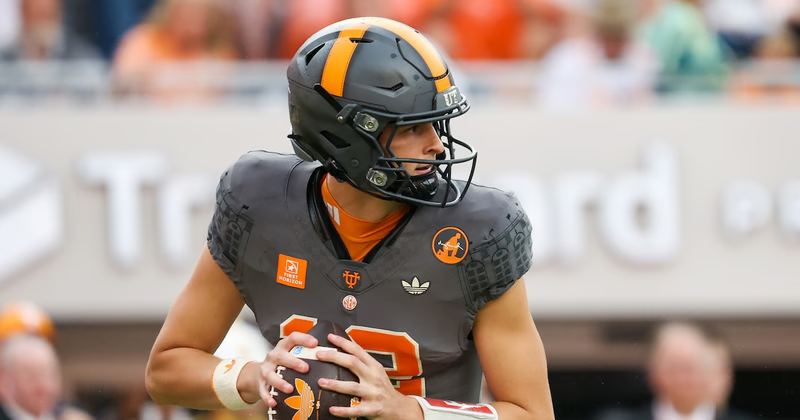
Like Texas A&M last week, Tennessee is vulnerable. The Vols are 4-1 and ranked 15th in the AP poll, but they’ve had offensive issues for a few weeks, culminating in the decision to make a quarterback change, benching former 5-star recruit Faizon Brandon and replacing him with redshirt freshman George MacIntyre.

Tennessee’s problems go well beyond the quarterback position, however. Brandon took too many sacks and was struggling to push the ball down the field, but Tennessee is having issues in pass protection and this year’s group of receivers aren’t quite as good as past years. MacIntyre played well enough down the stretch to beat Auburn, but it’s likely that move won’t be enough to fix the Tennessee pass game.
The bad news for Arkansas is that Tennessee does everything else extremely well. And that’s why Tennessee is coming to Fayetteville as 13.5-point favorites. The Vols have not won in Fayetteville since a rain-soaked dedication of the expanded Razorback Stadium back in 2001. Arkansas won home matchups in 2006 (the GameDay game), 2011 (the Joe Adams punt return), 2020, and 2024.
When Tennessee has the ball

Tennessee’s offense is decently-efficient (38th in Success Rate) but they aren’t generating enough big plays to create good drives. They are getting just 5.9 quality drives per game, which is 81st nationally, and they’ve only gained 44% of available yards, 96th.

You can see why the Vols made a quarterback change: despite being very strong on early downs thanks to a powerful run game, if you make Brandon drop back in a must-pass situation, bad things happen.
Of course, it may not matter. Arkansas’ defense has been a little too bendy on early downs, so there’s a very good chance that Tennessee will line up and run it straight down the Razorbacks’ throats and it won’t matter who plays quarterback or how often they have to drop back.
Now here’s the scariest part of the matchup:

Welp. That’s not ideal. Tennessee’s run game is absolutely elite. It’s very difficult to keep their run plays under four yards, which means they are always on schedule offensively. Star running back DeSean Bishop already has 540 rushing yards and seven touchdowns at more than six yards per carry. As a team, Tennessee put up 299 rushing yards on Georgia Tech and 247 more on Auburn.
Arkansas defensive coordinator Ron Roberts knows what the Hogs need to do. He’s said he’ll probably puke in the press box if the Vols get 200 rushing yards.
Hopefully someone has a trash can ready.
Any chance of a Razorback victory involves keeping Tennessee from going totally wild on the ground. Then, the Hogs need to exploit this much friendlier matchup:

That’s pretty ghastly, Tennessee. Despite Josh Heupel Briles-influenced love of the deep passing game (23rd in Air Yards per Attempt), the passing attack has been a mess, with Tennessee ranking at the very bottom of the FBS in almost every category.
If MacIntyre can get that completion rate up (-11% versus expected based on distance, 135th), the Vols will be happy, but Tennessee has to keep him clean first, something they have struggled to do.
Arkansas’ front four doesn’t get much pressure, but Roberts – long known as a creative pass-rush guy – dials up good stuff that creates clean looks at the quarterback at a high rate. I think Arkansas can make MacIntyre uncomfortable. A Roberts defense is really not what you want to see in your first career start as a quarterback.
The only question is will it matter given the run game matchup.
When Arkansas has the ball
Arkansas’ offense has been a trainwreck this season, and Tennessee is not a great get-right game. The Vols haven’t been dominant, but they’ve been solid defensively.

Arkansas doesn’t really do anything well other than run a bunch of plays (13th in Plays per Drive). Tennessee allows way too many successful plays (93rd), but they have two big things going for them: first, the successful plays they allow aren’t overly damaging (21st in Explosive Rate), and second, the unsuccessful plays they force are extremely damaging for the offense (28th in Havoc Rate).

Arkansas’ run game was much stronger against Texas A&M, but the Hogs still aren’t getting anything big. Second-level blocking hasn’t been great, but that could come in time as this line gets more experience playing and being coached together.
Tennessee’s defense is vulnerable against the run, so this might be an opportunity for the Hogs to finally get some movement. That’s going to have to happen if Arkansas is going to sustain any drives.

Tennessee can get after the quarterback, which is going to be a major issue. To make matters worse, the Vols get pressure without blitzing, which means they can keep their safeties deep to keep everything in front of them, allowing them to rank 27th in Explosive Pass Rate and keep the average pass attempt against them to just 7.9 air yards.
Tennessee’s ability to keep everything in front presents a major problem for Arkansas. The Hogs have been a very bad screen team, and their best pass plays are the ones that go deep down the field:

Chris Marshall is responsible for an enormous chunk of this. He’s been targeted on nine of 16 deep attempts and 18 of 38 intermediate attempts. But taken as a whole, you can see that Arkansas does better when they throw down the field. They may not get many chances, but if they can find a way to target Marshall (or anyone else) deep down the field, they should go for it.
At some point – especially if there’s an offensive coordinator transition in the offseason – we’ll dive in much deeper to modern trends in college football that Arkansas might want to emulate. One of the notable ones popping up recently is the football equivalent of basketball’s “death of the midrange”. Top offenses – Georgia, Florida, Kentucky in the SEC, several others nationally – are throwing fewer and fewer medium-distance passes (that’s 10-20 yards downfield). Instead, teams are beefing up both short passes because of their high success rate and deep passes because they have a higher payoff.
Arkansas still gets +0.51 EPA per Attempt on intermediate passes, but you can see a clear case to turn most of those 38 attempts into either deep passes for the higher EPA and yardage payoff, or short passes for the much higher success rate.
Keys to the game
Keep Ron Roberts from throwing up in the press box. Holding Tennessee under 200 rushing yards is going to be really difficult, but if the Hogs pull it off, they’ll have a real chance to spring an upset.
Win the battle of explosives. Arkansas’ offense has labored to produce explosives this year, but that’s your best chance to pull an upset. The Hogs are going to have to find a way to push the ball down the field against a Tennessee defense that’s able to focus on keeping everything in front. This won’t be easy.