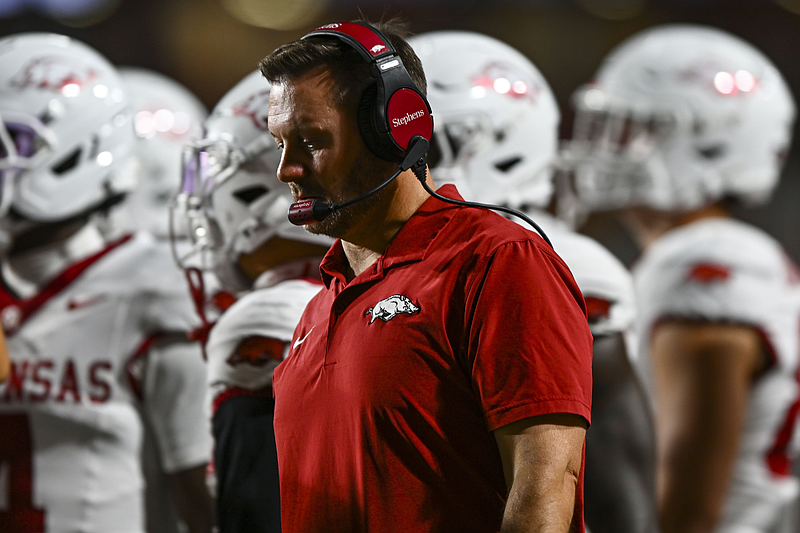
Just two games into the Ryan Silverfield era, and an offeseason full of the new Head Hog saying all the right things is right out the window. Arkansas, especially on offense, has been an embarrassment so far this season. And as we’ll see in this deep dive, Arkansas fans are right to demand good offensive football.
Silverfield’s job is obviously safe, so fan anger is largely targeting athletic director Hunter Yurachek. Yurachek has had plenty of goofs over his tenure as Razorback AD, but his mishandling of Pittman’s extension in 2022 followed by a widely-panned hire to replace Pittman is probably enough to justify wanting him gone.
John Calipari, meanwhile, put his support behind Yurachek, in a rare case of a coach giving his athletic director the dreaded vote of confidence.
If Arkansas continues to play anything like this, they’ll go 2-10. Actually, they could go 1-11, because Tulsa next week is no pushover. The utter collapse of Arkansas’ football program has been a long time coming.
So, how did we get here? And is there any hope? Or is Arkansas’ lack of NIL just killing the program permanently? I’m not there. Arkansas’ current low football NIL is mostly related to a few other factors, which are ultimately temporary:
- Enthusiasm being routed to basketball
- The university’s slow adoption of NIL best practices
- Lack of donor trust in Sam Pittman’s leadership of the football program
The second one is part of the case against Yurachek, but the third one is no longer at play. The report is that Arkansas will jump out of last-place in the SEC in NIL spending next season (you be the judge on whether that’s true). Ultimately, you have a state of more than three million people supporting just one school, which has a large fan and alumni base, and is located in a rapidly-growing and developing metro. The resources simply aren’t going to be absent forever. There’s nothing structural forcing Arkansas to go 2-10 every few years in football.
Instead, Arkansas’ fall is largely due to a series of bad decisions where the end result is a failure to build a consistent identity. The complaints about things like in-state recruiting and gameday stadium experience are not unrelated or coincidental. Those are part of the identity of the Arkansas Razorbacks. And Arkansas doesn’t have a true one. When the people in charge don’t understand what makes Arkansas Arkansas, they make bad hires and put a bad product on the football field, while also failing to properly market and sell the program off the field.
We like X’s and O’s on this blog, so that’s the focus of this piece, but there’s more to it to X’s and O’s. Other writers can tell that story. On the field, Arkansas has hired head coaches with radically-different philosophies. As I wrote over at Arkansas Fight (now deleted, RIP) after Chad Morris was fired in 2019: Bret Bielema tried to make Arkansas into Wisconsin, Chad Morris tried to make Arkansas into Clemson, but the next coach needs to make Arkansas into Arkansas. The eventual hire, Pittman, started good enough, but his two coordinator hires after his original ones left showed that he didn’t really understand building an identity either.
So here we are, trying again with yet another identity. Arkansas hasn’t really ever run the kind of offense (or defense, actually) that Silverfield and staff are trying to put in place. It might work, but as we’ll see, a few factors are working against Silverfield and staff.
How did we sink to these new lows?
To get an idea of where Arkansas football is historically, let’s look at the time period from 1998 to present. That starting year is perfect, as it aligns with the beginning of the Houston Nutt era and with the launch of the BCS, so it’s essentially the modern area for both Razorback football and for college football generally.
Our metric will be SP+ ratings. Bill Connelly, now at ESPN, developed this predictive metric years ago while writing for SB Nation (I blogged for SB Nation at the time and he offered access to his data back in the day). No football metric is perfect, but SP+ is pretty good. It’s a predictive, all-encompassing metric to measure how good a team is.
The output in the chart below can be understood as “predicted scoring margin against an average FBS team”. The SEC average since 1998 has been in the 12-15 range (slightly higher since the mid-2000s when the SEC rise really began).

The infamous motorcycle crash in April 2012 really messed this program up. Nine of Nutt’s 10 teams were above the SEC average, but since his firing, only five of 18 teams have been above the conference average.
Here are Arkansas’ best teams since 1998:

Nutt’s 2003 and 2004 teams suffered some pretty terrible luck because they were both really talented. Petrino’s 2010 Sugar Bowl team was the best of the era by nearly a full touchdown. You’ll also notice zero teams coached by Sam Pittman, and only one team coached by Bret Bielema.
If you’re curious, here are the five worst:

Pittman’s first team in 2020 is highlighted because it played an SEC-only schedule so SP+ has a difficult time evaluating it. It probably was not actually the third-worst of this era. The others went a combined 2-30 in SEC play.
No crying in the casino
Chad Morris’s dismal 2019 team is the worst by a huge margin and the only one of this era with a negative SP+ (meaning they would be underdogs against an average FBS team). Bielema’s first and last teams are here (his others were all decent).
What’s missing is Morris’s first team, in 2018, that also went 2-10. That team actually had an SP+ rating of 4.5, virtually identical to Petrino’s first team in 2008 (4.8) and ahead of Bielema and Pittman’s first teams. Petrino’s 2008 team went 5-7 because it won four games that came down to the final seconds (Western Illinois, UL Monroe, Auburn, LSU), while that Morris team couldn’t quite close the deal.
My longstanding suspicion is that Morris panicked after a 2-10 season and overhauled his roster – especially his quarterback room – when he didn’t really need to, resulting in the 2019 collapse. In hindsight, doubling down on Ty Storey at quarterback and focusing on improving the defense and offensive line might have been the move, as the Morris staff pulled in an amazing recruiting class that offseason. Instead, the new-look 2019 offense opened the season with two horrific performances (Portland State and Ole Miss) that essentially killed the Morris era.
The application? Don’t panic during the rebuild. After Bielema’s first team went 3-9, he didn’t replace Brandon Allen as his quarterback, and Allen eventually became an elite quarterback. Petrino and Pittman both started senior quarterbacks during their first season, but the second-year starter was on the bench in Year 1. Neither brought in a serious competitor to Ryan Mallett or KJ Jefferson, and both offenses took off in Year 2.
Let’s take a look at some things Arkansas can build on.
Just be average on defense
In the 27 seasons since 1998, Arkansas’ Defense SP+ rating has been above the SEC average just nine times. Even worse, six of those were under Nutt, whose tenure ended in 2007. Since Nutt’s firing, only the 2010, 2014, and 2021 defenses were better than the SEC average. That’s three different coordinators, three different head coaches, and three different rosters.
For posterity, here are the 10 best Razorback defenses since 1998:

Man, we really didn’t know how good we had it with Reggie Herring. His very dogmatic “rush four and play man” approach worked perfectly. It helped that his elite 2006 defense had Jamaal Anderson and Antwain Robinson on the defensive front, Sam Olajabutu at linebacker, and Chris Houston at cornerback. But let’s not forget that it was Herring who had the brilliance to move Anderson, a wide receiver, to defensive end in 2005. And Herring was hardly a one-trick pony: after losing Anderson and Olajabutu and others from the 2006 team, his 2007 defense was still really good and led the FBS in opponent yards per pass attempt and opponent completion percentage, with safety Michael Grant leading the nation in pass breakups.
And fans loved to hate on Willy Robinson, but he makes two appearances on this list (and his 2011 defense isn’t far off of it). What do Herring and Robinson have in common? They are the only two Razorback coordinators in this era to have significant NFL experience before being hired. Both had spent most of the decade before being hired in Fayetteville as NFL position coaches. Both ran very pro-style defensive schemes: Herring a Jimmy Johnson-designed Over front, Robinson a pretty conservative Under defense.
I do not think that’s a coincidence. Arkansas is at a major disadvantage on defense, where raw talent plays a bigger role. Without a huge NIL budget to land 4- and 5-star recruits, it’s hard for Arkansas to field an elite defense. The way to have a good defense is to get the best athletes you can into a simple, pro-style system, and develop them for multiple seasons. Herring and Robinson both relied on players recruited before they got there. Robinson in particular relied entirely on players recruited at the end of the Nutt era: Jerry Franklin, Jerico Nelson, Jake Bequette, and Isaac Madison, to name a few. Getting too cute with X’s and O’s, abusing the transfer portal, and running off young players (or letting them leave) are great ways to ensure you continue to struggle on defense.
Ultimately, Arkansas’ goal should be to have an average defense, not an elite one. That means a boring defensive coordinator like Willy Robinson is probably a better option than an exciting one. Teaching fundamentals and maintaining roster consistency is the best bet for Arkansas.
Offense wins at Arkansas
While only nine of 27 defenses fielded at Arkansas since 1998 have even been average, offense has fared better. Since the 1998 season, 19 of 27 offenses have been better than the SEC average. Every Razorback offense from 2002 to 2012 was above-average, but despite the program’s struggles, the Hogs have still had six above-average offenses since 2012. Bielema had three (2015, 2016, 2017) and so did Pittman (2021, 2022, 2025).
Here are the 10 best:

That 2015 offense largely came out of nowhere, but it had a third-year starting quarterback with an NFL arm, an NFL running back, and a veteran offensive line littered with former 4-star recruits. Dan Enos has had a rough go of things in recent years, but when it all came together, it was impressive.
You’ll note that each of the top five offenses returned its starting quarterback from the previous season, which reinforces the point about Morris’s 2019 panic made above. In this list, only 2011 (Tyler Wilson) and 2009 (Ryan Mallett) had a first-year starting quarterback, and both of those guys had been on the roster under the same scheme for at least one year before.
The mix of head coaches and coordinators and schemes makes clear that it’s not rocket science to have a good offense in Fayetteville. Nutt rode Clint Stoerner (1998), Matt Jones (2003-2004), and Darren McFadden (2007) to top-10 offenses. Petrino produced three (2009-2011), with two different starting quarterbacks, running a different scheme than Nutt. Bielema produced the best offense of the era (2015). And Pittman and Kendal Briles teamed up for a good one in 2022. All of these offenses finished above the SEC average, most of them way above.
The key application here is that you have to get the offense right to win at Arkansas. The key position is, obviously, the quarterback. As good as Darren McFadden and Felix Jones and Peyton Hillis were, the 2007 offense is only ninth on the list, and the 2006 offense that won the SEC West isn’t even in the top-10. As we saw with the numbers above, the success of those teams in 2006 and 2007 was due as much to Herring’s defense than to McFadden’s offense. Nutt’s McFadden-era offenses were worse than his Matt Jones-era offenses precisely because he couldn’t get the quarterback right in 2005-2007.
The worst offenses of the era are sobering:

Again, the 2020 offense has a huge asterisk, but the others all proved to be death blows for their coach. Pittman and Nutt both managed to salvage a couple more seasons after the ones on this list by making a major change (Pittman hiring Petrino, Nutt hiring Malzahn and benefitting from McFadden), but the 2005 and the 2023 seasons both destroyed a ton of goodwill for those coaches.
Unfortunately, as of now, Silverfield’s first team is tracking towards this list. There’s obviously a lot of football to be played, but without massive in-season improvement that allows the offense finish at 30 or better, a popular push will demand change this offseason.
Run blocking has collapsed
Arkansas’ biggest issue at the moment is that they can’t run the ball. Being able to run on Alabama or Georgia is one thing, but the Hogs cannot run on North Alabama and Utah. That’s pretty unusual. Arkansas is historically a great rushing team, and that trait has survived several different head coaches, coordinators, and offensive schemes. I would wager than any successful offensive coach at Arkansas will be able to run the football at a very high level.
Silverfield, however, walked into a beehive on this one. This is where I think he needs a lot of grace, because his predecessors did him no favors on the run game. I’ll try to explain my thoughts on this as best as possible.
The run game collapse is visible in the collapse of Arkansas’ run blocking. Here are Arkansas’ team run blocking grades from ProFootballFocus in the PFF era (since 2014):

Before we even jump into specifics, notice the trend here. Unlike the chart above, the numbers don’t jump up and down rapidly. There tends to be smooth upswings and downswings. That’s because the same guys get better when they play together, and declines happen when there’s a major talent reset or a scheme change.
We don’t have PFF grades for them, but Nutt’s offenses were generally elite at run blocking and put several offensive linemen in the NFL. Picking up on our data, Pittman’s 2014 and 2015 offensive lines were awesome and paved the way for a powerful rushing attack with Alex Collins and Jonathan Williams. After Pittman left, Kurt Anderson’s first line in 2016 was fine, but his second line’s struggles played a role in the end of the Bielema era. The Morris era with coach Dustin Fry was a disaster, though it was partially inherited from Anderson.
The temporary fix came when Pittman (now head coach) and Kendal Briles went for Cody Kennedy. Despite fan criticism, Kennedy’s lines improved their run blocking grades each season under Briles, with the 2022 line peaking as the best since Pittman’s final line in 2015.
Then came what I tend to think was the watershed moment in recent Razorback football: the sudden departure of Briles for TCU and his replacement with Enos 2.0. All indications were that the 2023 offense was going to be really good, and either Pittman or Briles (or both) decided to throw it all away. Pittman compounded this issue by hiring Enos, who was now running a different scheme than his first time through and a scheme that was a major departure from Briles. Kennedy’s line graded really poorly, as his linemen were asked to hold blocks for exceptional amounts of time to accommodate slow-developing run blocks, despite years of success with Briles’ quick-hitting rushing attack.
Enter Petrino 2.0, who put a Band-Aid on a gunshot wound. Petrino (correctly) figured that he (and his boss) didn’t have time to overhaul the offensive line. Plus, his scheme favors elite skill players over elite line play. Arkansas’ two highest PFF Rushing grades of this era (that’s rushing skill independent of run blocking) came in 2024 and 2025, as the Hogs rolled up more than 3.50 yards after contact per rush both seasons and routinely got runners on the edge, where they didn’t really need help from the line. Eric Mateos focused his transfer pickups on pass protectors, and the Hogs rolled up rushing yards despite poor run block grades.
Silverfield has inherited this mess than Petrino and Mateos left behind: gap-schemed blockers who were not very good at run blocking. Silverfield and Cramsey are bringing in a zone run scheme that requires great blocking. I’m sorry to disappoint everyone, but this is going to take time.
To build a consistent rushing powerhouse in the SEC, you have three options:
- Get a great offensive line coach and a good scheme and keep it in place for years
- Have a madman genius offensive coordinator who can run the football without great linemen
- Cultivate a distinct identity and keep making solid offensive line coach hires
Obviously, Nutt represents Door Number One here, as Mike Markuson handled his lines for the entire 10-year Nutt era. That level of consistency and stability doesn’t get talked about enough.
Petrino is Door Number Two. In 2025, Arkansas ranked 15th out of 16 SEC teams in PFF Run Blocking grade. They ranked second in actual rushing yards per game (191.9) and first in yards per rush (5.69). There are not a lot of coordinators out there who can make that happen.
The third is what both Pittman and Bielema failed to do. Both had a good scheme and offensive line coach in place: Enos/Pittman for Bielema, and Briles/Kennedy for Pittman. But both let a key piece walk, and the replacement hire tanked the operation. Maintaining that consistency at a place like Arkansas is not easy.
Silverfield is the latest to try Door Number Three. If improvement – even small improvement – is shown over the course of the season, there’s no doubt that the best path forward is to remain patient and stick to the plan. Building an elite run blocking line is possible at Arkansas: Nutt, Bielema, and Pittman all did it with different schemes. Maintaining it is a different story, but going around and firing coaches after one season is the opposite of maintaining.
If there’s zero improvement and the team goes 2-10 (or – gasp – a new low of 1-11), bringing back Cramsey and this staff is going to be a tough sell for Silverfield. At that point, you have to try to replicate Pittman’s hiring of Petrino and hope it goes a little better. Maybe there’s a madman evil genius out there who can get the run game going before the offensive line is fully fixed. (Yes, I’ve been watching Coastal Carolina games this year. Yes, their offensive coordinator is a Razorback alum. Yes, it’s Bobby Petrino’s son. More comments on that as the season progresses if necessary.)
Recap: How to fix Arkansas football
Let’s recap this post into a few key ideas.
Defense: aim for average, NFL experience is preferable. History suggests that having an above-average SEC defense is not in the cards for Arkansas football. But the late Nutt and Petrino eras showed us that an average defense is actually not a bad option, because offense is where Arkansas is going to make its mark. You want a boring but sound defensive coordinator. Neither Willy Robinson nor Reggie Herring were great recruiters and neither ran innovative schemes. But both had a litany of NFL experience and were good teachers and developers who focused on the fundamentals. For now, the Hogs are stuck with Ron Roberts. Despite no NFL experience, he largely fits this mold, because as I argued in my introductory post on his defense, he’s boring in a good way. Give him time, but should he not get the job done, I’d like to see an NFL assistant get a shot.
Quarterback: avoid turnover if at all possible. Fans want to see KJ Jackson benched, but do we really think AJ Hill would be any better? Fans wanted Ty Storey benched in 2018, but he was a whole lot better than the five different guys who replaced him and started at least one game in 2019. If Jackson gives you any signs of life, any improvement at all, he should be the unquestioned starter heading into next season. And maybe even if he doesn’t improve, if he holds onto the starting job this season, the offensive staff should think twice about trying to find a better option in the portal.
Offensive Line: this is going to take time. Arkansas’ current staff was dealt a bad hand on the offensive line, but history suggests that Arkansas is capable of building a good run-blocking offensive line. If there’s any in-season improvement, patience is warranted. Even if there’s not, there may not be a lot of other good options. I think it’s too early to judge the offensive line coaches. Should public pressure force Cramsey out as OC, Silverfield would do good to remember that fixing the skill positions is easier than fixing the line, and there are coordinators out there who can build exciting offenses without an elite line.
Consistency: necessary. Arkansas’ biggest problem since 2012 is that it can’t maintain a consistent identity. Nutt managed a good one for 10 years before quarterback play and off-field nonsense proved his undoing. Petrino provided the clearest identity for four years, but then he threw it away. Since then, it’s been a mess. Bielema provided a great offensive identity, but he never got the defense right, churning through three different coordinators. Morris may have overreacted to a not-as-bad-as-you-remember first season, which led to the collapse in Year 2. And then Pittman nuked his initial good hires by downgrading both coordinators, which set in motion a spiral to where Razorback football is now. That’s three straight coaches undone by a lack of consistency. And fans may not want to hear it, but you can’t fire your way into consistent football.
What about Georgia?
I think you just have to tough out this Georgia game and then look ahead to Tulsa. That’s going to be a big game, which is sad to say but it’s true. A win in that one could actually go a long way toward facilitating improvement and recovery of confidence.