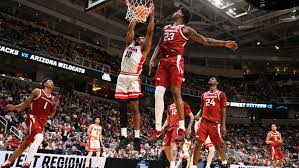
Arkansas’ season is over after a 21-point beatdown at the hands of top-seed Arizona in the Sweet Sixteen. This game was never really competitive, and as much as we wanted to brainstorm ways that Arkansas could win, this matchup in the paint was just too bad for the Hogs to have a chance unless Arizona just gave it away. And to the Wildcats’ credit, they did not. I wondered aloud in the preview whether Arizona’s version of Gorilla Ball could win a championship without elite guardplay; that to me remains a real concern, but Arizona’s guardplay was plenty good in this one, and their overwhelming frontcourt advantage was too much for the Razorbacks to overcome.
Arkansas ultimately wants more than Sweet 16 finishes, but a second-straight second weekend plus an SEC title plus having one of the best players in school history have probably the best individual offensive season in school history means that this can certainly be considered a successful and memorable season. The NCAA Tournament is a loser machine: 68 teams enter, and 67 end with their seasons with a bitter taste in their mouths. This is the bitter taste for Arkansas fans.
Darius Acuff scored 28 points in his final college game. This is the unfortunate part about your best player being a 6’3 point guard when the mismatch is in the frontcourt: Acuff didn’t look great, but there wasn’t really a lot he could do. Really the only thing he could have done is drill a bunch of pull-up 3-pointers against those dropping bigs, but sadly that shot was not falling for him in this game. There’s a reason that analytics says surrendering that shot isn’t a bad thing for a defense in the long run.
This will be discussed more in a second, but I hate it for Trevon Brazile, who has had a fantastic career in Fayetteville only to have it end on a low note. He was probably the worst player on the floor for most of this game, which stinks. The discussion about why John Calipari and staff thought it was wise to have him as the only true 4 is going to be relevant as we look at future roster construction, because he was overmatched against both Florida and Arizona.
What the officiating should tell us
And obviously, the officiating was garbage. It didn’t decide the game – Arizona’s paint dominance more than did that – but this game offered more good evidence that college basketball officials are struggling to officiate tall players and players who are good at flopping (excuse me, “selling fouls”). Coaches notice that and we are seeing convergence toward a mono-strategy: that’s why the four 1-seeds in this tournament have near-identical roster builds built to play Gorilla Ball.
The tone of how this game would play out was set in the first 90 seconds, when Arkansas was called for two fouls away from the ball after an Arizona player randomly went sprawling across the court as if he’d been picked up and thrown. We didn’t get a replay of either. Despite Arizona’s massive size and strength advantage – and the (not-untrue) claim that Arizona was “bullying” the Hogs with their size – every time a player went flying across the court as if hit by a supernatural force, it was an Arizona Wildcat. Only two of these plays got a TV replay – a shoving foul called on Nick Pringle that led to a technical after Pringle spiked the ball and a flagrant-2 on Billy Richmond when he tried to hedge a screen – and in both cases, the television commentators immediately noted the “acting job” (read: flopping) by the Arizona player. My guess is that if you reviewed the other three or four fouls where a Wildcat went flying, you’d see the same “acting jobs”. Meanwhile, Arkansas’ guys – namely Meleek Thomas, from what I noticed live – were fighting through aggressive contact with zero attempt to sell anything, so they didn’t get any calls.
The claim here is not that the officials were “protecting Arizona” or any kind of conspiracy. In fact, Malique Ewin drew a foul on Arizona’s Jaden Bradley that was also a bad call: Ewin stepped into Bradley and got his foot tangled and sort of fell down, and Bradley was whistled for a foul. It’s the same thing: officials saw a 6’10 guy fall down and blew their whistle, because they don’t know how to officiate bigs. That’s not favoritism towards a certain team, but in the long run that’s going to favor big-oriented teams (Arizona) and teams willing to aggressively sell any contact (Arizona).
Or consider that Pringle’s technical came after he was whistled for a common foul after jostling with Motiejus Krivas for rebounding position. Krivas – listed at 7’2 and 260 pounds – then went flying into the cheerleaders like he’d been hit by a car, so the whistle was blown. But just a couple hours before on the same court, this was Purdue’s game-winner:
The only difference is that the Texas defender made no attempt to sell this obvious foul, so the whistle was not blown. I don’t really feel bad for Texas: I mean that generally, but also because the only reason Texas was in the Sweet 16 in the first place is because their own 7-foot Lithuanian, Matas Vokietaitis, is a notorious foul-baiter who attempted 28 free throws across Texas’s first three NCAA Tournament wins.
What do we learn from this? More size is the future, like it or not. That’s where the college game is headed, so you can embrace it or be left behind. This is the largest Sweet 16 in years in terms of the average height of players, and that’s without Florida:
Arkansas has the same average height that their 2023 team had, yet that team was the biggest in the Sweet 16 while this one was seventh of 16.
Ryan Hammer here attributes the shift to “big skill and versatility”, but I’m not really that generous. Arizona’s bigs were certainly skilled, but they didn’t do anything that wowed me from a skill perspective, and I certainly would not call them versatile. I think Arizona runs excellent sets for the roster they’ve built and I think their style is consistent with how the college game is officiated. I said the same thing when I saw the Hogs play Duke way back in November. Cameron Boozer is very smart and very strong and plays in a system that works for Duke’s players, but his lack of explosiveness and high-level skill seems pretty evident to me. He’ll be a fine NBA player; I’ll be stunned if he’s a superstar.
If you can’t beat ’em…
The Arizona preview reintroduced and defined “Gorilla Ball”, noting its growing influence among major college basketball programs. Quick refresher:
Arizona is one of several power teams – Florida and Michigan being the main two – that has embraced Gorilla Ball this season. Gorilla Ball is a form of roster construction where teams emphasize size and strength over athleticism, versatility, and NBA skill. These teams typically have a 7-foot rim protector and are also tall at the 3 and 4 position. Their 3 position is usually more of a small forward than a guard, they often avoid the sort of “jumbo guards” that were featured in the Musselman era, and they prefer well-defined roles over the versatility and switchability of a more NBA approach.
There are four possible explanations for the rise of Gorilla Ball:
Cyclical nature of trends. Positionless basketball, which favored length over width, explosiveness over strength, and versatility over physicality has made teams smaller and more perimeter-oriented over the last several years. It was a matter of time until the pendulum swung the other way.
Officiating. Teams in the past that played with 7-foot rim protectors – often recruited from Eastern Europe – would find their rim protector in foul trouble every other game, or would find that he was a liability on offense. But as the soccer trend of foul-baiting becomes more prevalent in basketball – the NCAA has attempted to crack down it, but it’s tough – fouls are increasingly called only (or primarily) when the victim reacts, which creates some bad incentives. Your 7-footer is out of position for an offensive rebound? Fall down! Make the officials call something. A lot of the fouls called on Arkansas in this game saw the whistle being blown well after the play as the official waited for the offensive player to react.
Talent acquisition. The rise in global popularity of basketball combined with the NCAA opening the floodgates for international players means that teams like Arizona are stocked with international players. In Eastern Europe and the Balkans, these are often bigs, inspired by NBA superstars like Nikola Jokic. Because of their own natural physical skills and how they develop, they offer a different style of play from the more explosive style favored by American athletes, and good coaches – Arizona’s Tommy Lloyd is definitely a good coach – are able to seamlessly blend different flavors of basketball to create a team that is difficult to beat.
Tactical changes. As mentioned, drop coverage, which become popular after the Bucks used it in their 2021 NBA title run, helps a team “protect” their rim protector and keep him in the post while not allowing catch-and-shoot 3-pointers. NBA teams have more weapons to combat drop coverage, but college centers are rarely pick-and-pop threats.
Obviously, I think all four play a role. So what does this mean for Arkansas?
If you don’t want to play Gorilla Ball, the main alternative is the NBA style that beat Gorilla Ball in the 2010s: the 5-out. Teams that can space the floor with five shooters will draw the rim protector away from the rim and then slash to the basket. It started with the Steph Curry Warriors in the 2010s and trickled down to college from there. Teams got smaller in the 2010s as they tried this – Eric Musselman was a big advocate of this style of play, using then-trendy terms like “positionless basketball” to describe the concept of five guys all between 6’6 and 6’9 who could switch every screen and hit jumpers – and Gorilla Ball is succeeding as a reaction to this going-small trend. The modern counter would involve going even bigger at the 3-4-5 spots while maintaining the emphasis on having five perimeter threats.
Illinois is a good case study of the counter-trend. The Illini – also very tall, also heavy on international players – have a starting lineup that runs 6’2, 6’6, 6’6, 6’9, and 7’1, and all five are legitimate 3-point threats. All eight players in Illinois’ regular rotation have attempted at least 80 3-pointers this year. If the national championship is Illinois-Arizona, then the Wildcats would not be able to use the two-center Krivas-Awaka lineup that ate the Hogs up in this game, simply because Illinois would destroy it on the perimeter.
… join ’em
Calipari seems unlikely to embrace either pure Gorilla Ball or the 5-out spread of Illinois. He still wants to play a style that’s going to prepare his players for the NBA, and those strategies are a bit extreme. But he needs to find a happy medium. Arkansas basically had nothing going for it this year that could have countered Gorilla Ball.
Cal probably also won’t lean into the main defensive solution, which is what Muss employed in Fayetteville: ball pressure. Arkansas could not stop Arizona from entering the ball into the paint. That was really the first issue, even before we wrangle with Pringle and Ewin and Brazile as post defenders. But in the 2022 Gonzaga game, the Hogs – massively out-sized by 1-seed Gonzaga’s 7-foot rim protector and 6’10 leading scorer – aggressively attacked the ballhandler and denied paint entry passes. The Hogs allowed just 32 points in the paint and forced 15 turnovers, despite not playing anyone taller than 6’9. Yes, Gonzaga missed some open 3-pointers, but part of that was probably due to the Razorbacks successfully creating the chaotic pace they needed.
Ball pressure is high-variance: it concedes open 3-pointers due to the help it provides, and it risks being buried under foul trouble if the officials are feeling like blowing their whistle. But ball pressure allows you to introduce variance against a more-talented team. So Muss’s teams won big games, but he also struggled to establish a consistent regular-season winner. Those happened for the same reasons.
Kentucky-era Cal didn’t embrace that because he’s low-variance, preferring consistent outcomes like avoiding turnovers and keeping his elite point guard out of foul trouble and having defenders stay with their man rather than focusing on denying entry passes. That worked when he had superior talent at his Kentucky peak – and helped stave off upset-hungry teams like Muss’s Hogs – but it hasn’t worked as well since as the game has changed. Arkansas won 28 games and an SEC title but failed to beat a team seeded 1 through 4, going 0-6. Most of those teams were huge, and a low-variance strategy won’t work against superior opponents.
That’s not as doom-and-gloom as it sounds. Cal’s main advantage is that as long as he’s at Arkansas, he will land an elite scoring guard every single season. We saw that first with Acuff and now with Jordan Smith coming in next year. To succeed, Cal simply has to build a good supporting cast around his elite guards and let them go out-class opponents. So you don’t have to go full Gorilla Ball (in football, we used to call this trying to “out-Alabama Alabama”), you simply have to adopt enough of its elements to be able to play with it and give your guards a chance to win the game for you.
Here are a few things the Hogs are looking for:
Not just length, but girth. “Length” was a big term during the positionless basketball trend in the 2010s and into the early 2020s, but Gorilla Ball has reintroduced girth as important. Length is Brazile at 6’10; girth is Tobe Awaka at 6’10. And when Awaka was backing down Brazile 1-on-1 in the post, length had no chance. The only really girthy player Arkansas has had in two years was Adou Thiero, but he was only 6’8. You need a few post defenders who are big, not just long, since low-post bruisers are back in style.
Rim-runner wings. Brazile would have been better as a 3 against Arizona’s jumbo lineups. You want your 3 position to be 6’6 or taller in most situations. Ideally, they offer a 3-point threat from the wing or corner and the ability to be strong on the offensive glass. One tried-and-true way to beat Gorilla Ball is to have an explosive wing who can crash the offensive boards. Iowa’s starting wing, Tavion Banks, had four offensive rebounds in their upset win over Florida, to give a recent example. A “rim-runner” refers to a wing who plays on the perimeter for offensive spacing (and can hit 3s if open) but crashes the glass when a shot goes up. Richmond could crash the glass decently but he wasn’t enough of a 3-point shooter, so Knox was much better for that reason (both had identical offensive rebound rates). But Brazile would have offered a true mismatch without having to defend as many post-ups.
High-post forward. Another good way to attack drop coverage is a 4 who can catch the ball in the high post and then either: 1) hit a 12-foot jumper (if the defender sits back), 2) pass (if there’s help or the defender leaves the low post), or 3) attack off the dribble (if the defender is out of position). Brazile improved at this, especially late in the year, but he was never nearly as good as Thiero in this role. The Hogs could focus on finding another Thiero to play the 4.
Skilled rim defenders. If the Hogs aren’t going to ramp up ball pressure – which they aren’t – then the 4 and 5 must have more technical skill in defending at the rim. This is where Pringle was a massive disappointment, but Jonas Aidoo last year also struggled for much of the season. Cal didn’t bring onetime Kentucky commit Somto Cyril with him (he’s thrived as a rim protector at Georgia) and the Hogs whiffed on Mouhamed Sylla, who shows promise for that role (and his coach at Georgia Tech was just fired, so he could go portaling soon). But the evaluation that led to Pringle, who has never been an elite post defender, should be reconsidered before it misfires again. Maybe the Hogs didn’t enough money left to spend on a skilled rim defender, but with the direction college basketball has gone, that should be a high priority.
When it comes to rim protectors, here’s a good look at how Arkansas’ centers compare to a few potential portal candidates and some of the 1-seed’s rim protectors:

Just looking through this:
- Arkansas’ centers were awful defensively. Pringle posted a 22% defensive rebound rate at South Carolina last year, but that plummeted to 14.3% this year. The main reason: Brazile was at 22% both last year and this year, so he “stole” a lot of Pringle’s rebounds from the 4 position. But that team rim defense is pretty inexcusable.
- Sylla looks fantastic. Fair warning here: he only played 16 games due to injury, and the lion’s share of his minutes came against non-power teams, so his stats are a little inflated. However, he was a four-plus star recruit and if you wanted proof of concept that he could be an elite rim protector, I’m not sure what else you could want to see from a true freshman. And these are just defensive numbers; he averaged more than nine points per game and showed that he’s not a deadweight on offense.
- Cyril may be sticking with Georgia, but he looks very good too. His contest numbers are excellent (team 52.9% FG% allowed at the rim, individual 10.7% block rate).
- Anton Bonke of Charlotte is a name I’ve seen thrown out. Be careful on that one. Individual stats look good, but Charlotte’s team rim defense was awful, and more concerningly, it got slightly better when Bonke was out of the game. Maybe he was misused… or maybe he’s just a stat-stuffer who doesn’t make his team better.
- Massamba Diop is more of a project, but he has serious athleticism and can be a very good shot-blocker.
If Sylla enters the portal, I think the Hogs should be prepared to pay big. It’s going to cost them more than what it would have cost them to keep him away from Georgia Tech in the first place, since this season has made clear the value of an elite rim protector, so every college coach is getting ready to open the wallet.
More drop coverage? I also think part of the reason we’ve seen Pringle (and Aidoo, though to a lesser extent) struggled is that Arkansas does not protect their positioning as well as the Gorilla Ball teams do. That’s what drop coverage does. It cedes some floaters and even a few pull-up 3s in exchange for keeping the best rim defender in or near the paint so he can contest any near-proximity shot. Arkansas hasn’t minded sending their center out to the perimeter and even switching some in order to keep the ball outside, but that doesn’t seem to be working well. Modern college teams run good offensive sets that can punish that, and bigs usually aren’t able to keep the ball in front of them when they are that far away from the hoop.
Ewin’s role
And what about Ewin, who probably has another year of eligibility? He’s in a tough spot because he’s an in-between guy. He’s a very poor on-ball defender in the post. He could overcome that if he was a stretch-5 who could beat a Gorilla Ball counterpart out on the perimeter… but he’s not a perimeter player at all. So while he did really well as an offensive center against smaller opponents, Gorilla Ball defenses shut him down (as did Alabama’s deep drop coverage) and he was a liability on the defensive end.
If he comes back, I’d like to see him play the 4 against Gorilla Ball teams, maybe taking the high-post forward role described above. There are issues there: his defense would still be a liability even if he had help from a center, and his lack of perimeter play means you’d have two non-shooters in your frontcourt. However, against the main drop coverage defenses Arkansas faced this year (Oklahoma, Alabama, Florida, Hawaii, Arizona), Trevon Brazile was a combined 2 of 24 from beyond the arc. Those defenses didn’t switch or help, so his attempts were much more likely to be contested. Was his ability to shoot from the perimeter actually creating a mismatch? Maybe, in the sense that he was pulling a tall defender out of the post for someone else to score, but he wasn’t able to punish drop coverage from out there, so I wonder if two non-shooters would actually be a big issue.
He’s still a very good 5 in small-ball lineups. If Knox returns, Ewin-Knox is an elite small-ball frontcourt.
Up next
In the coming days, we’ll start to hear from guys about their future. Acuff is gone, and Thomas almost-certainly is too. I’d be surprised if all of Wagner, Sealy, Richmond, Knox, and Ewin return, because those five plus three freshmen already puts the Hogs at eight players, when they need to sign one more frontcourt defender at least. We’ll track key stats for portal targets as Arkansas is connected with them as well.
Thanks for reading! Be sure to follow us on X and Facebook for the latest posts.
The latest from Fayette Villains, straight to your inbox
Enter your email to subscribe and receive new post alerts and other updates. You can unsubscribe at any time.