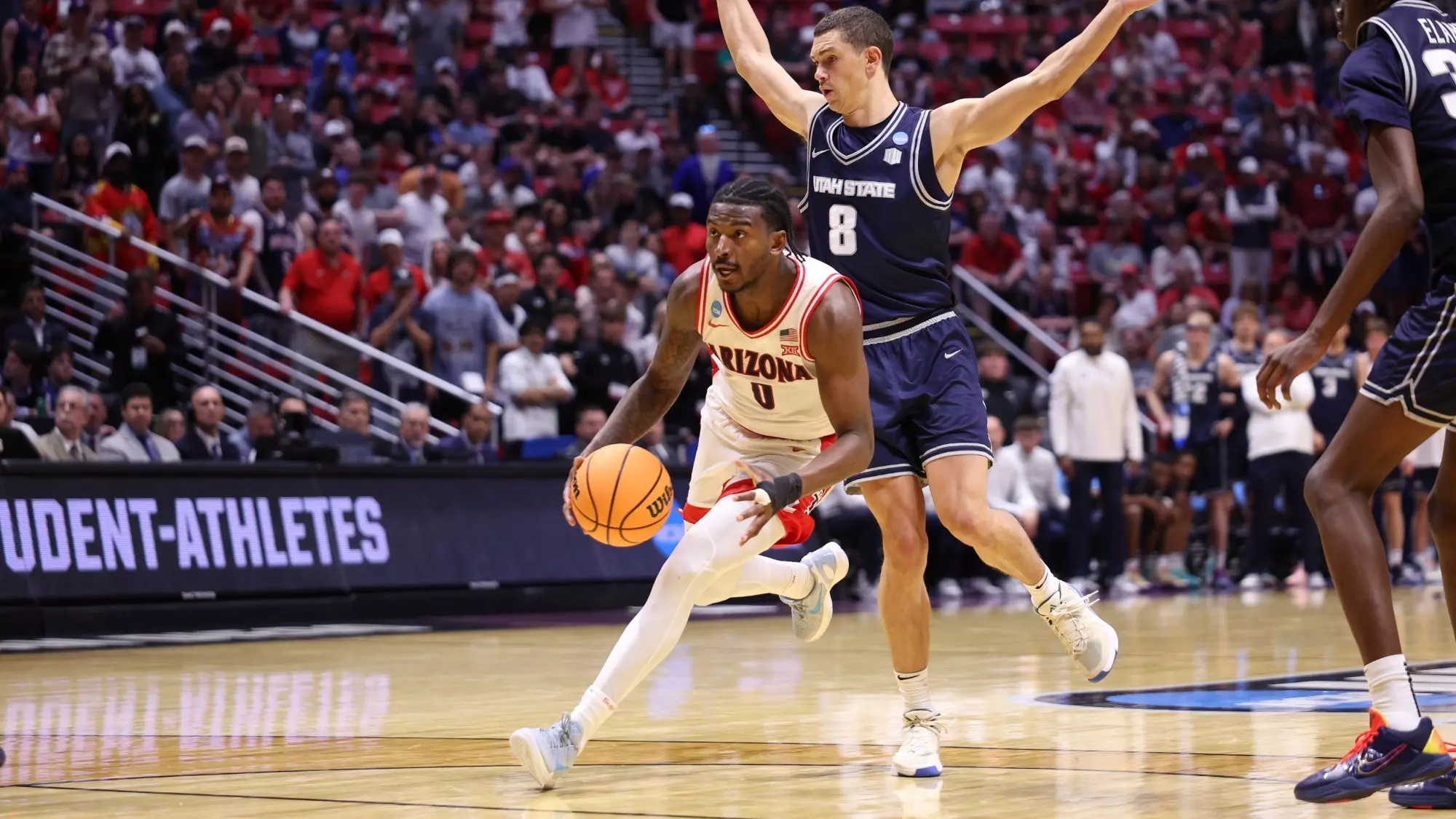
For its fifth straight NCAA Tournament appearance, the Razorbacks are through to the Sweet 16.
The setup is similar to 2022, when the 4-seed Hogs beat a 13-seed and then a very pesky 12-seed before facing a national title favorite, 1-seed Gonzaga. The Hogs won that game; their first-ever win over a 1-seed. Now Arizona steps into that role.
Arizona is favored by 8.5 points, the largest margin of the Sweet 16. On the other hand, John Calipari is 8-1-1 against the spread in his last 10 games as an underdog in the NCAA Tournament. Those haven’t all been wins (Texas Tech last year, for example), but they’ve at least been closer than expected. Cal thrives in the underdog role and he’ll get to play it in this game.
Meet the Wildcats
Arizona has been a powerhouse program since the 1980s and is close to “blueblood” status. Lute Olson coached them from 1983 to 2007, winning 11 Pac-10 regular season titles and reaching four Final Fours in Tucson, including the 1994 season that ended with a loss to eventual champion Arkansas. The Wildcats won the 1997 national title with, curiously, one of Olson’s worst teams. Olson’s later seasons were filled with NCAA sanctions and after he was forced out, he was replaced by assistant coach Russ Pennell, who later coached UCA and is now the head coach at Vilonia High School.
Following Pennell’s interim campaign, the Wildcats hired Sean Miller, who won five more Pac-12 titles and reached three Elite Eights, but failed to reach a Final Four and, like Olson, ended his Arizona tenure under scandal and investigation from the NCAA. Miller is, of course, now at Texas and could face his old team if both the Longhorns and the Wildcats win on Thursday.
After a search that included then-second-year Arkansas coach Eric Musselman, the Wildcats settled on Gonzaga assistant Tommy Lloyd, who is 146-35 in his five seasons with three regular-season conference titles. Despite regular season success, he has yet to advance beyond the Sweet 16, something that Arizona fans are desperate for. His first team in 2022 earned a 1-seed but lost to 5-seed Houston in the Sweet 16, while his 2024 team earned a 2-seed but lost to 6-seed Clemson, also in the Sweet 16.
This team has been his best by a long shot. They’ve combined international talent with 5-star freshmen and veteran transfers. They’ve been the most consistently-dominant team in the country this season, with wins over Florida, UConn, and Houston (twice).

Model pick: Arizona 87, Arkansas 80. This game is winnable, but it’s going to take Arkansas’ best performance of the season in order to get it done.
The biggest narrative is going to be whether Lloyd can actually win in March. His victories have been over teams seeded 16, 16, 15, 9, 9, 7, and 5, with losses to teams seeded 15, 6, 5, and 1. That storyline combined with Arizona’s dependence on freshmen could end up playing a role if the Wildcats look tight.
Personnel
Arizona is one of several power teams – Florida and Michigan being the main two – that has embraced Gorilla Ball this season. Gorilla Ball is a form of roster construction where teams emphasize size and strength over athleticism, versatility, and NBA skill. These teams typically have a 7-foot rim protector and are also tall at the 3 and 4 position. Their 3 position is usually more of a small forward than a guard, they often avoid the sort of “jumbo guards” that were featured in the Musselman era, and they prefer well-defined roles over the versatility and switchability of a more NBA approach.
The return of Gorilla Ball is part of the cyclical nature of basketball trends. Gorilla Ball was dominant in the 1990s and 2000s, but the rise of Steph Curry brought about an increased emphasis on the 3-point shot that effectively killed the old-school “center” and “power forward” as purely post positions. To combat dangerous 3-point shooters, the emphasis became switching, and terms like “positionless basketball” came into existence as versatile 6’6 guys were preferred over slower 6’9 post players.
For a while, bluebloods wanted to prepare players for the NBA, so they adopted this trend. But the rise of drop coverage, starting in 2021, changed the calculus quite a bit, as did the transfer portal. Drop coverage, which we covered in-depth in the Hawaii preview, enabled teams to protect their best paint defender and defend open 3-point shots without having to switch. This allowed for the re-introduction of the “lumbering 7-foot rim protector” position.
As Florida coach Todd Golden pointed out last week, one of the reasons we’re seeing fewer upsets (particularly mid-major over major) in the NCAA Tournament over the last couple years is that more and more majors are abandoning the high-variance NBA trends in favor of loading up on the biggest, strongest guys they can find, something that small schools can’t match.
When considering the rise of Gorilla Ball, you have two options: beat ’em or join ’em. John Calipari probably isn’t going to try a purely college-style scheme, so he needs to figure out how to beat ’em. That involves leaning into the NBA trends that include putting five jump shooters on the floor. If your center can shoot 3-pointers, you can run a 5-out offense and get the opposing rim protector out of the paint. Calipari tried this by recruiting Big Z, but it didn’t really work out, as centers who can shoot 3-pointers are often not good paint defenders, and I don’t think Cal liked having to protect Z on the defensive end of the floor.
So Arkansas’ roster is not particularly well-suited to tangle with Gorilla Ball, as we saw against Florida. The good news is that Arizona is probably a little bit less extreme in their roster construction, and the Wildcat frontcourt may not quite have the discipline that Florida’s did.
The biggest question beyond just this game is whether Gorilla Ball can win a championship. The NCAA Tournament is a guard’s game, and Golden himself found that out as his guards made serious mistakes down the stretch of an upset loss to Iowa. Last year’s Florida team was built on the same principles, but they had Walter Clayton. Can a Gorilla Ball team win a title without elite guardplay? If the answer is no, then there’s a good chance either Arizona is going down against the Hogs or Michigan is going down against Alabama.

Arizona’s version of Gorilla Ball starts with 7’2 center Motiejus Krivas, who may be the best pure rim protector in all of college basketball. He’s an elite shot blocker and he rebounds well. Your best bet to score in the paint if he’s in the game is to simply beat the Wildcats down the floor, something that Arkansas tried to do against Florida and will certainly try to do again. Offensively, he’s efficient, but they don’t run much offense through him. He’s a bigger threat for stickbacks and dump-offs.
Krivas is paired with the main frontcourt scoring threat, 6’8 freshman Koa Peat, who averages about 14 points per game. He’s a strong defender, but despite high volume, he has not been overly efficient as a scorer. He offers no 3-point threat (about half an attempt per game), which hurts team spacing, and his finishing is mediocre. He avoids turnovers and gets to the line at a decent rate, but shoots just 61% on free throws.
The other big that comes off the bench but will play significant minutes is 6’8 senior Tobe Awaka. Another post player with no perimeter offering, Awaka is a monster rebounder, tied with Florida’s Reuben Chinyelu for the Division I lead on total rebound rate (28%). He gobbles up rebounds at both ends. Other than that, he’s a drag on offensive spacing and less of a shot-blocker than Krivas.
The “tall 3” in this three-forward offense is 6’7 freshman Ivan Karchenkov, who chips in 10.3 points per game. He can hit some 3-pointers (33% on 2.7 attempts per game), so he aids in offensive spacing, but his scoring efficiency and defense are not exceptional. From a plus-minus standpoint, Arizona is actually much better with 6’8 freshman Dwayne Aristode, who does not play a ton (just three minutes against Utah State), but he has better shooting efficiency and much better plus-minus numbers in his limited sample size this year.
If the NCAA Tournament is a guard’s game, then Arizona really needs 6’3 senior Jaden Bradley and 6’4 freshman Brayden Burries to be great. Bradley is a transfer from Alabama who is an excellent defender, generating steals and guarding the ball really well. He’s not a very efficient scorer, but he leads the team in minutes because of his defense, and he has a good assist rate and low turnover rate as the main point guard. Burries leads the team with 16.0 points per game and is the primary 3-point threat, shooting 39% on 4.4 attempts per game. He’s also an excellent defender.
Off the bench, you’ll see 6’6 senior Anthony Dell’Orso, who will play some point guard. He mostly shoots 3-pointers but isn’t a great shooter (32% on 4.0 attempts per game), but like his fellow guards he is a good defender.
That’s it for the rotation. It’s basically a seven-man rotation with Aristode as the barely-used eighth man who jumps in for just a few minutes a game.
Lineup analysis
Starting with the obvious: 7-foot rim protector plus high-scoring power forward is the exact combination that has battered Arkansas all year. The Hogs allowed Coen Carr and Cameron Boozer to beat them up in the paint back in November, and it never really stopped: Malik Dia had two good games, JT Toppin ate the Hogs up, Florida’s bigs were dominant, and the list goes on. Peat isn’t quite at the level of Boozer or even Toppin, but he’s better than Dia at least, and he’s surrounded by a better roster. And Krivas is arguably better than Chinyelu (though slightly less athletic).
So Arkansas’ frontcourt is going to have to play out of their minds. At a minimum, they need Nick Pringle to be 100% healthy. Trevon Brazile and Malique Ewin are going to have be much better than they were against High Point. On paper, this matchup isn’t any worse than the 2022 Gonzaga game, but the Hogs saw multiple guys have the best games of their entire career that day (or close to it: Trey Wade probably had one of the best one-off games ever, Au’Diese Toney on defense, Jaylin Williams was fantastic).
You want some good news? Let’s dig. Arizona’s reliance on a shooting guard for scoring is pretty good news. The Hogs have struggled with high-scoring point guards because that’s who Acuff ends up guarding. Rob Martin was merely the latest to torch Acuff, joining Vanderbilt’s Duke Miles, Alabama’s Labaron Philon, Georgia’s Jeremiah Wilkinson, South Carolina’s Meechie Johnson, and others who scored in bunches on Acuff. But because Meleek Thomas is a much better defender, the Hogs have done better against true shooting guards like Burries, defending guys like Texas Tech’s Donovan Atwell, Texas’s Simeon Wilcher, and LSU’s Max Mackinnon (twice) at a very high level.
The best news is that Arkansas should be able to force freshmen to beat them. Krivas and Bradley will have a significant impact, but Peat, Burries, and Karchenkov are going to have to carry a lot of the load for Arizona, especially on offense. If the moment is too big for those guys and they struggle, the door will be open.
When Arkansas has the rock

To deal with Florida’s length, Arkansas tried to get in transition as often as possible. The vision was there: the Hogs had 32 transition points and 18 fast break points, both excellent. But the Hogs managed a season-low 77.6 halfcourt efficiency en route to a blowout loss. The good news is that Arizona will be vulnerable to the same strategy, as they rank just 125th in preventing transition possessions and 85th in fast break points allowed. Florida ranked 159th and 73rd in those same stats entering that game.
Unfortunately, as good as Florida was in halfcourt, Arizona’s defense has actually been slightly better. So while repeatedly getting in transition is a necessary ingredient to keep this game close, Arkansas is going to have to figure something out in their halfcourt offense.

Typical of Gorilla Ball defenses, the Wildcats don’t care much for forcing turnovers (181st), preferring instead to use drop coverage to keep their rim protector in the paint, allowing them to contest in the paint (2nd) without fouling (30th) and secure defensive rebounds (43rd), while the guards focus on smothering the perimeter and limiting open 3-point looks (109th). This is exactly what Golden was talking about: this is a very low-variance way to play basketball. There are not a lot of ways it can break down against a mid-major in a first-round game.
Typical of defenses that like drop coverage, the Wildcats force a lot of midrange, and those shots will be open all game for Acuff and Thomas. Arkansas only shoots 32% as a team on midrange, but their floaters and runners are much higher (many of them are considered paint shots because they occur in the high paint area).
Lobs are one area to watch. As we mentioned in the Hawaii preview, lobs are a great way to beat drop coverage defenses, because the dropping big is in conflict between the screener and the ballhandler. Sure enough, Arkansas hit several lobs on Hawaii. They didn’t get many against High Point, because the athletic Panthers switched more often so there were fewer lob opportunities. That said, the Hogs also didn’t get many lobs on Florida because the Gators’ length was able to take away those looks. Arizona is long too, but do they have the quickness and reflexes of the Florida frontcourt? I’m not convinced they do.
And lastly, Arkansas is going to have to knock down some contested 3-pointers. Brazile in particular needs to hit a few from the wing or corner. Arkansas probably needs to shoot 40% or better as a team. That’s roughly their season average, but they were just 4 of 13 from beyond the arc against Florida. Winning this game won’t necessarily require superhuman shooting, but the Hogs will need more than 13 attempts and way more than four makes.
When Arizona has the rock

The Wildcats play fast (29th in average possession length) and will cash in fast break opportunities (14th) but will not aggressively push the pace (79th in transition rate). Overall, their offense ranks second in percentage of possessions where they get points, right behind Arkansas.

Only three teams in the country attempt 3-pointers at a lower rate than Arizona. The Wildcats don’t really shoot 3-pointers unless they are wide open, so their percentages on those shots are good (62nd). They get into the paint at a very high rate (11th) and they finish well (53rd). That’s obviously a major concern for Arkansas’ weak paint defense. Florida dismantled the Hogs in the paint, and Arizona is actually even better.
The Wildcats also draw tons of fouls (25th), which is a potential problem given Arkansas’ limited bench. And the Wildcats are elite on the offensive glass (10th), which is a problem because Arkansas isn’t a great defensive rebounding team (211th).
Arizona’s love of midrange jumpers is probably their biggest weakness. Their field goal percentage on those shots only goes up slightly compared to a 3-pointer, but they lose 33% of the value by attempting a 2-point shot rather than a 3. In the Texas Tech loss, fully 25% of their field goal attempts were classified as midrange jumpers.
Keys to the game
Arizona has only lost twice, but both losses (Kansas and Texas Tech) unfolded the same way. The main note is that offensive rebounds and points in the paint were dead-even in both games. That’s how Arizona wins, so battling them to a standstill there is a good counter: Kansas’ final margin came by generating extra free throws (the game was in Lawrence and Kansas gets probably the most favorable home whistle in the country), while Texas Tech’s came from making extra 3-pointers. Arkansas will need 10+ offensive boards and they’ll need to keep points in the paint close to even (a very tall task), then they can win by shooting a good percentage from beyond the arc.
My biggest concern with Arizona as a national title contender is that they have some weird inconsistencies, especially on offense. One stat I track is correlation value: basically, the correlation across every game between a team’s marginal offensive efficiency and other smaller stats (offensive rebound rate, paint usage, free throw rate, halfcourt efficiency, etc). Arizona has no strong correlations, which mean there’s not one single thing you can take away from them to guarantee they have a bad game. But the flip side of that is that they’ll have weird off-games for no obvious reason. Texas Tech – a below-average paint defense – held them to just 26 points in the paint, for example. That might be a side-effect of Gorilla Ball: running the offense through the frontcourt is hard because it requires good play from the guards, something that becomes even more of a premium in the NCAA Tournament. Florida losing points in the paint and offensive rebounds to Iowa in their loss is a possible example of that.
I don’t know that it will matter in this one if Arkansas’ paint defense remains bad, but if Arizona loses, I suspect it will be the same way Florida did, with their guards unable to activate their paint offense.
Go, go, go. Arizona is more than capable of playing fast, but pace is Arkansas’ friend. The faster the pace, the less time Arizona has to set up their paint defense, and the higher the chance of the Arizona guards trying to take over the game instead of facilitating the paint attack by the bigs. The Hogs have successfully managed to turn recent games (Vanderbilt, Hawaii, High Point) into 1-on-1 and 2-on-2 games with the guards; that’s exactly what the Hogs want to do here.
Greatness from the bigs. Arkansas’ bigs need to all have tremendous games to give the Hogs a chance. They need to contest shots inside the arc, come away with defensive rebounds, snag a few offensive boards, and finish around the rim when they get the chance.
Knock down open (and semi-contested) 3-pointers. Arizona’s defense would rather contest your shot at the rim than watch it be taken from the perimeter. Their use of drop coverage and going under screens will give Acuff some pull-up 3-point looks, which he needs to hit. But the bigger key is other guys hitting catch-and-shoot 3-pointers from the wing and corner. Arkansas has been very inconsistent on those ever since the injury to Karter Knox: Richmond presents minimal threat, and despite a few good shooting games, Brazile has been inconsistent.
Thanks for reading! Be sure to follow us on X and Facebook for the latest posts.
The latest from Fayette Villains, straight to your inbox
Enter your email to subscribe and receive new post alerts and other updates. You can unsubscribe at any time.