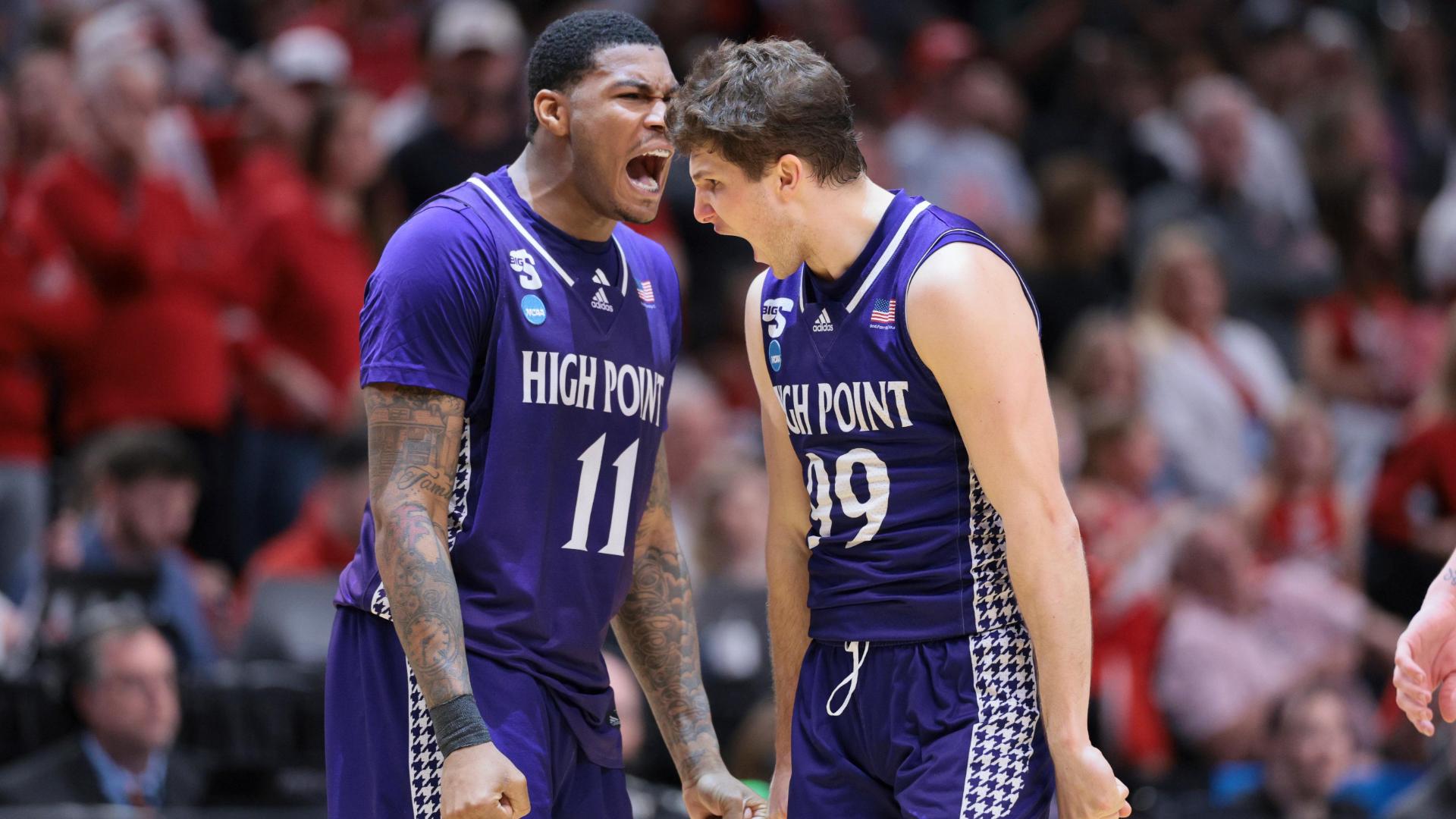
I trust everyone’s brackets are still intact after a full day of March Madness.
Hopefully, you didn’t overthink things and let Arkansas-Hawaii break your bracket. Hopefully, Wisconsin-High Point didn’t break your bracket either. As I said in the Hawaii preview:
The second-round with Wisconsin’s high-powered offense would be fun… if the Badgers can survive High Point. And I’m not sure they can. High Point has the statistical profile of a mid-major that springs a first-round upset. For example, they have the second-best net halfcourt efficiency of all teams seeded 12-16 since 2018. Entering this season, the 20 best net halfcourt efficiency teams in those seeds were 10-10 against their 1-5 seed counterparts. Poor Wisconsin has been victimized twice already on that list: against 12-seed Oregon in 2019 and against 12-seed James Madison in 2024. Very unfortunate draw for the Badgers.
So the good news is that Arkansas doesn’t have to face an excellent Wisconsin team. The bad news is that they get a dangerous High Point team instead. And losing to High Point would feel a lot worse than losing to Wisconsin.
The bracket is setting up like the 2022 season, when Arkansas also got a 4-seed. They beat Vermont in the opening round and saw 12-seed New Mexico State upset 5-seed UConn. They took out the Aggies and took their shot at 1-seed Gonzaga, and the rest is history. But that New Mexico State game was a slog, and while this game likely won’t be that low-scoring, it would not be at all surprising if it ends up a very close game.
- The real rebuild has now begun for Ryan Silverfield

- Box Score Breakdown: Utah 43, Arkansas 10
- What to watch for against North Alabama

Meet the Panthers
Located in High Point, North Carolina, the university is a private religious school associated with the United Methodist Church. Like many other private religious schools – it’s often compared to Liberty and Grand Canyon, though there are nuances – it has in recent years begun to massively increase spending on the university, funded by major donors. The school is noted for its highly-corporate culture (the school president is a former CEO) and abundant (if not excessive) amenities, including campus tours by golf cart, multiple fancy reservation-only restaurants on campus, and a mock airplane cabin that business students can use to rehearse for a future of schmoozing with executives while traveling.
The university-wide investment has trickled down to athletics as well, as High Point probably has the highest NIL spend of any Big South school. Former coach Alan Huss won regular-season Big South titles in both years at the school, and the Panthers broke through with their first NCAA Tournament appearance last year. Huss left to be coach-in-waiting at Creighton, so Flynn Clayman is in his first season after spending the last two years on Huss’s staff.
Clayman complained after the Wisconsin win that no one wanted to play his school, but it’s not really surprising that major schools would want to avoid a suspiciously-well-funded mid-major named “High Point”. There’s no upside to a win, and the team is probably good enough to beat you.
High Point’s toughest non-conference game came against UAB, and it ended in a 91-74 loss. In conference, High Point mostly cruised, and their biggest battles came with Winthrop, who took the Hogs to the wire in November. The Panthers and Eagles split their regular-season series before High Point crushed them in the conference title game.

Model pick: Arkansas 90, High Point 86. The Panthers are very strong for a 12-seed.
When Arkansas has the rock
We spent most of the Hawaii preview focused on Hawaii’s drop coverage and no-help man-to-man principles. The Razorbacks came out of the gate extremely prepared for Hawaii, and with vastly superior athletes, this one was over in a hurry. Hawaii did successfully chase the Hogs off the 3-point line, but that was just about all they were able to accomplish. The Hogs beat the ‘Bows up and down the floor in transition, hit open midrange shots, and were largely unbothered by Hawaii’s length around the rim.
High Point is going to be completely different… probably. While Hawaii’s comparison to an SEC defense is probably Oklahoma, with High Point, I’ll go with Missouri, a zone-heavy defense dependent on forcing turnovers.
High Point typically opens games in an aggressive, helping man-to-man defense, and they will stick to that if it’s working. They are very good at forcing turnovers and they have a ton of athleticism at all positions so against opponents that struggle to take care of the basketball or that don’t have a strong post presence, their man-to-man dominates. However, that was not the case against Wisconsin, a team that, like Arkansas, had a massive size advantage and rarely turns the ball over. The Badgers jumped to a 15-5 lead by the first media timeout, and High Point quickly recognized that their lack of rim protection was going to be a problem:

After the bad start, High Point heavily relied on zone, specifically a 3-2 zone that allowed them to contest jump shots.

This was not a dominant defensive performance at all. The Badgers scored 82 points and hit 31 of 65 field goals, but High Point’s zone was really a tough matchup for Wisconsin’s base offense. Note the guy in the corner in above clip (#7 white). He’s not really doing anything. If you watch the full game, you’ll see that Wisconsin’s offense was basically 4-on-5, as they had a guy in the corner doing nothing on every trip up the floor.
Here’s another:

If that guy in the corner is Trevon Brazile or Billy Richmond, they should be crashing toward the rim. But that’s not how Wisconsin operates. As a result, the Badgers only had six offensive rebounds, which is embarrassing for a tall offense facing a zone defense. They probably could have gotten away with it if they had hit more 3-pointers, but they were just 9 of 23 from beyond the arc. High Point has good athletes and they were able to close out.
As Hawaii realized their signature drop coverage had no shot against the Hogs, they decided to throw a 2-3 zone and see how Arkansas responded. As they have all season, the Hogs made short work of it:

You can see that lob could have gone to either Ewin or Brazile. And a couple possessions later, Brazile got his turn:

That, Badgers, is how you attack a zone defense.
Now to be clear, Hawaii does not have great athletes and probably has not practiced their zone as much due to their commitment to their base defense. High Point is much more athletic and their guys understand how to play zone much better. But if High Point throws this 3-2 zone at them – and they almost-certainly will – I would expect the Hogs know better how to attack it.

Because they are more athletic than most of their competition, the Panthers do a good job of limiting transition possessions (20th). However, like a lot of zone-heavy teams, teams that are able to run are typically able to score (209th in transition scoring percentage).

Turnovers are going to be a big story in this game. High Point forces a lot of turnovers, but they depend heavily on forcing turnovers. The Panthers are 17-0 when they generate turnovers on at least 20% of opponent possessions and 28-2 when they top 15%. Under 15%? They are just 3-2.
Arkansas has the nation’s lowest turnover rate and avoiding turnovers is also key for the Razorback offense. The Hogs have topped a 20% turnover rate in only two games this year, both losses (Michigan State and Georgia). The Hogs are 3-5 when they turn it over on more than 15% of possessions, and 24-3 when they are under 15%. Most notably, they have lowered their turnover rate over the last couple months: Arkansas hasn’t topped a 15% turnover rate in any game since January 17th at Georgia.
If Arkansas stays under 15%, they will probably score almost at will against the Panthers. High Point lacks a rim protector, so if they play man-to-man they will have to deal with Acuff and Thomas at the rim all game, and if they play zone they will have to deal with lobs and offensive boards by the Razorback frontcourt, plus some open 3-pointers.
Personnel

This is a very different roster from what we saw against Hawaii. The Panthers are smaller but much more athletic.
The trio
Much of High Point’s offensive production comes from its trio of 6’6 senior wing Terry Anderson, 5’10 senior point guard Rob Martin, and 6’7 senior forward Cam’Ron Fletcher. Anderson averages 16.0 points per game and is a monster inside the arc, boasting explosive athleticism that is seen in his excellent finishing around the rim, high rate of drawing fouls, and excellent rebounding at both ends. He’ll take some 3-pointers but he’s at just 28% on the year. Most of his work is doing inside the arc. I expect that Billy Richmond will draw the assignment of guarding him.
Martin, a transfer from Southeast Missouri, does well on offense as a point guard, dishing out assists and protecting the ball. Like Anderson, he’ll take enough 3-pointers to be dangerous, but he’s shooting just 30% on the year from downtown and does most of his damage inside, particularly by drawing fouls.
And Fletcher, who started his career playing for John Calipari at Kentucky in 2020, has been a key guy. Fletcher was a 4-star recruit who had a famous meltdown on the bench during his freshman season in Lexington over a lack of playing time, leading to him being asked by Calipari to step away from the team. He spent three seasons at Florida State and one season at Xavier – largely riding the bench – before landing at High Point. Because of his high-end athleticism, he’s at his best in the biggest games: 20 points and 12 rebounds in the UAB loss, 17 points and 19 rebounds in the Big South title game, and 14 points and 11 rebounds on Thursday against Wisconsin. He shoots 37% from beyond the arc on 3.3 attempts per game and is a beast on the defensive boards, grabbing 30% of potential rebounds while on the floor playing defense.
The rest of the bunch
Fletcher’s likely frontcourt mate is 6’8 senior Owen Aquino, a transfer from Liberty. Despite only being 6’8, he’s an excellent shot blocker, swatting 7.2% of 2-point attempts while on the floor. He had a couple against Wisconsin, including the one with four seconds left that sealed the game:

Offensively, Aquino contributes 9.5 points per game on decent shooting efficiency, although he does have a high turnover rate.
And Fletcher normally comes off the bench but will likely ending playing the majority of minutes in place of 6’7 sophomore Braden Hausen, who chips in six points per game at the 4. Hausen mostly just attempts 3-pointers, taking 4.4 per game and hitting them at a solid 36% clip. He’s significantly less athletic than Fletcher and not nearly as good of a rebounder or shot-blocker.
The final starter is 6’4 senior guard Scotty Washington, a transfer from CSU Northridge. Just over half his field goal attempts are 3-pointers (37% on 2.9 attempts per game), and he grades as a solid though low-usage player at both ends.
The Panthers have a deep roster in terms of minutes, but the value they get drops off significantly once they go beyond these six guys. The most notable guy is 6’3 senior Chase Johnston, who is the last guy Calipari wants to see in March, due to how much his playstyle resembles former Oakland star Jack Gohlke, who knocked out Calipari’s Wildcats in 2024. Entering Thursday, Johnston was 64 of 132 (48%) from beyond the arc, playing with a total green light to take ridiculous shots:

That’s an absolute giant-killer skill in March. There’s not a lot that can be done to defend that. Johnston caught fire in this game, hitting 4 of 6 3-point shots while playing extra minutes because that’s the kind of things you have to do to pull big upsets.
Most hilariously, Johnston entered this game 0 of 4 for the season on 2-point attempts, which is ridiculous by itself. Even more ridiculous? This was his first 2-point make of the entire season:

It does not get much more March Madness than that.
So what do you do if Johnston gets hot? Obviously, you can face guard him because he’s no threat to drive at all. And at the other end, he’s a really bad defender who commits a lot of fouls, so you can just go right at him. But things will really be scary if he gets hot from downtown.
The only other guy who will get significant minutes is 6’0 junior Conrad Martinez, the backup point guard. Compared to Martin, he’s a slightly better shooter but he has a higher turnover rate and is a worse defender.
Lineup analysis
High Point is definitely built to win in March. They have an athletic frontcourt and guards who can shoot. This game screams Richmond, Brazile, and Ewin as key guys. I think Acuff and Thomas will need to primarily hit open shots, avoid turnovers, and make good passes against the zone, but if High Point actually sticks with this zone, I’d be surprised if they combine for 45 points again (although Acuff has surprised me all year, so who knows).
Richmond has to have a big game guarding Anderson, and Brazile has to have a big game guarding Fletcher. And both, plus Ewin, need to crash the rim at all times, especially against the zone. Ewin could end up playing a major factor on offense, as High Point struggles with centers who can score and are active on the glass. Winthrop’s 6’10 center Logan Duncomb really ate them up in all three games: 28 points + 6 rebounds in the first game, 23 points + 14 rebounds in the second game, and 17 points + 10 rebounds in the third game (High Point successfully fouled him out in 24 minutes). As a team, Winthrop recorded 46 offensive rebounds in the three meetings, or 15.3 per game. Ewin is an elite offensive rebounder, grabbing 17.2% of Arkansas’ missed shots while he’s on the floor, which is top-25 nationally, and actually happens to be tied with… Winthrop’s Logan Duncomb.
When High Point has the rock

High Point’s offense is elite and built to play fast. They are 5th in the nation in fast break scoring rate and they had 16 fast break points against Wisconsin, including the game winner. They force a lot of turnovers, but if they don’t get those, their ability to run will be limited.
Interestingly, while they generally play fast, they probably don’t want to get going too fast. Their two wins over Winthrop came in a relatively-slower games, while their loss came in one of their fastest-paced games of the season. And that’s not really an outlier: while they’ve had a few good games that played at a chaotic pace, their UAB and Appalachian State losses also came in extremely-fast games. Arkansas may be able to use their athleticism advantage better in a game that reaches a chaotic pace, though that’s obviously risky against a team with dangerous shooters.

The Panthers avoid turnovers and are decent on the offensive glass. That’s part of what makes them so dangerous: unlike Hawaii, they often generate more shot volume than their opponents. Against Wisconsin, they were +4 in turnovers and +7 in offensive rebounds. That’s 11 extra chances to shoot in a one-point game.
They will take 3-point shots at a decent rate but are not elite shooters. They hit 15 of 40 (38%) from downtown against Wisconsin, and it’s a good sign that the Badgers, whose height is similar to Arkansas, successfully forced them to launch so many 3-point shots. I think the Hogs could live with High Point going 15 of 40 again if the offense plays well.
I think a bigger concern is that they finish well in the paint and draw a lot of fouls. That’s a major concern if Nick Pringle is out or limited, so once again, we have to careful of foul trouble. Ewin can’t dominate if he’s on the bench. Much of the foul-drawing is by Anderson so Richmond has to stay in front.
Keys to the game
Protect the rock. The specific goal here is a turnover rate of under 15%. If the Hogs hit that, I think they’ll score enough points to survive whatever the High Point offense is able to do to them. If they fail, then you risk High Point doing to the Hogs what they did to Wisconsin: bury them under an avalanche of extra shot chances.
The Malique Ewin game. I think Ewin is critical for Arkansas’ offense, both on the offensive glass and as a zone buster. A double-double would be a great sign. Arkansas will probably want to target at least 10 offensive rebounds (that’s low, 15+ would be better), and Ewin would need to grab half or more of those. Keeping him out of any foul trouble is part of this as well.
Richmond defensive masterpiece. Billy Richmond is a good on-ball defender, but I was still a little surprised that he made the SEC all-defensive team, given how bad Arkansas’ team defense is and the fact that it didn’t improve when Richmond became the starter. This game, however, is a chance for him to earn that title. Arkansas’ biggest defensive vulnerability is a true power forward (see: Cam Boozer, Malik Dia, Thomas Haugh, Coen Carr, others), and they match up slightly better with an explosive wing like Anderson due to the fact that Richmond can defend him. But the Anderson-Fletcher duo is very scary if the Hogs struggle to stay in front and secure defensive rebounds, and preventing that starts with Richmond having a great defensive game.
Thanks for reading! Be sure to follow us on X and Facebook for the latest posts.
The latest from Fayette Villains, straight to your inbox
Enter your email to subscribe and receive new post alerts and other updates. You can unsubscribe at any time.