I’ve long been annoyed at the lede of the AP story that recapped Arkansas’ ugly 56-53 win over Wofford to open the 2015 NCAA Tournament. It was really simple: “Arkansas surely knows about Wofford now.”
The background is that Wofford was a fiesty 12-seed and popular upset pick. In press interviews the day before the game, Razorback stars Bobby Portis and Michael Qualls admitted that the Hogs had not done any kind of scouting or specific preparation for Wofford, and that Wofford-specific prep would consist of a scouting report given the to players hours before the game. That didn’t exactly inspire confidence that the Razorbacks could win the game.
However, the Razorbacks did win. That was despite the fact that 12-seeds had won six of eight matchups over 5-seeds over the two previous seasons. I felt like the story could have focused on how it was only Arkansas’ second NCAA Tournament win since the Nolan Richardson era, or something like that. Instead, the recap focused on the pregame narrative of Arkansas being unprepared.
I bring all that up for a couple reasons. First, because things have changed quite a bit 11 years later. Hawaii is not going to be a popular upset pick at all, largely because of what folks have seen from Arkansas in recent games. And despite John Calipari’s issues as a higher seed in his last few years at Kentucky (we’ll get to that, I promise), he’s a Hall of Fame coach and people know that.
The second reason I bring this up is because Arkansas had better do some Hawaii-specific prep, or they are going to be really confused when the game starts. Hawaii has a fairly unique defensive scheme, and you have to be aware of what they are doing. We will get to that.
- The real rebuild has now begun for Ryan Silverfield

- Box Score Breakdown: Utah 43, Arkansas 10
- What to watch for against North Alabama

The regional outlook
This is a tough draw mostly because the Hogs have to travel to Portland and play on Thursday. Take those two factors away – say, in Oklahoma City on Friday – and we would be calling this a friendly draw. Hawaii is tough, but they are not as strong as the 12-seeds.
Wisconsin. The second-round with Wisconsin’s high-powered offense would be fun… if the Badgers can survive High Point. And I’m not sure they can. High Point has the statistical profile of a mid-major that springs a first-round upset. For example, they have the second-best net halfcourt efficiency of all teams seeded 12-16 since 2018. Entering this season, the 20 best net halfcourt efficiency teams in those seeds were 10-10 against their 1-5 seed counterparts. Poor Wisconsin has been victimized twice already on that list: against 12-seed Oregon in 2019 and against 12-seed James Madison in 2024. Very unfortunate draw for the Badgers.
Arizona. The Wildcats are one of the national title contenders and are absolutely elite. Along with Florida, they are one of the best rim-protector teams in the country, so this would not be a friendly matchup for the Hogs at all. I prefer facing them to facing Florida or Duke, only because coach Tommy Lloyd still needs to prove he can be a good tournament coach, and their freshman-heavy lineup definitely makes them vulnerable.
Purdue. The 2-seed in this regional was a preseason national title contender, but five home losses really hurt. However, they recovered to win the Big Ten tournament and sneak into the 2-seed. They are probably the weakest 2-seed. Their offense is really good and their size is a problem for teams like Arkansas, but the Hogs would potentially have the ability to speed them up and cause trouble for their very deliberate style of play.
Meet the Rainbow Warriors
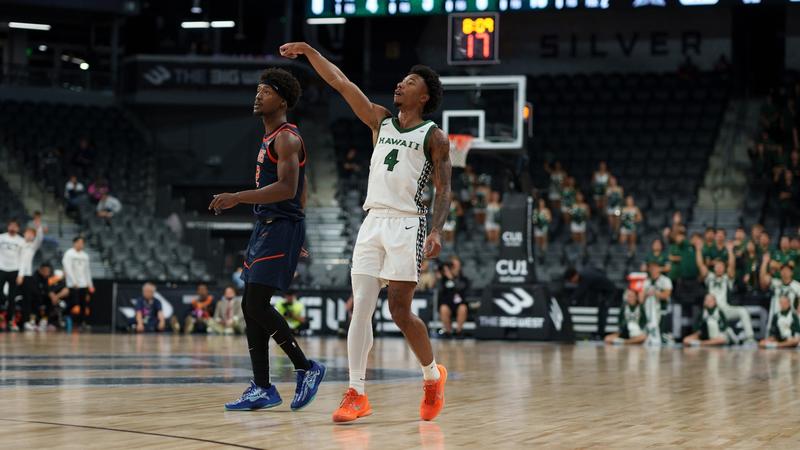
Hawaii has a veteran coach: Eran Ganot, now in his 11th season. His Hawaii tenure started off with a bang: his first team in 2015-16 went 28-6, won the Big West, earned a 13-seed, and promptly upset 4-seed California, coached by Cuonzo Martin. So Ganot knows about pulling upsets, specifically in a 4/13 game.
The next nine years were spent in total mediocrity. No good seasons, no bad seasons, just an 80-74 conference record and no postseasons. But they’ve broken through this year: 24-8, a second-place regular season finish in the Big West, and an upset of UC Irvine to get back to the Dance.
They’ve played two power conference teams – Oregon and Arizona State, who were both pretty bad – and lost both, although both were close games (60-59 to Oregon and 83-76 to Arizona State).

Model pick: Arkansas 87, Hawaii 76. Hawaii’s offense is the weakest Arkansas has faced in a very long time (even December opponents like Queens had better offenses), but the defense is very good at forcing the kind of tough shots that you want to force in March.
The no-help defense
If you follow trends in basketball – college or NBA – you may be aware of what Hawaii is doing defensively. Jordan Sperber – whose YouTube channel is called Hoop Vision – returned to making videos this year after a stint on Chris Jans’ staff at Mississippi State, and he’s long been one of my go-tos for X’s-and-O’s breakdowns. He put out a fantastic video on Hawaii’s defense earlier this year, so I was excited as soon as I saw the bracket matchup.
Here’s the video, for those interested. We’ll be applying concepts from the video to the stats we have on hand:
We’ll break this down as we go, but basically, Hawaii does not help on defense. It’s a pure man-to-man. Most man defenses help some: the Chris Beard No-Middle helps with the low man, the old Wisconsin/Virginia Pack Line helps with a one-pass-away defender, and there are more. Some man defenses help very little: one of Hall of Fame Utah coach Rick Majerus’s big defensive principles was that you never leave a shooter in the corner to help, because kickout corner 3s go in at a very high rate.
But Hawaii doesn’t really help at all. They have a very long roster and everyone aims to stay between their man and the basket, using their length to force tough two-point shot attempts. The Razorbacks may be able to have success by simply spreading them out and isolating Darius Acuff one-on-one. Expect to see plenty of that, but that would work even better if the Hogs could get a switch and get Acuff matched up against a big on the perimeter who can’t stay in front of him.
The ballscreen game
That’s the real problem here: Hawaii doesn’t switch. The guy assigned to guard Acuff is going to follow Acuff around the whole game. If he gets clipped by a really good screen, the ‘Bows might temporarily switch, but they’ll be looking to switch back as soon as possible.
Ballscreens are normally how you attack man-to-man defense. If you decide not to switch, a really good screen will create an opening for the ballhandler. If the defender chases his man over the screen, the ballhandler has a free path to the basket (you do not want to do that against Acuff); if the defender goes under the screen, he cuts off the penetration, but cedes an open pull-up 3-pointer (you do not want to do that against Acuff either).
In the SEC Championship Game, Vanderbilt did some switching and chose door number three: the hard hedge against screens. Watch the screener’s man – Devin McGlockton – jump this screen to prevent Acuff from using it:

This is a form of ball pressure, where you attack the ballhandler to try and force a mistake. An attempt to screen for Acuff ended up as a double-team, as Acuff’s man (Tyler Tanner) recovered and doubled Acuff with McGlockton, while Vanderbilt switched away from the ball (watch Richmond’s man, Tyler Nickel, leave him to pick up Ewin’s roll to the basket).
Unfortunately for the Commodores, Acuff was just too good. Watch this sequence in the second half where the exact same thing happens. The Hogs have Pringle screen, McGlockton hedges, it turns into a double-team, and Nickel leaves Richmond to pick up Pringle’s roll to the basket. Read that again, though. Nickel leaves Richmond:

Throughout the game, particularly late in the second half, Jay Bilas repeatedly pointed out that everyone for Vanderbilt was keyed on Acuff, so role players were left open. Wagner and Brazile hit 3-pointers, and Richmond caught lobs. Arkansas’ offensive spacing is perfect and their role players know how to attack help defense.
So the more ball pressure you put on Acuff, the more assists he gets, and he had 11 in this game. Help defense leads to assists, as we see in the clip above.
But what if you don’t help? Acuff’s lower-assist games show us opponents that tried a different strategy. Arkansas has already played a few low-help defenses this year, and they beat one in the quarterfinals. Watch how Oklahoma’s big (Mohamed Wague, #5) deals with this ballscreen from Pringle:

This is the opposite of a hedge. This is called drop coverage. The screener’s man stays lower than the screen to take away both the dribble-drive and the pick-and-roll. You could say that he “drops” like a free safety in coverage, hence the name. I mentioned the low-help defense of Majerus earlier, so it may not be surprising to you that Porter Moser is a disciple of Majerus. This is not a ball pressure defense at all. Acuff isn’t really pressured, but there are no lobs available because no one is leaving their man.
Acuff kicks the ball to Richmond. This is the first few seconds of the game, so he wanted to confirm the Sooner strategy. No Sooner defender leaves their man, so now he knows how they are playing ballscreens. A few seconds later, he gets the ball back, calls for another Pringle screen, and knows exactly how to attack:

That shot was a lot more difficult than a Richmond lob. That’s what drop coverage does: it exchanges ball pressure for creating tougher shots. Moser’s mantra at Oklahoma (and at Loyola Chicago before that) is “tough twos”, and that was certainly a tough two. Acuff just happened to make it.
Drop coverage became really popular when the Milwaukee Bucks won the 2021 NBA title with a defense built around drop coverage, which kept their rim protector, Brook Lopez, in the paint. Notice in the Vanderbilt clips that McGlockton has to wander far away from the rim to help, while Wague is able to stay between the ball and the rim.
The Sooners did this all game. The first Razorback bucket is above, and here’s the second bucket of the game, with Thomas taking the shot:

Again, these are tough shots. He misses this one, but Brazile cleans it up.
At this point, you’ve probably picked up on where we are going: no one in college basketball sticks to drop coverage more dogmatically than Hawaii. The ‘Bows want to force tough twos by keeping their 7-foot rim protector Isaac Johnson, nicknamed “Big Fish”, safe in the paint, where he can take away lobs and contest driving guards. They allow the third-lowest assist rate in college basketball, and they allow basically zero catch-and-look 3-point attempts per game.
So you may be thinking, It sounds like Acuff is going to have to score a lot of points. Without lobs or catch-and-shoot 3-pointers or assists, you’ll see a lot of Acuff working one-on-one. After all, Acuff had 37 in this Oklahoma game, because the Sooner drop coverage forced him to do everything.
To drive home the point further, consider the other SEC team besides OU that loves drop coverage:

Yes, that’s Alabama, who first starting spamming drop coverage to protect Charles Bediako back in 2021 (what ever happened to that guy?). And yes, Acuff scored 49 against the Tide because that’s what the defense gave him.
Attacking drop coverage
Arkansas is built about as well as anyone in the country to attack drop coverage. If they had an old-school post-up power forward, that would be the final missing piece. But in terms of guardplay, the Hogs are set. Alabama above is deploying the Bucks’ strategy of a deep drop, where the rim protector doesn’t even leave the paint. That completely cedes the pull-up 3-pointer, which analytics say is a bad shot so Nate Oats can live with it. It’s not a bad shot for Acuff, but it is for most point guards.
Oklahoma didn’t have Wague drop nearly as deep. And neither does Hawaii. They are okay with having their rim protector come outside the paint. In this play, UC Irvine tries to set a low off-ball screen to force the center to contest a guard. It almost works, but the play develops too slowly so the original defender is able to recover:

Because the rim protector focuses so much on staying between the ball and the rim, all shots near the rim are going to be contested:

There are a few key ways to attack drop coverage.
Lob to the roller. In the first Hawaii clip, you can see the screener (#14) has an open path to the bucket on the other side from the ball. But Big West centers aren’t usually lob threats. Ewin, however, is a lob threat. Hawaii’s preference for a shallow drop rather than the deep drop of Alabama helps take away the pull-up 3-pointer but creates a high vulnerability for the alley-oop, especially if Acuff gets downhill before his man can recover from the screen.
Secondary cut. When the center is retreating after a screen, Hawaii will use the backside low defender to come up to help. That puts the low defender in conflict between the ball and the man he’s defending. Hawaii’s no-help principles say that the defender should prioritize staying on his man, but if Acuff gets downhill he won’t have much choice. Arkansas’ wing and corner players are significantly more athletic than any that Hawaii has seen this season, and the Hogs have shown the ability to attack that low defender:

And here’s UC Irvine stretching the low defender by sneaking a shooter back to the corner:

Floater/midrange. The most tried-and-true way to beat drop coverage is to have a good floater game. The dropping big isn’t going to get a good contest on a floater or runner in the high paint area, and drop coverage actively encourages those shots, so Hawaii will have no real answer if Acuff and Thomas can hit those at a rate of 50% or better.
Transition. Probably the biggest reason that Hawaii is going to struggle is that Arkansas is willing and able to attack before they get set up. This isn’t necessarily a specific defect of a drop coverage team, but it is a defect for any team that relies on a good rim protector (and those teams often play drop coverage). Hawaii’s defense makes staying between your man and the ball essential, and that’s hard to do against Billy Richmond (and others) in the open floor after a turnover or rebound.

Opponents tend to play very fast against Hawaii in an effort to speed things up (337th in defensive pace), and they’ll aim for transition buckets (275th) and fast breaks (221st) as often as possible, and those are big concerns for the ‘Bows against an Arkansas team that is elite at running.
But in halfcourt, Hawaii is tough. They rank 13th in opponent halfcourt efficiency and second in Division I in halfcourt points allowed per 100 possessions.

Hawaii’s no-help man defense prevents assists (third) for reasons we discussed, secures defensive rebounds (seventh, since no offensive player is ever unaccounted-for in boxouts), prevents 3-point looks (13th), forces lots of inefficient midrange attempts (21st), and contests well in the paint (20th).
But allowing lots of shots in the paint (293rd) means that there will be contact and thus free throws (196th), and those fouls come without generating a lot of turnovers (161st), since they aren’t really pressuring the ball.
The recipe for an upset
Hawaii’s ability to force tough shots in halfcourt makes them a dangerous team to encounter in March. Favorites often come out deliberate and timid in the opening round of the NCAA Tournament. This explains why so many slower-paced teams get upset (Purdue, Virginia, and Wisconsin have been repeatedly victimized): their timidity in attacking the opposing defense in the halfcourt means they can’t simply crank the tempo in order to push their athletic advantage.
John Calipari’s two upset losses in his final seasons at Kentucky followed this pattern. His freshmen played like freshmen against Oakland in 2024. Despite their struggles, Kentucky still would have won (probably easily) if Oakland’s Jack Gohlke didn’t have one of the most ridiculous (and honestly fluky) 3-point shooting performances you’ll ever see. So a lot had to come together for that one to happen. The 2022 upset loss to Saint Peter’s was quite different. The Peacocks were a legitimately strong defensive team, built to pressure the ball, and Kentucky simply didn’t have the normal level of Calipari guardplay to control the game with their star, Oscar Tshiebwe. The Wildcats had an uncharacteristically-bad defensive performance in that one, but their roster was not built to win in March.
A good example of breaking out of that issue is the 2021 Arkansas-Colgate game. Colgate was a disciplined team that was very good in halfcourt. Arkansas came out very cautious on offense and quickly fell behind. The Colgate lead swelled to 15. A Virginia or a Purdue would be done at that point. But Eric Musselman was able to put on a full-court press and the Hogs fast-breaked their way to a 17-0 run to close the first half.
Like Colgate, Hawaii is built to take advantage of a cautious offense, because their defense forces so many tough shots. It would not surprise me at all if the Hogs look a little nervous offensively early in the game. That’s what happens in the Round of 64. If they are unable (or unwilling) to get in transition, or they settle for too many long twos in order to avoid attacking the paint, or everyone becomes too unselfish and passes the ball around the perimeter for 30 seconds, this game could absolutely get really dicey really fast.
Personnel

You may think of mid-majors as having scrappy, undersized lineups. With Hawaii, don’t. The Warriors are huge, with only Missouri and Florida taller in terms of total starting lineup height among SEC teams.
The frontcourt
The engine that makes this team go, especially on defense, is 7’0 senior Isaac Johnson, a transfer from Utah State nicknamed “Big Fish”. Johnson is a hoss. Once a coveted 4-star recruit, he left Oregon after a year and spent two seasons mostly coming off the bench in Logan before Hawaii gave him a chance to meet his potential. He averages 14.1 points and 5.8 rebounds per game, pacing the team in both categories. He’s a major shot-block threat, swatting 5.1% of all 2-point attempts while he’s on the floor (equal to Trevon Brazile and Malique Ewin, who are both at 5.2%). He’s also a strong rebounder at both ends. And for every shot he blocks, he alters or influences several others, contributing to Hawaii’s strong paint defense. Offensively, he’s a major threat because he can shoot 3-pointers: not well (31%), but he’ll shoot often (3.4 attempts per game) to draw the opposing rim protector away from the basket. He gets about 5.5 attempts per game in the paint and finishes those well. Foul trouble will likely be a concern: he fouled out of the season opener against Oregon and has had to sit for long stretches with foul trouble in several conference games, which is why he averages just 25 minutes per game.
The other two forward positions are manned by a committee including 6’9 senior Harry Rouhliadeff, 6’8 senior Gytis Nemeiksa, and 6’8 junior Isaac Finlinson, who are all very long, which helps Hawaii defensively. Rouhliadeff is an efficient scorer, shooting 40% from beyond the arc on about three attempts per game and also finishing well inside of it for a team-best 63% true shooting. Turnovers are an occasional issue for him. Nemeiksa is a much worse shooter but he does defend well. And Finlinson, who has been starting more recently, shoots 38% from beyond the arc and draws a ton of fouls but is the worst defender of the three.
The backup center is 6’10 senior Yacine Toumi, who may be a familiar name because he started his career at Little Rock back in 2021. He’s a decent shot blocker but really struggles to do anything on offense.
The backcourt
The starting backcourt duo is 6’3 senior Hunter Erickson and 6’6 senior Dre Bullock. Erickson is the primary point guard. He’s a decently-efficient scorer, including shooting 36% from beyond the arc on 3.5 attempts per game, but all the good he does is largely undone by his horrific 25% turnover rate. Bullock is the probably the most-traveled guy in college basketball, with previous stops at Louisiana Tech, Niagara, and South Dakota. He’s second on the team at 13.8 points per game. His 3-point shot isn’t falling (27%), but he’s decently efficient inside the arc and his low turnover rate and good rebounding mean that his plus-minus numbers look good, and his 3.3% steal rate leads the team.
Off the bench, the backup point guard is 6’3 sophomore Aaron Hunkin-Claytor, another guy who deals out plenty of assists but is undone by his 27% turnover rate.
Lineup analysis
Hawaii is more long than big. Their main goal defensively is to stay between their man and the basket, and use their length to cover for a lack of explosive athleticism. If you want to score, you have to go through or over them. It seems likely that the Hogs will take some time to get used to how Hawaii plays defense. They won’t force many turnovers, but their whole lineup is strong on the defensive boards and they can protect the paint well, which is scary if the Hog shots are not falling.
On the other side, Hawaii’s main ballhandlers are extremely turnover-prone, which is often a death-knell for mid-majors hoping to pull an upset. It’s unclear if the Hogs, who do not have a turnover-forcing defense, will be able to force many turnovers, but trapping and pressing the ball could be a good strategy. Hawaii will put five 3-point threats on the floor, but several of them are not actually very good shooters. If they get hot, there could be trouble, but the stats say they are unlikely to do a ton of damage.
When Hawaii has the rock

The ‘Bows will play at a brisk pace, but they are not really much of a transition team (224th in transition rate, 161st in fast break points), which is definitely good news for Arkansas.

Hawaii is going to space the floor with five shooters and try to win off the dribble. That’s probably not going to be easy against a team like Arkansas, especially because those shooters are mostly not good: Hawaii ranks just 299th in 3-point percentage. Rouhliadeff and Finlinson are decent shooters, and Erickson isn’t bad either, but none are elite and they don’t really have anyone else unless someone gets really hot. Because they aren’t really a good 3-point shooting team and because they don’t have an elite point guard who can initiate their offense and set guys up, they don’t end up taking a lot of 3-pointers, and many of the ones they do take are not really open. It will be really disappointing if the Hogs are unable to get closeouts on Hawaii shooters.
That said, Hawaii’s size does help them in the paint, which is a big concern for Arkansas. The ‘Bows rank 63rd in paint usage, 93rd in paint shooting percentage, and 44th in getting to the free throw line. A threat here is getting Arkansas’ bigs in foul trouble by repeatedly attacking in the paint.
Finally, we have to look at that turnover rate, because that’s ghastly. Hawaii usually plays with only two guards, and both point guards on their roster are extremely turnover-prone. Arkansas is not a turnover-forcing team. We saw the Hogs briefly press both Oklahoma and Ole Miss in the second half, probably to make them tired, but Arkansas is not a pressing team.
The Hogs may not have to press, since a lot of Hawaii’s turnovers from their point guards look like this:

And here’s another really lazy pass:

The lion’s share of Hawaii’s turnovers are these bad passes, because their offense really telegraphs everything it’s trying to do. And you can see how Hawaii’s offense really hurts that transition/fast break number for Hawaii’s defense, because there’s not much Hawaii can do defensively after turning the ball over at the logo right at the beginning of the possession.
Keys to the game
Don’t play scared on offense. There will be nerves and there will likely be caution, but Hawaii is counting on Arkansas to settle for open-but-difficult long 2-point shots. There will be some of those, but the Hogs cannot play timid. Brazile and Richmond could have big games as rim runners, and Acuff and Thomas need to be unafraid of tossing lobs and attacking the Hawaii rim protector.
Keep the bigs out of foul trouble. Hawaii does draw some fouls, and as the underdog, I would expect them to be aggressive. If the Hogs have to sit Pringle and Ewin for long stretches, the ‘Bows will have a major size advantage. Pringle just had an excellent SEC tournament and has been contesting well at the rim, but he also has a tendency to commit cheap fouls.
When in doubt, run. The absolute last thing Hawaii wants to do is turn this into a track meet. If the ‘Bows are struggling with live-ball turnovers or to keep Arkansas from simply beating them down the court, then not only is Arkansas going to win, but it’s probably going to be a blowout. The Razorbacks need to maintain maximum pressure by pushing the pace as often as possible.