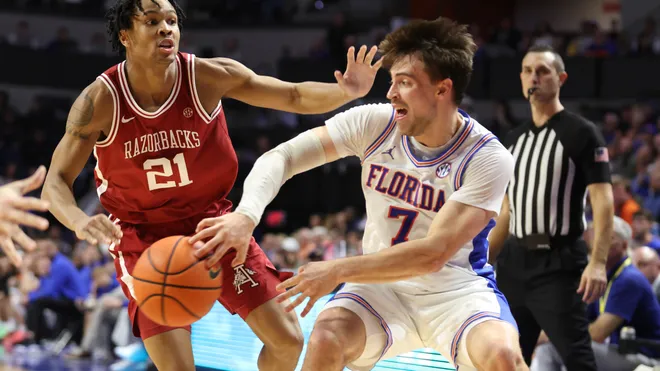
Well, that went about as badly as it could have. Arkansas’ trip to Gainesville ended in a 111-77 loss, with the 34-point margin of defeat tying the largest of John Calipari’s career.
Obviously, if you read the preview, you knew an ugly loss was probably the most likely result. Arkansas has not demonstrated an ability to defend in the paint all season, even back to November losses to Duke and Michigan State when Coen Carr and Cameron Boozer ate them up. From the preview:
Let’s start with the bad part: this is a horrifying matchup for Arkansas, especially with Karter Knox still hurt. This is the kind of game you lose because you failed to acquire a true paint defender in the offseason.
And:
It’s hard to see a scenario in which the Gators don’t just take what they want inside.
Okay, so Florida is really good, but this was more of a specific personnel issue more than just Florida being more talented overall. Florida would have won this game without shooting well from 3, but they shot better than 40% from beyond the arc and made eight 3-pointers. All that was a bonus, and an unlucky one for the Hogs. If you would have just given me that stat and nothing else from the game, I would have known this was a blowout loss.
The result raises a couple of questions.
Is this the new metastrategy?
Florida’s three-forward lineup is monstrous, but it’s hardly unique in the year 2026 in college basketball. Consider:
Those four teams have looked the best of anyone in the country over the last month and could end up being the top four seeds in the tournament. And they are all built the exact same way:
- Center is 6’11+ and low-usage on offense, while specializing in paint defense and rebounding
- Major scoring threat comes from 1-2 forwards who are 6’8 or taller and can handle the ball and play inside or out
- Guards are very good defensively
Arizona uses an enormous center – 7’3 Motiejus Krivas – and pairs him with 6’8 rebounding machine Tobe Awaka (#1 in Division I in total rebound rate) and 6’8 inside-outside scoring threat Koa Peat (13.7 points per game). Duke pairs the size and defense of 6’11 center Patrick Ngongba with the scoring power of 6’9 Cameron Boozer (22.5 points, 10.0 rebounds per game). Michigan also has a huge center – 7’3 Aday Mara – and gets a scoring punch from the 6’9 duo of Morez Johnson (13.4 points per game) and Yaxel Lendeborg (14.3 points per game). And Florida does what you just saw on Saturday.
So, is this the new way to build a team? It’s not really that new, just a resurgence of an old trend. Early 2000s NBA teams – particularly after the end of the illegal defense era – often did this, with the Celtics “Big Three” being the most notable. In college basketball, this was common in the early 1990s: think prime UNLV, with 6’7 power forward Larry Johnson controlling the offense and 7’0 center Elmore Spencer anchoring the defense. It worked together, with Spencer’s defense freeing Johnson to be an offensive guy. This strategy faded with the rise of Steph Curry and a higher volume of 3-point shots. Switchability become important to stop 3-point shooters, so you started hearing terms like “positionless basketball” that did away with the monster defensive center.
As teams have gotten smaller and guard-oriented over the last 15 years, it’s a bunch of young coaches (Duke’s Jon Scheyer, Michigan’s Dusty May, Arizona’s Tommy Lloyd, and Florida’s Todd Golden) who have figured out that bucking the modern trend of “positionless basketball” and bringing back clearly-defined roles of “power forward” and “center” is actually the way to go right now.
So, is this strategy unstoppable? No, not at all. The way to stop it is the same way it was stopped before. If your center is a spot-up 3-point threat and your point guard is a pull-up 3-point threat, you can basically do the prime Warriors strategy and shoot this scheme out of existence. The center sets a high ballscreen… if the defense protects their center with “drop coverage” – basically all these four teams do – then the ballhandler can pull up for 3 right there or find the screener for a wide open pick-and-pop. Unfortunately, Arkansas does not have a 3-point threat at center, so they could not do that. They had no way to get Chinyelu out of the lane. And with Trevon Brazile suddenly struggling to present a 3-point threat (he’s under 25% since mid-January), the Hogs couldn’t get Alex Condon or Thomas Haugh out of the paint either.
One of the reasons this strategy works so well is that many centers that can shoot 3-pointers (think Zvonimir Ivisic) are going to be abused by the power forward at the other end, because they often are not good on-ball defenders. So Big Z might have helped the Hogs score more than 77 points on Saturday, but they may still would have allowed 111 to Florida. So the full counter-strategy is a 3-point center and an elite defensive power forward who can rebound and protect the paint. The Hogs had that last year in Adou Thiero, but they do not have that this year. Another part of the counter-strategy is forcing turnovers. Fewer guards means fewer ballhandlers which usually means more turnovers. Florida, as we mentioned in the preview, has a negative turnover margin this season. That actually helps explain why Florida’s strategy is thriving: the pace-and-space era has de-emphasized forcing turnovers, so teams like Florida and Michigan aren’t as worried about facing a serious pressing or trapping defense like what prime Nolan Richardson would throw at them. Again, the 2026 Hogs are not well-equipped to press and trap.
If you can’t beat ’em… join ’em?
It’s widely known at this point that John Calipari used his NIL stash to focus on retaining four key players from last year and adding two five-star freshmen. The center position was an afterthought. Malique Ewin is a very good offensive player but the modern game does not love him as a 5 because he offers neither defense (the Florida/Arizona/Duke/Michigan build) nor 3-point shooting (the counter-build). Nick Pringle has been a pretty good rebounder during his career but he’s never been a strong defender or offensive weapon of any kind, so he also fits neither mold. To that end, I don’t know what the vision was at the center position this year.
Here are some key defensive numbers for the 4s and 5s last year and this year:

So Jonas Aidoo was an elite defensive rebounder who also blocked shots at a good rate. Big Z was a major shot-blocker if nothing else. And Thiero was also an excellent defender who had an extremely high steal rate. Those are three different skillsets. Not bad.
To replace them, look at the 2024 numbers for the three players on the right side of the chart. What’s the strategy? The overall crop of forwards was worse in every conceivable way last year: no replacement for Thiero’s steal rate, no replacement for Z’s (or Aidoo’s) block rate, no high-xDRAPM guys. The only thing Pringle offered was a 23% defensive rebound rate… but the Hogs already had a 22% defensive rebounder in Brazile. So Pringle’s only real contribution was a duplication, and as a result, even that has plummeted this year as Brazile has “stolen” the rebounds he got last year at South Carolina. The Hogs would have been better-served signing an actual paint protector or a 3-point shooter at center. We could get into Brazile as well, but without his 3-point shooting, his skillset isn’t particularly helpful either, which might explain why Knox-Richmond-Ewin lineups with him on the bench have performed so well (Knox at least offers on-ball defense at the 4).
What about moving forward? Arkansas is set to return zero players at center or power forward, so Calipari and staff need to decide: go all-in on copying the strategy of the current big dogs? Or go all-in on a strategy that counters them, which is kind of what the strategy was last year? People who call Calipari archaic will tell you he’s probably going to do neither because he doesn’t have a metastrategy in the way that Golden, May, Lloyd, and Scheyer clearly do. He didn’t stick with the Big Z experiment, and in the other direction, he probably didn’t get as much out of the Oscar Tshiebwe era as he could have.
- The real rebuild has now begun for Ryan Silverfield

- Box Score Breakdown: Utah 43, Arkansas 10
- What to watch for against North Alabama

Advanced stats
Let’s keep this brief.

Arkansas tried to play fast, which was clearly the right decision. Lane Kiffin once said after a loss to Alabama in which he went for it (and failed) several times on fourth down, turning a close game into a blowout, sometimes the difference between having a chance at an upset and having no chance is getting blown out. Point being: the only strategy that gives you a chance to win may also cause you get blown out, and that doesn’t mean it was a bad strategy.

Arkansas got no ball movement and took almost no 3-pointers. Florida smothers the perimeter, but with Karter Knox’s injury and Brazile’s shooting woes, the Hogs have only two shooters on the floor at all times, and they are both guys with the ball. That’s simply not going to fly.
There’s not much else that can be said here. This is a fun team to watch, but their One Big Weakness, that we’ve known about all season, is a really glaring one. This loss makes me think more about how Calipari and staff try to counter it next year.
Up next
The Hogs get Texas on Wednesday in the home finale. A loss there and there’s serious risk of ending up 11-7 in SEC play, since Missouri is playing better (and with a 7’5 center and high-scoring 4, they are leaning into this strategy too). That would knock the Hogs down to the 6-seed line. Texas is very beatable, although they did just knock off Texas A&M to move more safely into the field for now.
Thanks for reading! Be sure to follow us on X and Facebook for the latest posts.
The latest from Fayette Villains, straight to your inbox
Enter your email to subscribe and receive new post alerts and other updates. You can unsubscribe at any time.