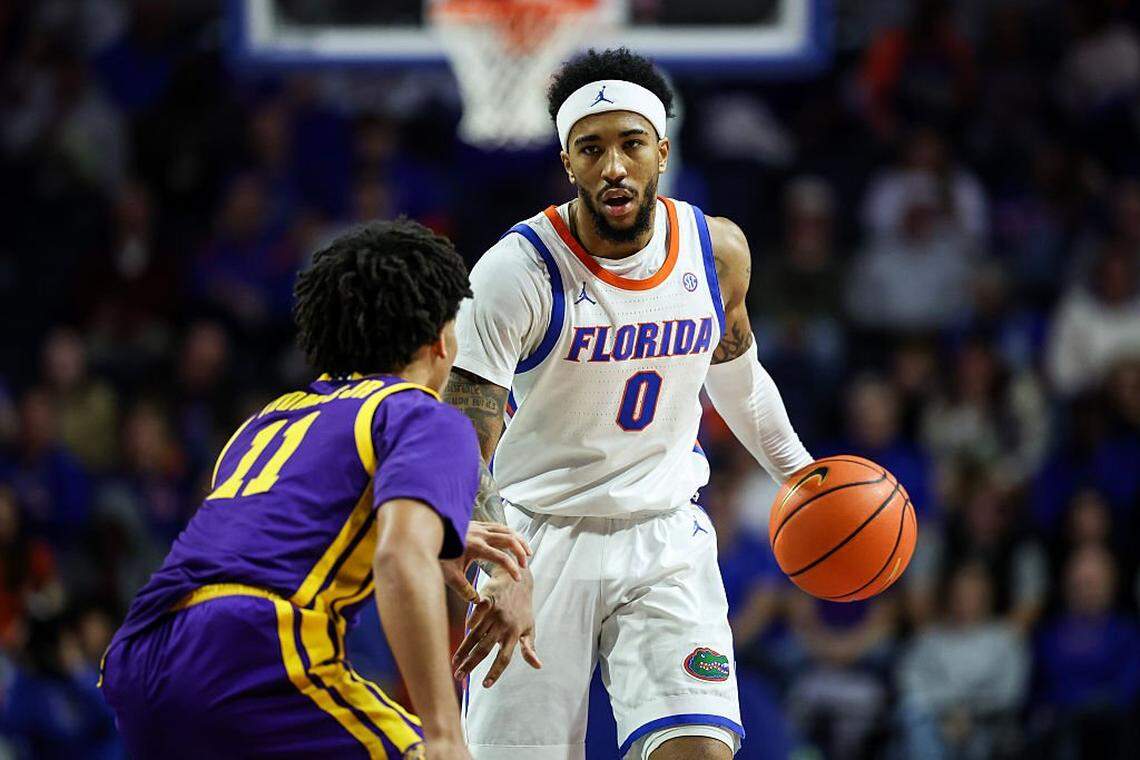
The Razorbacks are on the road Saturday to take a swing at SEC favorite Florida. The Hogs will be clear underdogs, but a win would mark the season’s signature victory.
One of the biggest storylines is Boogie Fland against his old team. It’s not a “revenge game” because there’s not really any bad blood here. I think the storyline would probably be different had Fland not returned for the NCAA Tournament last year. Then the more obnoxious voices among the Razorback faithful could have accused him of quitting on the team, which would cause much harder feelings. But Fland returned and played absolutely elite defense, particularly against St. John’s, whose returning players probably had nightmares of Boogie while going the final 17 minutes without a basket against UConn in their midweek game.
The story has been rehashed, but if you missed it or heard an incorrect version: Arkansas had a commit in Darius Acuff long before there was any question of Boogie’s return, when he was still expected to be a one-and-done. Arkansas engaged with Fland in an attempt to convince him to stay, but both sides knew that wasn’t an ideal arrangement with Acuff and Meleek Thomas coming in. Florida emerged as an obvious fit, and there’s no hard feelings. Most Arkansas fans wish him nothing but the best, except for Saturday.
The other storyline is the SEC title, with Florida leading by two games with three to play. Probably the funniest result of an Arkansas win would be that Florida has to visit Kentucky next week. That would mean that Arkansas fans would be forced to root for Kentucky (since the Gators have to lose one more game), while Kentucky fans would know that their team winning would potentially deliver an SEC title to John Calipari. I really hope that happens just for the resulting banter between the fanbases.
- The real rebuild has now begun for Ryan Silverfield

- Box Score Breakdown: Utah 43, Arkansas 10
- What to watch for against North Alabama

Meet the Gators
This one’s on me: I was a little underwhelmed with Florida’s hiring of Todd Golden a few years ago. I knew that he was an analytics guru who had done well at San Francisco, but he’d really had only one good season and I sort of grouped him in with coaches like Mark Pope (then at BYU) who use analytics to boost their KenPom rating in a way that vastly overstates how good their teams are. I still think that about a lot of coaches (including Pope), but Golden has since demonstrated that, in fact, he’s just a good coach.
Florida always has access to talent, and Golden has done a good job building his last couple of rosters. Everything came together for last year’s team, as veteran guards Alijah Martin and Walter Clayton carried the load as Florida brought home a national title, their first since Billy Donovan went back-to-back in 2006 and 2007.
Golden brought back his frontcourt but had to rebuild the backcourt. He followed the same model as last year: a crafty, high-IQ guard paired with an athletic guard, both able to handle the ball. It’s been a bumpier ride, but things seem to finally be coming together.

In hindsight, those early-season losses to Arizona and Duke don’t look bad at all (different story on the TCU loss and the way-too-close Florida State win), but you can see that Florida’s problem was an offense (orange line) that didn’t figure things out until late December.
In SEC play, the Gators took a bad loss to Missouri and rock-bottom loss to Auburn. Then look how they responded: a season-high 95 grade in a 95-48 win over South Carolina, followed by dominant performances in wins over Alabama (100-77), Texas A&M (86-67), and Georgia (86-66). You want hope? Notice that the Gators have very much come back to Earth since, letting Kentucky and especially Texas stay very close, and hardly dominating Ole Miss and South Carolina.
Ultimately, this chart shows a Florida team that responds incredibly well to losses and adversity, but does have a little bit of a tendency to get complacent. With an SEC title on the line, the Razorbacks probably shouldn’t count on the Gators to be unfocused, but it’s worth noting anyway.

Model pick: Florida 87, Arkansas 80.
Notice that Arkansas’ strength of record is actually higher. I’m really interested to see the final pecking order, because last year, my SOR metric perfectly picked the four 1-seeds (teams 1st-4th in SOR) and the four 2-seeds (teams 5th-8th). As of now, the Hogs would be… a 1-seed? Probably not, but that metric is a testament to good scheduling and some luck: the UCA Bears have had an incredible season and have a legitimate chance to make their first-ever NCAA Tournament out of the A-Sun, while Winthrop (12-3) and Queens (13-4) also have strong records in their conferences. Non-conference wins over Texas Tech and Louisville also look really good, and the Hogs don’t have any truly bad losses.
Personnel
Florida has one of the most balanced and deep rosters in the country. They are strong at every position and no one dominates touches on their offense.

The Gators usually roll with a three-forward lineup where the two guards act as initiators and defenders. Their tremendous frontcourt size is enough to intimidate most teams, while their bigs are athletic enough to still compete in a full-court game.
The frontcourt
There are guys whose names get called more, but understanding Florida starts with understanding their 6’10 center Reuben Chinyelu. He gets 11.1 points per game on decent shooting efficiency, but he’s the highest-graded Gator defender. The big reason for that is that he grabs an astonishing 27% of all available rebounds when he’s on the floor. That’s second-highest among all power conference players, narrowly trailing Arizona’s Tobe Awaka. He’s dominant at both ends, but his 33% defensive rebounding rate (he gets the rebound on 33% of opponent missed shots) edges out Awaka for the power conference lead. While he is a shot-block threat, note in the chart above that his block rate is actually lower than both Trevon Brazile and Malique Ewin, so he’s hardly dominant.
In case you are curious, the second-highest rebound rate in the SEC belongs to Chinyelu’s backup, 7’1 Micah Handlogten. He only gets four points per game and struggles offensively thanks to turnovers and low usage, but like Chinyelu, he absolutely gobbles up rebounds when he’s on the floor.
Since rebounding is taken care of, the Gators like to turn lose their star forwards Thomas Haugh and Alex Condon to be dynamic scorers who win with mismatches. Haugh, a 6’9 junior, paces the team with 16.9 points per game, while Condon, a 6’11 junior, gets 14.3 points per game.
Haugh is the volume scorer. He’s more of a small forward who is perimeter-oriented, so he takes about five 3-pointers per game, hitting them at a 34% clip. His overall shooting efficiency is only decent, but he’s so difficult to defend as a 6’9 guy who can play the wing. He also defends well himself, blocking shots at a good rate because he’s typically so much taller than the man he’s guarding.
Condon is a major guy to watch with three straight 20-point games. He’s an elite passer for a forward, assisting on 15% of Florida’s made buckets while on the floor. Unlike Haugh, he doesn’t really offer a 3-point threat (under 20% on less than two attempts per game), and he can be a bit turnover-prone at 17%.
When the Gators want a smaller, quicker lineup, they’ll bring in 6’6 freshman CJ Ingram or 6’4 sophomore Isaiah Brown to play wing and leave either Haugh or Condon at the 4. Ingram got double-digit minutes in several games in November but has fallen out of the main rotation, playing only sporadically now. His shooting and turnover numbers are both very poor. Brown has taken over as that eighth man who can step in and play the 3 to give Condon or Haugh a breather. He offers a 3-point threat (35%, and about one-third of his attempts are 3-pointers) and doesn’t turn it over, which helps the offense even though he scores just five points per game.
The backcourt
Florida’s backcourt has been messy but things seem to be coming together now. The starting duo are 6’3 sophomore Boogie Fland and 6’4 senior Xavian Lee, a transfer from Princeton. Boogie has been… Boogie. His 3.7% steal rate is elite, which explains why he’s their second-highest-graded defender after Chinyelu. He’s an absolute NBA prospect as a defender, so seeing how Darius Acuff is able to deal with him is going to be fascinating. Offense has been a bit more iffy. He’s shooting a dismal 21% from beyond the arc for the season. Between January 10th and February 21st, a period of six weeks, Boogie was 2 of 26 from beyond the arc. He was a combined 0 of 10 in their two SEC losses, and in fact, his two makes against Duke are the only makes he’s had in a game Florida lost all season. Golden certainly knows that modern analytics say if your point guard and your center are not 3-point threats, your offensive spacing is going to be a mess, so Boogie has continued to shoot just to keep up appearances to the defense. Has he finally turned a corner? He’s 5 of 9 over his last two games. If he starts to hit at just a 35% clip, Florida is a bonafide national title contender.
For Boogie, he’s still helping even when his shot isn’t falling, thanks to elite defense and good passing with a low turnover rate. That has not always been the case for Lee, who is not as good of a defender. Also, Lee is supposed to be the more volume perimeter scorer, but he’s shooting just 28% from beyond the arc, despite more than half of his attempts coming from out there. He’s still a good passer and a solid defender, but 3-point shooting is what everyone is watching.
When either guard needs a break, the other takes over at point guard and the Gators bring on their only real 3-point threat, 6’1 Urban Klavzar. The Slovenian junior is shooting 40% from beyond the arc on five attempts per game (more than 70% of his own field goal attempts). As a catch-and-shoot threat, Klavzar avoids turnovers but contributes very little beyond his shooting.
Lineup analysis
Let’s start with the bad part: this is a horrifying matchup for Arkansas, especially with Karter Knox still hurt. This is the kind of game you lose because you failed to acquire a true paint defender in the offseason. In addition to Fland off the dribble, Florida has two forwards that can shoot and pass inside the arc, plus a space-eating center who can clean up offensive boards and catch lobs when you help. The Gators have been punishing teams in the paint all season, and Arkansas’ defense has been punished in the paint. It’s hard to see a scenario in which the Gators don’t just take what they want inside. Foul trouble also becomes a real possibility with such a thin frontcourt.
I mention Knox because he could at least hold up a bit in guarding Haugh, moreso than most other SEC wings. But with him out, you’ve got Billy Richmond giving nearly four inches, and he’s not as good of an on-ball defender anyway. And that’s before you get to Brazile on Condon and Ewin on Chinyelu. Both can block shots but are better as helpers. If the Hogs are able to avoid foul trouble, they could try a three-forward lineup with Nick Pringle, Ewin, and Brazile playing together. But that will exhaust your front line, risk foul trouble, and takes a key fast-break guy (Richmond) out of the lineup.
Want good news? Florida’s lack of 3-point shooting should allow Arkansas to pack it in under the basket. That’s where the Hogs’ length can be a problem for a Florida team that usually has much more length than their opponent. The Gators are elite at interior passing to set up good shots, but that can lead to more batted balls and turnovers, which have plagued Florida at times this year.
When Arkansas has the rock
Florida’s defense is the strongest the Hogs have faced since the Duke game back on Thanksgiving.

As good as the Gators are defensively, they tend to make it hard on themselves. Notice that they are outside the top-50 nationally in all three “easy points” categories at the bottom. I do think that could potentially bite them against an elite offense. Arkansas does have an elite offense.

Florida wants to funnel everything inside the arc so their bigs can contest it in the paint. They allow a very low rate of 3-point attempts (25th). The flip side? They rank 306th in opponent paint usage. The Hogs will get good shots around the rim, so we’ll see plenty of the nation’s 7th-ranked paint shooting offense against the nation’s 5th-ranked paint shooting defense. The Gators block and alter shots at one of the highest rates in the country.
Shot volume is another story. The Gators are elite on the defensive glass, as you might expect, but they don’t really force turnovers. (That’s a potential issue, as no national champion since 2008 has had a negative turnover margin for the season, as Florida presently does.)
So the Hogs should be able to put up a good volume of shots, largely in the paint, and may can also draw some fouls. The Gators have also shown vulnerabilities to guards or wings who can put the ball on the floor and drive to the rim, as Auburn’s Keyshawn Hall did in the Tigers’ upset win in Gainesville, and as Arkansas is very good at.
That’s a good starting point. It’s all going to come down to how well Arkansas plays in the paint. If they finish well, draw fouls, and compete on the offensive glass, they have a good chance to win. If they do none of those things, they’re going to be in big trouble. I think this needs to be a legacy game for Malique Ewin. As Florida focuses on containing Acuff, Ewin is going to get some one-on-one opportunities with very good individual defenders. If he can win at a good rate, Florida will be in a bind.
When Florida has the rock
After a rough start to the year, Florida’s offense is now very strong.

Florida is particularly dangerous in transition because they have a 6’9 and a 6’11 guy who are comfortable running the floor. That’s rare and very hard to defend. If the Hogs want to run with the Gators, they’ll have to be competitive in defending those transition opportunities.

Florida does three things well, and they are all related: they get into the paint (38th), they finish well in the paint (23rd), and they get offensive rebounds (2nd). That’s a pretty devastating 1-2-3 punch. Unfortunately, that’s also exactly what Arkansas is weak against. The Hogs are going to have to be out-of-character good in the paint to keep Florida from scoring a ton of points here.
And again, the good news is that the Gators are atrocious 3-point shooting team, so unless somebody gets hot, the Hogs can be aggressive inside the arc with helping on those tough forwards. Still, this is going to be a tall order for a Razorback defense that has struggled with teams that can pound the paint all year long.
Keys to the game
Dominate the turnover margin. I think Arkansas has to go at least +5 here, maybe more. The Hogs need nearly no turnovers, and I think getting stops will depend on forcing a few against a Gator team has had issues at times turning it over.
Dominate the 3-point line. There’s not a lot the Hogs can do if Fland, Lee, Klavzar, or Haugh just gets hot from beyond the arc. Klavzar and Lee must be aggressively defended, and the Hogs need to hope that everyone else just misses when they do shoot. For the Hogs, they can win without a high volume of 3-point makes, but an efficient percentage is necessary, given that things inside the arc will likely be less efficient.
Avoid cheap fouls. Florida doesn’t draw just a ton of fouls, but they are going to pound the Hogs in the paint, which risks foul trouble for a thin frontcourt. All Hog forwards have to be smart and not foul unnecessarily.
Legacy game for someone. The Hogs might can have a chance if Acuff goes off for 40-plus again, but my guess is that any chance of an upset is going to depend on someone else having the best game of their career. My money would be on Ewin, but my sleeper pick is Meleek Thomas, who is going to have a shorter, non-elite defender on him. If he can put together a lottery pick performance by dominating Lee at both ends, I think the Hogs might have a fighting chance.
Thanks for reading! Be sure to follow us on X and Facebook for the latest posts.
The latest from Fayette Villains, straight to your inbox
Enter your email to subscribe and receive new post alerts and other updates. You can unsubscribe at any time.