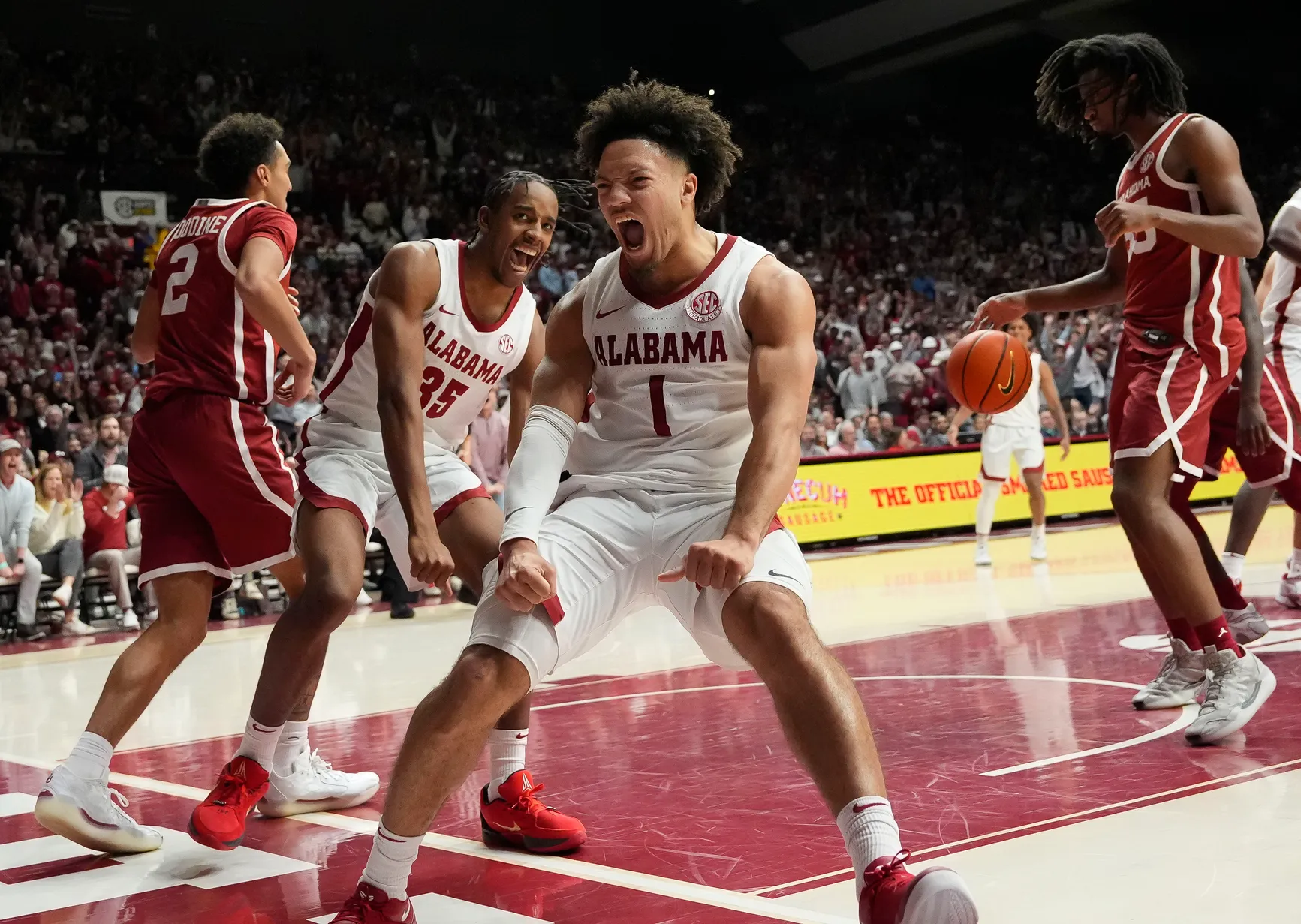
Arkansas is on the road Wednesday for a game that could be critical for SEC Tournament seeding.
Arkansas sits alone in second place at 9-3 in the SEC, but a four-team logjam of 8-4 teams sits immediately below them. One of those teams is Kentucky, who owns a tiebreaker over Arkansas. Two others are Tennessee and Vanderbilt, where Arkansas owns the tiebreaker. And the fourth team is Alabama.
Alabama has one of the easiest remaining schedules among SEC frontrunners, so they have a very good chance to end up stealing the 2-seed with a win over Arkansas.
- The real rebuild has now begun for Ryan Silverfield

- Box Score Breakdown: Utah 43, Arkansas 10
- What to watch for against North Alabama

Meet the Tide
Nate Oats loves to challenge his team, so he arranged an absolute murder’s row of non-conference games for the Tide this year. They beat Illinois, Clemson, and Saint John’s, but lost to Purdue, Gonzaga, and Arizona. Not bad.

Conference play has been messy, but a 100-97 win over Texas A&M seemed to help right the ship. Alabama has now won four straight.

Model pick: Arkansas 92, Alabama 92. If you like scoring and fast-paced basketball, I’d recommend watching this one.
Personnel
Alabama’s roster has undergone some changes this year. The Tide have suffered from injuries and poor play in the frontcourt, which played a role in their decision to add G League veteran Charles Bediako to the roster. Bediako played in five games before a real judge restored sanity and declared him ineligible. Bediako did not play enough minutes to crack the top-nine on the Tide roster in terms of playing time, so he’s not in this table.

The dangerous backcourt trio
Much of Alabama’s production comes from its backcourt trio of Labaron Philon, Aden Holloway, and Latrell Wrightsell Jr. Nate Oats’ offensive strategy is built around having his ballhandlers drive to the paint and his forwards shoot 3-pointers in order to create maximum mismatches, so while Philon and Holloway are willing shooters, they are serious threats off the dribble as well.
Philon, a 6’4 sophomore point guard, paces the team with 21.3 points per game. He shoots 40% from beyond the arc and averages a team-high 4.9 assists per game with a low turnover rate. However, as with Darius Acuff for the Hogs, everything runs through him when he’s on the court, for better or for worse, so everyone else becomes an offensive role player. He’s also a very poor defender who struggles to stay in front of his man.
Holloway is the actual team MVP, per our advanced stats. The 6’1 junior who originally transferred from Auburn is shooting 44% from beyond the arc on high volume. He helps spacing a lot with his shooting range, and he dishes out 3.9 assists per game as the secondary ballhandler. Like Philon, he’s not a great defender.
Wrightsell is more of a catch-and-shoot specialist who is less of a driving threat. He hits 36% from beyond the arc on extreme volume (7.8 attempts per game, or about 77% of his shots) but outside of his 2.1 assists per game, he does little else. He often comes off the bench but has made 11 starts this season. He is also a very poor defender.
These three guards’ inability to stay in front of their man could play a significant role in this game.
The splashy small forwards
Analytics say your wings need to be major 3-point threats or else your spacing will suffer, and Oats is an analytics guy. Alabama has four players that our model categorizes as small forwards, and all four of them take more than half their shots from beyond the arc.
The main two that you need to be aware of are 6’8 freshman Amari Allen and 6’5 senior Houston Mallette. Allen usually gets the start and he averages 11.5 points and 7.5 rebounds per game. He’s not a particularly high-volume 3-point shooter (36% on about four attempts per game), but his rebounding and defense are essential for a team that has struggled with both. When he leaves, in comes Mallette, the one-time Pepperdine transfer who pretty much only shoots 3-pointers. He hits 34% of them, but his 5.1 attempts per game (88% of his total shots) have significant analytical value, hence Mallette’s awesome plus-minus numbers despite being statistically worse than Allen.
The thin frontcourt
You’ll understand why Alabama was desperate to add Bediako once you meet the Tide frontcourt. The two starters – 6’10 sophomore Aiden Sherrell and 6’8 freshman London Jemison – aren’t bad, but they’ve been hit-or-miss against good teams, and the depth is very little.
Sherrell (10.5 points, 5.7 rebounds per game) is fairly productive. He blocks shots and crashes the offensive glass, although he is not a great rebounder for his size and can be moved out of position on defense too often. Jemison (6.1 points) has been seeing more minutes recently and is a very flexible defender, although he’s not overly productive. He shoots 35% from beyond the arc but isn’t a great finisher inside. If the Tide could get 40 minutes out of each of those guys, Oats would probably be happy. But he can’t.
So he has to give minutes to these other guys. First up is 6’8 Florida State transfer Taylor Bol Bowen, who played with Malique Ewin last year. He shoots just 30% from beyond the arc and doesn’t do a whole lot inside of it, which is pretty limiting to Alabama’s offense. And his defense is not particularly impressive either. He’s been the main starter at the 4 but has an injured leg and didn’t play against South Carolina, allowing Jemison to get the start. It’s not clear whether he’ll be ready to go on Wednesday.
Oats already knows what’s going on: “We need some length and athleticism in this game.”
However, the rest of the length has been 7-foot Bucknell transfer Noah Williamson. He’s somehow shooting 28% from the field (I honestly do not know how a center does that), including 2 of 20 from beyond the arc. Alabama expected him to be an actual contributor this year, but he has not made a field goal since the January 10th game against Texas.
Against more guard-oriented teams, the Tide have been able to roll with Sherrell at center and one of the other forwards when Sherrell needs a breather, but that’s not going to fly against bigger teams. Here are some points in the paint numbers against the Tide in their worst losses: Florida 72 (!!!), Gonzaga 52, Arizona 44. Tennessee forward Nate Ament scored 29 points in a win in Tuscaloosa. All four of those teams are long and athletic and cannot be defended with a 6’8 center for long.
Lineup analysis
Also long and athletic and unable to be defended by a 6’8 center for long: Arkansas. Given how Alabama has managed previous games, Oats probably isn’t going to throw Williamson out there for extended minutes and let him struggle. Instead, he’s going to play small with an offense-optimized lineup and try to simply outscore the Hogs.
Guards that cannot stay in front of their man combined with thin frontcourt depth is a recipe for disaster against this Arkansas team. The Razorbacks should be able to punish Alabama in several different ways. It probably just starts with Acuff off the dribble. He could go for 30 easily. It also stands to reason that this could be the best game of Ewin’s career, as he’s going to have plenty of opportunities against defenders that are either smaller, exhausted, poor on defense, or hoping to stay out of foul trouble. And Trevon Brazile will also have plenty of chances, especially if Bol Bowen is out or limited.
Arkansas has a thin frontcourt of its own, with the latest news being that both Karter Knox and Isaiah Sealy will miss this game. Knox clearly reinjured himself against Auburn. That leaves Arkansas with two players (Billy Richmond III, Brazile) for two positions (wing, power forward). The Hogs could try to steal a few possessions with some Pringle-Ewin lineups, though that’s not a great matchup against Alabama, but you’ll probably see some more three-guard looks with DJ Wagner coming in. Acuff, Meleek Thomas, and Richmond could all end up playing the full 40 minutes.
When Arkansas has the rock
Both offenses will have major advantages for this game.

Oats-coached teams of the past have been able to slow opponents down slightly, allowing Alabama to play smooth and free while the opponent was often frustrated with the pace. But that hasn’t happened this year, as Alabama is 200th in fast break scoring allowed and 257th in transition rate allowed. Arkansas loves to run, so expect the Hogs to push the pace as often as possible. The average possession against Alabama lasts just 16.6 seconds, so this will probably be the fastest-pace game Arkansas plays this year.
The biggest matchup is right there at the bottom: Arkansas is 7th in paint scoring rate, Alabama is 300th in paint scoring rate allowed. Arkansas will probably need close to 50 points in the paint to win this game. That’s a huge number, but it’s extremely doable against this defense and at this expected pace.

This is a very friendly table for the Hogs. Alabama allows 54% of shots against them to come in the paint (308th), which is not what a defense wants to allow against a Razorback offense that shoots 63% on paint FGAs (5th). The Tide also absolutely do not force turnovers (363rd out of 366 Division I teams). They also do not rebound well (223rd) and foul too often (200th). Alabama’s low assist rate allowed (48th) highlights their general vulnerability to driving guards: Arkansas has mostly scored at will against teams with that defensive profile this year (Vanderbilt, Oklahoma, LSU).
The big watchout? The Tide actually do defend shots well. Their 66th ranking in paint FG% defense is thanks to the fact that they have some athletic shot-blockers who can contest well. Their problem is that they are often out of position, a problem shared by both guards and forwards, which is why they allow so many shots. So there is a slight concern here that Alabama ends up swatting a lot of shots around the rim and Arkansas gets there, but doesn’t finish in the paint. I’ve said it before but it bears repeating: Arkansas has to absolutely destroy the Tide in the paint or they do not have a great chance to win this game, given that it’s on the road and you have to expect Alabama to shoot well.
When Alabama has the rock

The Tide atone for their defensive woes on the offensive end, pushing the pace to extremes. They can overwhelm most opponents with pure athleticism, and their transition 3-point shooting is probably the most dangerous part of their offense. Arkansas has struggled to prevent teams from getting in transition (231st), so they’ll have to really focus on getting back.

No one in the country shoots more 3-pointers than Alabama, who will have five willing shooters on the floor at all times. They shoot 36% as a team and are pretty consistent game-to-game. Past teams have been better than this one at getting into the paint, so the Tide have to attempt even more 3-pointers. The Tide don’t turn it over at all but they aren’t great at crashing the offensive glass.
The biggest defensive key is disciplined switching. Philon and Holloway are pull-up threats, so going “under” a screen set for them is risky, but they are also both driving threats, so going “over” is probably an even worse idea, even though Arkansas has contested really well in the paint the last couple of games. Good defensive communication is key to switching, which can prevent open 3-point looks.
Keys to the game
Handle screens and close out shooters. The Hogs have played decent perimeter defense all year. They allow a few too many looks, but at least they close out well. If the Tide get hot, this could be trouble, but if they just shoot around their season average, that might be enough for the Hogs to outscore them.
Relentless attacking in the paint. Arkansas has amped up its paint offense in recent games, albeit against weaker competition. However, Alabama’s interior defense is very weak. The Hogs need to get their guards downhill, have Brazile and Richmond crash, and find Ewin when he’s isolated inside.
Thanks for reading! Be sure to follow us on X and Facebook for the latest posts.
The latest from Fayette Villains, straight to your inbox
Enter your email to subscribe and receive new post alerts and other updates. You can unsubscribe at any time.