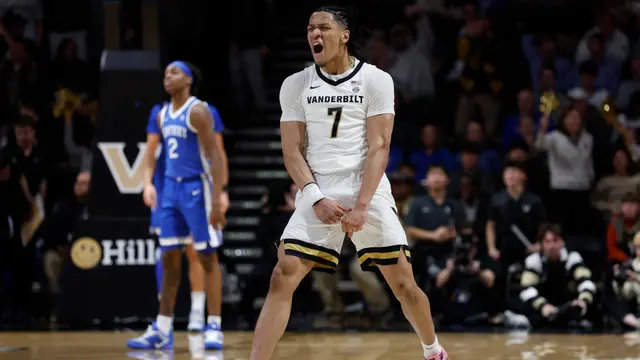
It’s here. Kentucky fans circled this game last year, and now Arkansas fans have circled it this year. The annual John Calipari Bowl sits once again in primetime.
I don’t want to jinx anything or be a Debbie Downer, but man, the setup seems almost identical to last year, except with the teams reversed. Last year, the injured and underachieving Razorbacks limped into Rupp Arena to face a hostile crowd, but put together their best performance of the season in a monster upset win. Now Kentucky, injured and underachieving, limps into Bud Walton Arena as underdogs to face what figures to be a hostile crowd.
The difference? One team has a Hall of Fame coach, and the other doesn’t. We’ll see how much of a difference it makes on Saturday.
- The real rebuild has now begun for Ryan Silverfield

- Box Score Breakdown: Utah 43, Arkansas 10
- What to watch for against North Alabama

Meet the Wildcats
Kentucky fans have been on a roller coaster over the past two years. After Calipari’s 3-seed Cats were upset by Oakland in the first round of the 2024 NCAA Tournament, fans were ready to move on, but most probably didn’t think it would happen. Instead, Cal gave them a gift, willingly walking away from his massive buyout and letting Kentucky start fresh.
That fresh start led to two huge swings and misses in the coaching search: UConn’s Dan Hurley and Baylor’s Scott Drew. (The Cats were rumored to target Alabama’s Nate Oats as well.) By the time the search settled on BYU’s Mark Pope, fans were apoplectic. But as fans usually do, they bought in. Pope, a key player on the 1996 national title team, allowed Kentucky fans to rehabilitate the Rick Pitino era that had been inaccessible to them due to Pitino’s long stint at rival Louisville.
Initially, Pope turned the excitement into winning. He positioned himself as the opposite of Calipari, replacing a pro-development scheme and roster construction with a win-now college-style system. His transfer class wasn’t loaded with guys with raw NBA tools; instead, it featured high-IQ players who could stretch the floor and shoot 3-pointers. It seemingly lacked high-end talent, but the pieces all worked together, and Kentucky had a good season.
Shaka Smart Syndrome
Unfortunately, Pope quickly ran into the biggest pitfall of all small-school coaches who make the jump to a major program: Shaka Smart Syndrome. It’s name for Smart, who as coach of VCU had success with a fun scheme he developed known as “Havoc”. It featured undersized-but-quick guards who executed a full court press defense.
His success got him the Texas job, but once there, he was faced with a difficult choice. He could continue to run his Havoc system, but that would require passing up on a lot of the 4- and 5-star recruits that Texas was able to recruit, since those guys would not be good fits. But it’s easy to get stars in your eyes for those potential NBA prospects. Basically, should he recruit to his scheme, or scheme to his recruits? Smart, of course, chose the latter, and he chose wrong. His Texas teams were always loaded with talent but lacked an identity. After a few choppy years, he voluntarily jumped ship for Marquette.
Pope may have fallen right into the same trap. His first Kentucky team had the same problems that his BYU teams did, problems that would probably keep them from winning a championship. As good as they were at ball movement and 3-point shooting, they struggled to win 1-on-1 physical battles, which meant they struggled to defend and create shots against tight defense. Watching Adou Thiero dominate in Rupp Arena might have been a contributing factor to Pope altering his strategy.
So last offseason, the Wildcats targeted players whose skillsets would not have made them targets at BYU. Rather, many of the offseason additions were primarily long defenders aimed at shoring up Kentucky’s isolation defense and preventing opponents from pounding the paint. The tradeoff? Many of them are not great shooters, and the scorers are often not active without the ball. The result has been modest improvement on defense that has been offset by a large decline in the quality of Kentucky’s offense.
An excellent article at Basketball Under Review compared Pope’s 2026 Wildcat roster decisions to… Calipari’s Arkansas roster last season. Here’s what the author said about Arkansas last year:
Because of a fundamental flaw in the Arkansas roster when John Calipari was constructing it – your starting PG and center could defend but couldn’t shoot, the backup PG and center could shoot but couldn’t defend – Arkansas’s offense suffered all season long, finished 64th nationally despite having (at worst) top-20 talent.
The author contrasts this with Kentucky’s roster last year, arguing that it was “more than the sum of its parts” because everything worked together well. But of this season, just eight games into the year, he said this of the 2025-26 Wildcats:
The first warning sign for 2025-26, I guess, was an obvious one: a coach defined by great shooting and mediocre defense in his career had a roster with, on paper, great defense and mediocre shooting.
***
What we have here is a roster that is less than the sum of its parts, because its best parts do not fit together and the most optimal lineups possible can’t be the best lineups. It’s talent over fit in a stunning rebuke of what worked so well for Kentucky last year.
I highly recommend reading the full article, but we’ll back up some of its specific points with numbers below.
Anyway, here’s how the season has unfolded in Lexington.

For all the money Kentucky spent on this roster, the results have been very disappointing. They ran up lopsided scores in buy games but their first two real tests (Louisville, Michigan State) saw them fall behind by 20 points and lose each time. They’ve taken wire-to-wire blowout losses against Gonzaga, Alabama, and Vanderbilt as well, plus close losses to North Carolina and Missouri, both at Rupp Arena.
A difficult schedule and no bad losses means this is still a tournament team right now, but not one likely to make much noise. And as bad as the narrative surrounding this team is right now, they are still very talented. At full health, they beat Indiana and St. John’s. Even at partial health, they won five straight SEC games.

Pope teams tend to run up big numbers on bad opponents, which boosts their metrics. However, they’ve been hurt by getting dominated in several key games. Their Game Control is especially bad due to their tendency to fall behind early in games (in addition to blowout losses, they erased large deficits to beat LSU and Tennessee).
Model pick: Arkansas 89, Kentucky 83. There is obviously a chance that this turns into a blowout due to the inconsistent effort of the Wildcats, but I sort of expect a competitive game.
Personnel
The article linked above makes the case that even fully healthy, the pieces of Kentucky’s roster were likely never to come together. But the Cats have not been fully healthy at all. Two of their top portal signees are not in the table below, because they aren’t top-nine on the team in total minutes this season. And the best player that you see in the table below is injured and probably out for the season.

The clubhouse leader is plainly 6’4 senior wing Otega Oweh, a returning starter who was considered a preseason candidate for SEC Player of the Year. Despite his team-leading 16.4 points per game, he makes Kentucky significantly worse at both ends when he’s on the floor. Offensively, he shoots just 29% from beyond the arc on fairly low volume, which is not great for a wing in this kind of offense. He gives Pope what he wanted more of this year: the ability to bull his way into a few tough baskets per game, but it’s not helping them win. Defensively, he’s very good, particularly at generating steals. His advanced metrics are not great, although it’s notable that he’s been much better in conference play, while several of his teammates have fallen off badly.
Backcourt: No point guard
The backcourt trio consists of 6’5 senior Denzel Aberdeen, 6’5 sophomore Collin Chandler, and 6’5 freshman Jasper Johnson, with Aberdeen and Chandler as the normal starters. This is another issue, as Aberdeen is not a particularly good point guard, but expected starter Jaland Lowe is out for the season after appearing in only a few games. Aberdeen is a good defender and he shoots 38% from beyond the arc on moderate volume, but he lacks the vision and passing skills of Lowe. Chandler is the 3-point specialist and a more traditional Pope player, shooting 39% on 4.4 attempts per game. He’s also a decent defender. His main weakness is that he has to be set up for shots, and that doesn’t always happen in Kentucky’s offense. Off the bench, Johnson shoots 38% from 3 (most of his attempts are 3-pointers), but he’s not nearly as good a defender as his teammates.
So what’s the problem in the backcourt? The linked article above details problems with Lowe’s game that aren’t relevant for Saturday, but Aberdeen and Johnson as your point guards is bad, because both are really shooting guards. Neither is particularly efficient at pull-up jumpers that point guards need to be able to hit. Playing them together helps them set each other up, but that requires removing your best actual shooter (Chandler), so there’s no possible combo of these three that consistently works.
Frontcourt: Defense, but no shooting
The big news is the frontcourt is that Jayden Quaintance, who has already missed a lot of basketball, is “completely shut down from all on-court activities.” Quaintance is an elite defensive center who is still a work in progress on offense. Even with him, he offers very little shooting threat, but his defense is missed.
In his stead, the main starters are 7-foot freshman Malachi Moreno and 6’7 junior Mouhamed Dioubate. Both offer solid interior defense and offensive rebounding ability. The problem? Neither are shooters. Dioubate is 2 of 17 on the year, while Moreno is 0 of 2. As you can imagine, that’s a problem, because Kentucky is rolling with two non-shooters in the frontcourt in an offense that requires spacing you out and presenting 3-point threats. It just doesn’t work.
That’s why Kentucky’s actual best player this year has been 6’8 forward Kam Williams, because he’s shooting 35% on 3.6 attempts per game from downtown, thereby creating the spacing the Wildcat offense needed. However… he’s also hurt. He won’t play against the Hogs and may not play again this year as he battles lingering injuries.
That means that Moreno’s backup at center is 6’10 junior Brandon Garrison, who has had a nightmare season after playing a lot last year. Garrison was the expected starter but made just five starts before Moreno took the job. Garrison does nothing well: he offers no 3-point threat on offense and is a shockingly-bad rebounder for his size. You’ll also see 6’11 freshman Adrija Jelavic, who at least offers the threat of 3-point shooting. However, his 2.4 attempts per game are only falling at a rate of 27%, and he’s not a good defender.
The final name to watch is 6’5 sophomore Trent Noah, who will likely see increased minutes with no one to back up Oweh. Noah is a 3-point shooter, hitting 38% on the year, but his lack of size and athleticism is a problem for him, hence his low minutes this year.
Does Kentucky have any advantages?
I would say that Quaintance is Kentucky’s most talented player, Lowe its most essential player, and Williams its best player (from an overall contribution standpoint). None of those three will play against Arkansas. The Hogs have been there, so we can be a little bit merciful.
As for the remaining roster, what does Kentucky do well? First, the Cats have solid 3-point threats at both guard spots. Unfortunately for them, they have no one to set those shots up, and they will have two non-shooters in the frontcourt. However, if the Hogs struggle to defend screens or blow assignments, they are capable of hitting some shots.
Second, they have tremendous length and athleticism across their whole roster. Aberdeen, Oweh, and Dioubate in particular are long and switchable defenders who can swat passes, recover, and close out on shooters. They aren’t an elite turnover-forcing team, but they individually get a lot of live-ball steals, which can create fast breaks. Their athleticism also makes them extremely dangerous in transition. If Arkansas does not get back after defensive rebounds or steals, they are at high risk of allowing easy buckets the other way.
That’s really about it. The Wildcat halfcourt offense is a wreck with a bunch of pieces that don’t fit. They will likely struggle to space the Hog defenders out and create open looks. There have also been signs of inconsistent effort in recent weeks. Because of that, this game could turn into a blowout, although I’m not counting on it.
When Arkansas has the rock

Kentucky’s length and switchability means they will make you take your time on offense. They limit transition chances and generally defend the paint well. Their halfcourt defense has been iffy at times.
Arkansas has had issues in games where opponents were able to take away the fast breaks, namely Oklahoma, although the offense was much better than the defense in that one.

Kentucky’s first-shot defense is solid. They defend the perimeter well by closing out, and their length guards the paint well. Opponents end up taking a lot of contested 3-pointers against them. Their main weakness is shot volume. They don’t force a ton of turnovers, and their rebounding is mediocre. Arkansas should be able to protect the basketball and get a high volume of shot attempts.
It is notable that ball movement is an antidote to beat Kentucky. The Wildcats allow assists on 58% of made field goals against them (307th), which means that they are better against isolation offenses and worse against space-and-pass offenses. That’s a significant reversal from what we’ve seen this season, with defenses like Vanderbilt and Oklahoma generally allowing low assist rates but showing vulnerability to driving guards in isolation. This just means that Kentucky’s isolation defense is strong, or at least, that opponents don’t test it all that much. Guys like Darius Acuff and Meleek Thomas are going to be tested if they try to take on long, athletic defenders like Aberdeen and Oweh in 1-on-1 situations. Kickouts, reversals, and pick-and-rolls have a much higher success rate against this defense.
When Kentucky has the rock

Kentucky wants to run. The Cats have to run. Kentucky ranks third in the nation in fast break scoring rate, 23rd in transition percentage, and 10th in total transition scoring. Arkansas has shown vulnerability to offenses that try to push the tempo, so that’s a huge risk here. As you can see from the bottom-right of the chart, Kentucky is heavily dependent on getting easy points, namely fast breaks and layups.
If the Hogs can mostly limit the Cats to halfcourt sets, they rank just 144th in efficiency. And even that number is inflated by the blowouts they had back in November and December. Against Vanderbilt, for example, they had just 32 halfcourt points in 54 halfcourt possessions for a ghastly 59.1 efficiency.

Kentucky avoids turnovers and gets assists on a high percentage of its baskets. As Nate Oats candidly noted after the Alabama-Kentucky game earlier this month, the Wildcats ran up their assist rate against bad teams and generally struggle to generate assists against better defenses.
While the Wildcats finish well in the paint (53rd), they are a poor jump shooting team, ranking just 185th in 3-point percentage. The Hogs will want to compete on the offensive glass and keep them out of the paint as much as possible.
Keys to the game
Get back on defense. It’s no secret that Arkansas’ transition defense is poor. Kentucky absolutely has to dominate transition in order to have a chance. The Hogs must force the Wildcats into halfcourt as often as possible.
Get good ball movement. Kentucky’s defense features strong individual defenders, so attacking with screens and passes is essential for creating openings. The Hogs need both Acuff and Thomas to be sharp, while Brazile and Knox hitting corner 3s could play a big factor as well.
The latest from Fayette Villains, straight to your inbox
Enter your email to subscribe and receive new post alerts and other updates. You can unsubscribe at any time.