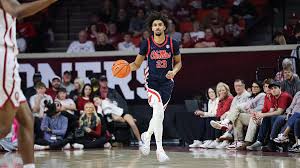
After a monster win over Tennessee, Arkansas starts a two-game road trip with a visit to Oxford for a midweek tilt on Wednesday.
At a minimum, the Hogs need to split these two road games, with Auburn on Saturday. Then beat South Carolina at home next week and split the two ranked games after that (at Georgia, Vanderbilt), and Arkansas is looking at a 4-2 SEC start with a long stretch of unranked opponents coming up. At that rate, the Hogs could easily be 10-2 in conference play by the time they head to Tuscaloosa.
But it all starts with this one, because it’s hard to see 10-2 if the Hogs can’t get a win over six-loss Ole Miss.
If you haven’t yet, be sure to check out the site’s new Basketball Homepage. It has a link to the advanced stats glossary plus interactive charts connected to the same data I use to write these articles.
- The real rebuild has now begun for Ryan Silverfield

- Box Score Breakdown: Utah 43, Arkansas 10
- What to watch for against North Alabama

Meet the Rebels
Chris Beard has long been a well-known name in Arkansas. A Texas alum who spent a decade at Texas Tech under Bob Knight (and his son, Pat), Beard developed the now-common No Middle defense while coaching at lower levels of college basketball. His breakthrough came in the 2015-16 season at Little Rock, where he led the Trojans to 30 wins and an upset of Purdue in the NCAA Tournament. His work there got him the Texas Tech job, where his Red Raiders were NCAA Runners-Up in 2019. That March run delayed an attempt by Razorback boosters to try to hire him after Mike Anderson’s firing.
He controversially left for Texas after falling to Arkansas in the 2021 Round of 32, but was fired in his second season over a domestic violence arrest. Through two seasons at Ole Miss, he quickly rebuild the Rebel program, turning down overtures from Arkansas after his first season. The Rebels reached the Sweet Sixteen last year for the second time ever (and first since 2001).
Unfortunately for Beard, his moves to make Ole Miss into a basketball power have stalled, at least for now. This was always going to be a rebuilding year, as Ole Miss lost top three scorers Sean Pedulla, Jaemyn Brakefield, and Matthew Murrell from last year’s team, but things have been rough in Oxford so far this year.

Ole Miss is now 0-6 against power conference foes. Their best win is a six-point home victory over 101st-ranked Memphis. That said, the losses have generally been close, and they don’t have any truly awful losses.

Model pick: Arkansas 82, Ole Miss 76. Even on the road, the Hogs should win this one.
Personnel
Beard raised some eyebrows in the offseason when he spent lots of time talking about Kentucky transfer Travis Perry was a major key to Ole Miss’s success this season.
If you are racking your brain wondering who that is, that’s the kid from a tiny high school in rural Kentucky who scored a ton of points in high school but mostly rode the bench for the Wildcats last year, averaging two points per game. Kentucky fans mostly laughed at the idea that Perry would be a major factor for Ole Miss.
No one’s laughing now. Seriously. Kentucky fans aren’t laughing at much of anything, as running off scrappy players that fit Mark Pope’s system in order to load up on athletic guys who can’t shoot is the reason Kentucky is struggling right now. But Ole Miss fans aren’t exactly laughing either, as Perry is averaging just 4.9 points per game and shooting 31% from beyond the arc. That might have been normal offseason bluster from Beard, but if he legitimately thought that Travis Perry was the key to his offense, the Rebels ranking just 130th in Offensive Efficiency suddenly makes a lot of sense.

The key guy to watch for Ole Miss is true freshman guard Patton Pinkins, a 6’5 former four-star recruit. He’s been Ole Miss’s best player by Adjusted Plus Minus for a while now, but only in the SEC opener did Beard finally make him the focal point of the offense. He scored a season-high 25 points in a season-high 30 minutes of an 86-70 loss to Oklahoma.
Pinkins is what Beard wanted Perry to be – a true shooting guard – which is probably why Perry played just four minutes against Oklahoma. Pinkins is shooting 49% from beyond the arc while maintaining a microscopic turnover rate of just 1%. He’s shooting a good percentage inside the arc as well. He will have to be the priority of the Arkansas defense, mostly because the Rebels don’t have much else offensively.
Backcourt: The French connection
I would expect Pinkins to get an expanded role moving forward, but if he keeps coming off the bench, the Ole Miss starting backcourt consists of a pair of Frenchmen, 6’4 Ilias Kamardine and 6’1 Kezza Giffa, a transfer from High Point. Kamardine is the primary ballhandler and is Ole Miss’s second-worst regular player by APM, despite leading the team in minutes. Offensively, he’s not awful, shooting a decent 35% from beyond the arc and 55% true shooting, while pacing the team with 4.1 assists per game. His 19% turnover rate is a bit high, however. His bigger issue is on defense: he’ll get a few steals here and there, but his On-Off team defensive rating is the second-worst among the five starters.
Giffa, meanwhile, struggles on offense despite an excellent 58% eFG% and 66% true shooting. He’s an exceptionally poor rebounder – even for his height – and his 15% turnover rate is high for a shooting guard who doesn’t get a lot of assists.
Wing: If you can’t say something nice…
Starting on the wing is an old friend, AJ Storr, formerly of Kansas, formerly of Wisconsin, and formerly of St. John’s. Storr was fantastic in 2024 at Wisconsin, making him a prized transfer, but he was awful with the Jayhawks last season. However, his best game came in the NCAA Tournament loss to the Hogs, when he had 15 points.
Storr’s back to his old tricks, ranking as Ole Miss’s worst player by an enormous margin. Offensively, he loves his midrange jumper. It rarely goes in, but as at Kansas, that has not stopped him from shooting it. His 27% usage rate is the second-highest on the team (for comparison, that’s equal to Meleek Thomas), but he absolutely sucks Ole Miss possessions into the void with inefficient shots and poor ball movement. Pinkins getting extra minutes didn’t cut into Storr’s at all: it was another day in the office for Storr against Oklahoma, as he connected on 3 of 14 field goal attempts for eight points.
Storr doesn’t still play because of his defense, either: he grades as Ole Miss’s worst defender. He’s a below-average rebounder, has the worst steal rate of Ole Miss’s five starters, and his stock-to-foul ratio of 0.2 is the worst on the entire team (meaning that if he tries to block a shot or get a steal, he’s five times more likely to be whistled for a foul than to succeed). Ole Miss has a 105.6 defensive efficiency when he’s on the floor, compared to 88.2 when he’s off, meaning that Ole Miss’s best team defensive lineup this season is “any lineup that doesn’t include AJ Storr”.
So… why does he still play? We’ll tackle that below once we meet the lineup, but the short answer is that they can’t play three-forward lineups due to a lack of depth, and three-guard lineups are going to be too small against most opponents. So Storr is often spelled by 6’8 Augusto Cassia, who barely played at Butler last year. Cassia is significantly better on defense but offers nothing offensively. More notably, Cassia is more of a power forward who backs up Dia, and Ole Miss has to play with a smaller lineup if Storr is out.
Frontcourt: Good defenders, but no depth
Ole Miss’s most reliable overall player is its only returning starter, 6’9 senior Malik Dia, who paces the team with 14.9 points and 7.0 rebounds per game. He’s an inefficient scorer (just 47% eFG%), but he’s a very good rebounder at both ends and his defensive length and versatility is the engine that makes a pretty good Ole Miss defense work. He’s not a super shot-blocker, but his length and athleticism allow him to rotate into the lane of driving guards, which is an essential element of the No Middle defense. The scheme aims to take away guards from attacking off the dribble, so Arkansas’ iso-heavy offense has to be careful (more on that in the stats below), especially when Dia is in the game.
Dia is mostly a 4, but he will play the 5 some. The main centers are 6’10 James Scott and 6’8 Corey Chest. Scott, a Louisville transfer, is an efficient scorer (66% true shooting on low usage) and a monster on the offensive glass. He’s not a great defender, however. Chest, an LSU transfer, is an even better rebounder, but he’s less of a scorer. Chest is a more athletic defender, which is key in the No Middle. So Scott gives them a slight offensive boost while hurting the defense, while Chest gives the opposite.
Why can’t the Rebels replace Storr?
Storr’s 330 minutes ranks third on the team behind Kamardine and Dia, and the Rebels haven’t committed to any lineups that don’t have Storr in them, despite the fact that he’s plainly their worst player. What other lineups could they try?
Here’s a look at their substitution patterns against Oklahoma. Storr played 24 minutes, so they had 16 minutes without him.
- Storr subbed out midway through the first half with Ole Miss up 20-16. The Rebels surrendered a quick 5-0 run to lose the lead, but had gotten it back to a 24-21 advantage when Storr subbed back in. Oklahoma immediately went on an 11-0 run.
- Storr exited again late in the first half, down 35-31. The Rebels battled back to tie the game at 38, but trailed 43-41 at the half.
- He exited in the second half down 51-46, but the Rebels couldn’t close the gap, and Storr came back in down 59-53. Oklahoma promptly went on a 23-5 run to close the game. Storr subbed out late for bench players.
He finished a team-worst minus-22 in his 24 minutes. When he was out, Ole Miss exclusively used a three-guard lineup, usually with Kamardine, Pinkins, and Giffa (or little-used reserve Koren Johnson). The frontcourt was mostly Dia plus Chest or Scott. With Storr out, Ole Miss attempted a ton of 3-pointers offensively and took almost no shots at the rim. The defense was notably better.
So I think the simple answer for why Storr doesn’t ride the pine is that Ole Miss does not have another wing. Their three-guard lineups are more perimeter-oriented and they don’t have good enough shooting to maintain that.
When Ole Miss has the rock
As you’ve probably figured, the Ole Miss offense is the weak point.

The Rebels rank just 191st in Halfcourt Efficiency, which is where their problems start. They are very efficient in transition, but they just can’t play fast enough, ranking just 149th in Offensive Pace, 164th in Transition Rate, and 202nd in Fast Break Scoring Rate.

Ole Miss doesn’t do much well on offense, though the Hogs have plenty of defensive issues too. The Rebels do a few things well: they don’t turn it over a ton (98th) and they get decent ball movement (94th in Assist to Turnover Rate). When they get a paint chance, they finish decently (104th). But goodness, that shot selection is hideous. Only 44% of their field goal attempts come in the paint (321st), as they end up opting for inefficient midrange jumpers (18%, 344th). They don’t shoot jumpers well at all, so they are just 168th in Effective Field Goal % and 184th in True Shooting. And while the shot volume isn’t hideous (118th in EPR), they aren’t great on the offensive boards.
Arkansas defends jumpers well and doesn’t foul, and that’s about it. In fairness, however, that might be all it takes to slow down Ole Miss.
Arkansas probably wants to turn this game into a jump shooting contest. They have to like their chances if both teams are kept away from the paint area. Arkansas should also win free throws and turnovers, so just a push in jump shooting percentages would be enough to win.
When Arkansas has the rock
We’ve introduced the No Middle many times before, so I’m not going to do another deep dive on it. I recommend to read our past work on the scheme, but basically, Ole Miss wants to take away dribble penetration. In the past, you’d use a 2-3 zone for that, but the No Middle instead rotates the away defender (that is, a defender who is not guarding the ball or a man who is near the ball) down to the low block. As the name implies, they want to force the ball to one side and create a 4-on-5 situation where the offense has a random guy in the opposite corner who cannot help at all, while his man is underneath the basket preventing you from driving.
The No Middle is vulnerable in a lot of the same ways a zone is. Sudden ball reversals can lead to open 3-point looks on the other side. The No Middle makes it hard to reverse, but a guard driving downhill and kicking across to the opposite side can create an open look almost every time. Additionally, the No Middle has to get set up, so it will generally struggle in transition.

Ole Miss is a solid 54th in Halfcourt Efficiency defense, but the Rebs are just 163rd in Transition Efficiency defense and 80th in opponent Fast Break Scoring Rate. The Hogs are good enough to beat Ole Miss in the halfcourt, but they might can get more shots around the rim if they can get in transition regularly.

Shot selection at the bottom is key here. Ole Miss is generally good at keeping opponents out of the paint (54th), instead forcing lots of midrange jumpers (44th-most) and allowing lots of 3-point attempts (228th). Unfortunately for them, those 3-point looks tend to be open, and opponents are hitting 51% eFG% against them this year, which ranks 222nd nationally. The Razorbacks have a tendency to take what the defense gives them, and they risk the defense “giving” them a ton of semi-open midrange looks.
Although Ole Miss is decent at forcing turnovers (109th), the Hogs should generally be able to protect the ball and get to the free throw line. Arkansas needs only do one of three things well in order to score enough points to win: 1) get in transition much more often, 2) get hot from 3, or 3) dominate the offensive glass. Do two of three and you have the recipe for a blowout win.
Keys to the game
Don’t let the Rebel shooters get hot. Ole Miss doesn’t shoot all that well, but the Rebels do have a couple guys that can knock down 3-pointers. Arkansas wants to force contested jump shots, not foul, secure defensive boards, and live with the results if a team makes shots.
Don’t settle for unproductive shots. The No Middle is common enough now that everyone knows how to attack it. The Razorbacks have the pieces to shoot this defense to death, but if they fall into an undisciplined tendency to try and drive on help defense or settle for too many floaters or baseline jumpers, they might find themselves in a dogfight. Good passing and spacing will open up plenty of holes in this defense.
The latest from Fayette Villains, straight to your inbox
Enter your email to subscribe and receive new post alerts and other updates. You can unsubscribe at any time.