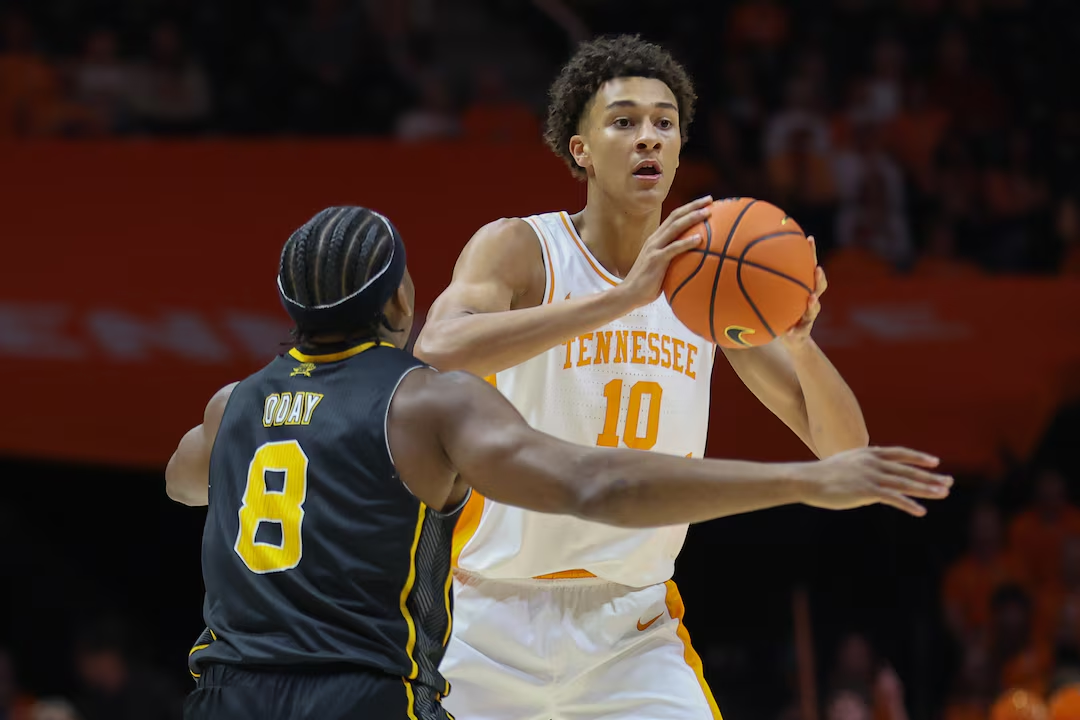
SEC play starts the first weekend in 2026, and we will find out really quickly whether Arkansas is a serious competitor for the SEC title.
First up is a home game against Tennessee, which is going to be an extreme challenge. Despite a couple hick-ups in late November, the Vols might be the conference’s best team. Unfortunately, this is not a friendly matchup for the Razorback defense at all due to the way both rosters are constructed and the style both teams play. That said, it’s in Fayetteville, and the crowd at Bud Walton Arena could play a major factor, plus the Razorbacks may have the tools to crack a difficult defense.
Meet the Vols
Rick Barnes has been coaching forever. He’s still looking for his first Final Four at Tennessee. After an exodus of talent from last year’s Elite Eight squad, this team was supposed to be a small step back. But a 76-73 win over Houston (still the Cougs’ only loss), only for it to be derailed the next day with a loss to unranked Kansas.

The Kansas loss was followed by losses to Syracuse and Illinois, and suddenly, the Vols were who we thought they were. After a 10-day break in early December, they recovered to crush Louisville and right the ship.

Our model pick is Tennessee 84, Arkansas 83. The analytics love Tennessee, but looking at their schedule above shows you why. Like many teams in this analytics-focused era, the Vols have been running up their stats with huge blowouts of bad teams. They have wins of 39, 33, 25, 29, 42, and 49 against low-Quad-3 and Quad-4 opponents. In six games against power conference opponents, they are 3-3. They have an enormous win (Houston), a very good win (Louisville), and a who-cares win (Rutgers). The losses to Kansas and Illinois are acceptable, but Syracuse has a loss to Hofstra and the Orange’s next-best win is… maybe Saint Joseph’s?
So Tennessee’s iffy performances against power conference teams might be a better indictor than their dominance of really bad teams. However, the Vols still have some major strengths.
Personnel
One of those strengths is the fact that Tennessee may have the best player in the conference in Maryland transfer Ja’Kobi Gillespie.

Gillespie, Florida’s Thomas Haugh, and a couple of Vanderbilt upstarts make up the SEC’s top-5 in Wins Above Replacement (WAR), which measures total contribution based on Adjusted Plus-Minus (APM) and total minutes actually played. Gillespie’s plus-10.3 net points contributed per 100 possessions is better than any Razorback.
Gillespie does everything well, especially on offense. He’s a very efficient scorer (57% true shooting) despite very high volume (28%). About half his shots are 3-pointers, and he’s shooting a decent 35% on those while finishing very well inside the arc. He sets his teammates up too, recording 5.8 assists per game with an extremely-low turnover rate of just 10%.
After Gillespie, all the rest of Tennessee’s offense comes from its forwards: the shooting guards are mostly there to protect spacing and defend. The leader in the frontcourt is 6’10 freshman Nate Ament, a five-star recruit who Arkansas pursued last offseason. Ament is a force on defense, showing good movement for his size and offering elite defensive rebounding and shot-blocking. Offensively, however, his 30% usage rate is hurting the Vol offense. His 46% effective field goal percentage is poor and his 15% turnover rate, while not awful for a high-usage forward, is a bit high. He does draw fouls at a good rate and he presents a 3-point threat, though he’s shooting just 28% from beyond the arc. Tennessee will do a lot of inside-out with Gillespie and Ament, but Ament isn’t overly efficient there.
Frontcourt: paint dominators
That said, Ament gets the attention, which has opened up opportunities for the other forwards: 6’11 Felix Okpara, 6’8 Jaylen Carey, and 6’11 JP Estrella. The latter two, in particular, seem to be two of the Vols’ most productive players despite seeing fewer minutes. The caveat is that these guys have probably inflated their numbers against bad teams.
Okpara, who played a lot on last year’s team, generally starts at the center position with Ament at the 4. He’s a force on the offensive glass, but most of his points will come from putbacks or when the defense forgets about him to help with Ament or Gillespie. He’s supposed to be a good defender, but Tennessee’s defensive On-Off with him in the game is actually really bad. His defensive rebound rate is really low (Ament may be stealing a lot of his rebounds), but the Vols are allowing 100.6 points per 100 possessions with Okpara in the game, which is the worst on the team.
When Okpara comes out, the Vols get much better, mostly thanks to Estrella, who usually replaces him. Offensively, he’s shooting a scorching 71% effective FG% on high usage, almost all of it right around the rim. That’s what sending his Offense APM into the stratosphere (see the chart above). That said, most of his damage came in November games against Quad-4 opponents, though I’d note that the APM calculation accounts for the quality of the other nine players (including opponents) on the court across every possession each player plays. It’s also interesting that he scored 18 points on 7 of 7 shooting with only one turnover in the games against Kansas and Syracuse… only to be rewarded with single-digit minutes in the next two games against Illinois and Louisville.
Carey, a transfer from Vanderbilt, subs in to give Ament a breather or when the Vols flex Ament to the 5 (rare, but they’ve done it). Like Estrella, he’s an absolute monster on the offensive glass, and although his 56% eFG% is merely pretty good, he’s pouring in 9.3 points per game. Unlike Estrella, he’s not offering much defensively.
Backcourt: space and defense specialists
The Vols will use several guys in the backcourt, but the two main ones are 6’4 Bishop Boswell and 6’3 Amaree Abram. Boswell has been the more efficient guy, thanks to his 56% 3-point shooting percentage (and 78% eFG%) on offense and his team-best 4.2% steal rate on defense. He’s an afterthought in the offense – just 3.1 field goal attempts per game, including 1.6 3-pointers – but he helps with spacing because the defense cannot leave him alone. His steal rate and overall perimeter defense are excellent.
Abram, a Louisiana Tech transfer who has pulled off the coveted “four Division I schools in four years” trick, has much more pedestrian numbers but also grades as a very good perimeter defender.
The Bottom Line: watch for the supporting cast
Gillespie has been elite, but the other players who are contributing the most help aren’t Ament and Okpara, but rather the backup forwards (Estrella, Carey) and the low-usage guards (Boswell, Abram). Because of Ament’s high usage, the Hogs will have to focus a lot of defensive effort on him, but they need to be aware of the opportunities that will open up, particularly for Estrella and Carey.
Arkansas will probably ask Nick Pringle to deal with Ament and have Trevon Brazile focus on Okpara, plus any post help or rebounding opportunities. When Pringle comes out – or if he’s a liability on offense – then the Hogs desperately need the combo of Brazile and Malique Ewin to punish the Vols in the post. I am very interested to see if Tennessee tries an Estrella-Ament frontcourt for an extended period, because on paper, that would give Arkansas quite a bit of trouble. If it turns out that Estrella’s numbers seen here are inflated by weak competition, then I like Arkansas’ chances, because Tennessee has had some real issues against the good teams they’ve played.
When Tennessee has the rock
Barnes is a defensive guy, but this team has shown the ability, at least against weaker competition, to really pour in the points.

The Vols don’t get much off turnovers or on fast breaks, but they rank 5th in the nation in points in the paint, which makes sense given what we know about their personnel.

The risk here is obvious: Tennessee takes 58% of its shot attempts in the paint and then rebounds a staggering 46% of its misses. If you can’t compete with them in the post, your chances of winning are going to die a slow and painful death.
There are plenty of weaknesses here. The Vols don’t take a lot of 3s (266th), don’t make jump shots well generally (215th in midrange eFG%, 133rd in 3-point eFG%), turn it over way too much (212th), and despite all that paint work, they are not free throw merchants (155th).
Arkansas will likely try to smother the perimeter, avoid fouls, and rebound as best as they can. If the Vols go stone-cold on jumpers, can’t totally dominate the glass, and aren’t bailed out by fouls, their offense will likely struggle, especially if the Razorback offense is hot.
When Arkansas has the rock
It’s good-on-good when the Razorbacks have possession, as both teams have top-20 units.

The Vols will make you take your sweet time on offense, ranking 19th in opponent average possession length (18.5 seconds) and allowing just 20.2 transition points per 100 possessions, 3rd nationally. However, pure fast breaks (defense is unset) may still favor the Hogs, who rank 2nd nationally against just 61st for the Vol defense.

The Razorbacks are going to get plenty of 3-point looks against a Vol defense that’s interested in preventing you from getting anything easy. The Vols allow just 43% of shots against them to come in the paint (19th) and are allowing opponents to shoot just 50% (57th) on the attempts they do get. Throw in their tremendous ball pressure (32nd in opponent assist rate) and you have the recipe for a defense that forces you into a perimeter game and then stifles you there.
If there’s a weakness here, it’s against iso-ball that limits the Vols’ strong team defense. That could play into the Hogs’ hands. If they can get Darius Acuff and/or Meleek Thomas going downhill inside the arc, much of the eliteness of this defense falls apart. They’re still very good because of their length and athleticism, but the Hogs can probably draw fouls or create open shots with kickouts even if the path to the basket is blocked.
Keys to the game
Legacy game for Ewin or Pringle. It’s a shame Arkansas can’t combine Ewin’s offense and Pringle’s defense into one player, but they will settle for just one of them having one of their best games of the season. An elite game from Pringle means a rough game for Ament, forcing Tennessee’s offense to be one-dimensional and take more jumpers than they’d prefer. An elite game from Ewin punishes Okpara’s defensive weaknesses and gives some help for Acuff. Whichever guy takes over needs to be strong on the defensive boards as well.
Guards win in space. Tennessee’s lone game allowing 80-plus came against Kansas. Despite the Jayhawks not having superstar Darryn Peterson, they were able to get their guards in space to generate fouls and unassisted buckets. Three different guards totaled at least 13 points, and all three attempted six or more free throws. They assisted on only half of their made field goals. Arkansas is built to do the same thing.