Everyone is reacting to Tuesday’s College Football Playoff rankings reveal for Week 13, and we’re getting the normal “this committee has no idea what they’re doing!” reactions. Most are overreactions, so here’s my underreaction to balance it all out.
Why is Yurachek doing this?
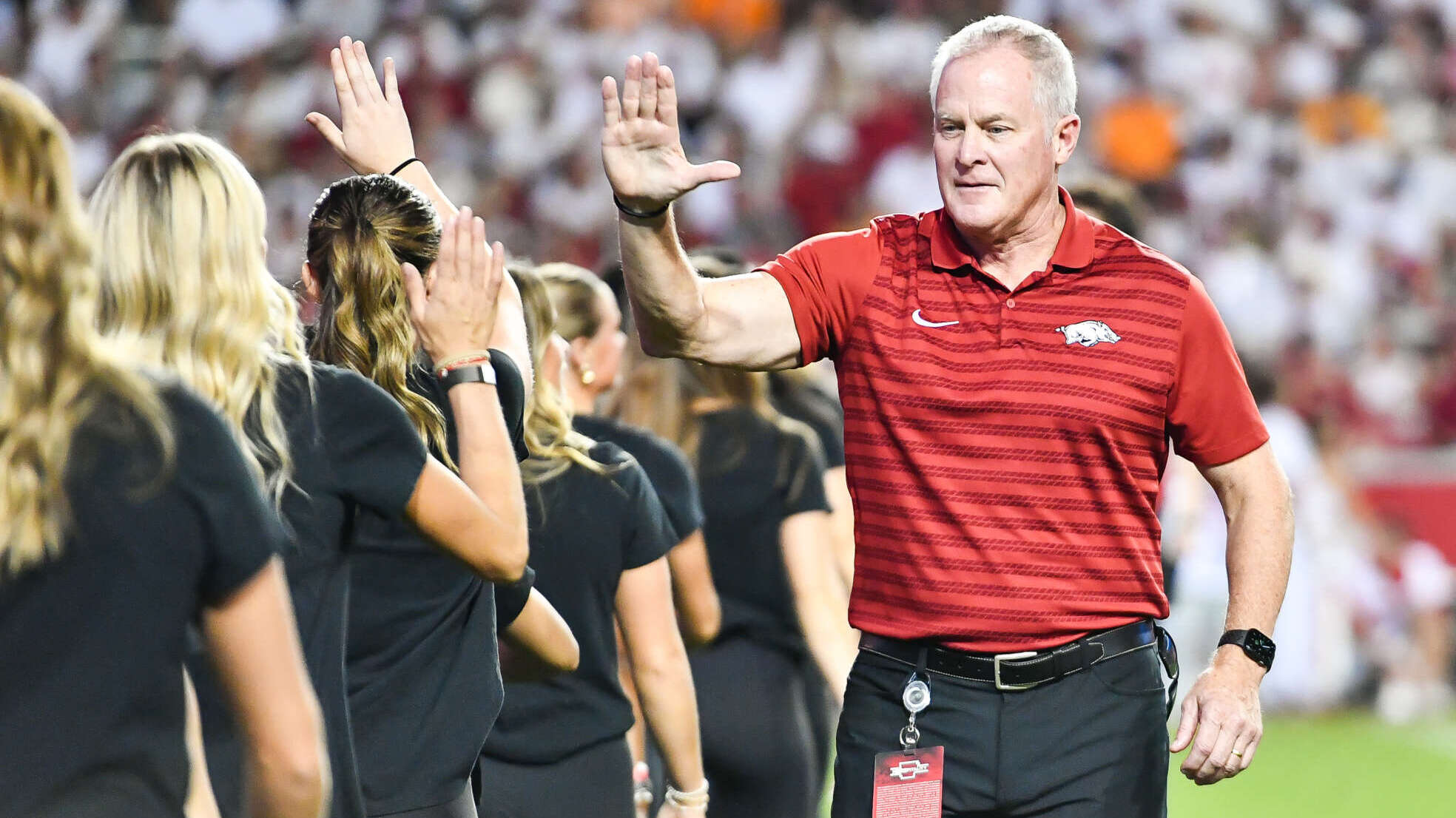
Razorback AD Hunter Yurachek is now in charge of the playoff committee after Baylor’s Mack Rhoades stepped down. Tuesday was his first time presenting and defending committee decisions, and he’s taking a ton of heat today.
I don’t know why he’s doing this in the middle of an important coaching search. Does he think this will get him connections? Surely he doesn’t think potential coaches will be impressed by his time on the TV? As I’ll discuss here, national media are unreasonable in their evaluations of the committee’s job. He’s not going to get any good press no matter what rankings he puts out or how he defends them. This is not a job that you want to have.
Hopefully this is a sign that he’s content with where the coaching search is. Time will tell on that, I guess.
The playoff debate
Just as we’ve seen with previous playoffs, the debate is all about the final spots. That was the case when it was a 4-team playoff, and now it’s the case when there’s a 12-team playoff. Expand it to 64, and we’ll be debating the final two or three at-larges and screaming that this dang committee doesn’t know what the heck it’s doing.
Most of the drama centers on Notre Dame and Miami. Both are technically in the bracket, but Miami really isn’t right now. They are the committee’s highest-ranked ACC team, but they’re going to need a labyrinth of specific results to even reach the ACC title game: six different ACC games would have to go a specific way for them to make it. If they don’t, then the ACC winner would take the conference’s auto-bid, and Miami would be out of the field as an at-large.
A season that ends with 10-2 Notre Dame and 10-2 Miami (no ACC title appearance) would be an absolute nightmare for the committee. The reason is simple: Miami beat Notre Dame 27-24 in Week 1. But since then, Notre Dame has mostly destroyed weak opponents while losing only one game (by one point to third-ranked Texas A&M), while Miami has looked pedestrian and lost two unranked-but-solid opponents, Louisville and SMU. Most advanced metrics (SP+, FPI, etc) say Notre Dame is a touchdown better on a neutral field. The loss was on the road in Week 1: the first career start for Notre Dame’s freshman quarterback.
There’s another layer to this: the committee’s own guidelines say that direct head-to-head results can be considered if two teams fall within three spots of each other. But Notre Dame (ninth) and Miami (13th) are four spots apart. That’s convenient, and it’s because Alabama fell from fourth to 10th after losing to Oklahoma this weekend. That’s a large fall for a close loss to the current-eighth-ranked team. Alabama has four ranked wins to Notre Dame’s one. The only difference is that Alabama has a much worse loss: 5-5 Florida State, also in Week 1.
Losses matter more than wins
The problem people have is that it’s a pretty sudden shift for a committee who usually values quality wins to suddenly start caring about quality losses. Notre Dame is above Miami and Alabama because their losses are more respectable, not because their wins are better. Utah (12th) also comes in above Miami because its only two losses are to Texas Tech and BYU, both solidly-ranked teams.
The biggest issue with the complaints, however, is that no one is consistent. I’ve seen a lot of “replace the committee with AI” complaints… but AI would take Notre Dame over Miami, just as every advanced metric already does.
Replace Yurachek with former ESPN statistician Chris Fallica, who had the biggest meltdown on Tuesday night, and you’d get a presentation that was every bit as unreasonable and silly.
Case in point:
Okay, so the committee should value quality wins and metrics over quality losses… but both Notre Dame and Miami should be in. That’s sort of an issue when you look at the bracket, because that means either Oklahoma or Alabama has to come out. And both have more quality wins and better metrics than Miami. Fallica’s conclusions are not one iota better than what the committee is already doing.
Fallica isn’t alone here. Replace the current committee with all the national media writers who have columns out today and you’ll find that all have different and probably-wrong presuppositions that are driving their anger. There’s the “resume-only” folks who care only about wins and losses. They don’t care when each game was played, how close each game was, or what any advanced metrics say. Others have clear biases for or against specific conferences. Others are too willing to ignore the results of specific games.
The biggest problem is people who refuse to engage in critical thinking. There are no nuances in their world, so they need clear rules: Miami beat Notre Dame. Miami should be higher. Miami is not. Committee bad. Rules like this, which are, of course, based on people’s own presuppositions, are helpful because they set an objective standard to judge the committee by. But that’s often lazy thinking.
Here’s the best example I saw of people refusing to think critically. Lots of folks got mad over this very reasonable statement on Oregon’s resume:
If you watch college football at all, you know that it’s a pretty common phenomenon for teams to play at the level everyone assumes they are. There are dozens of examples just over the last few years of teams that everybody thinks are really good playing well early, and only falling apart after they realize they aren’t that good.
Just off the top of my head, take 2021 Florida: started the season ranked 13th after a strong 2020. They play a couple cupcakes then welcome top-ranked Alabama to Gainesville. It’s a great game, back-and-forth to the end. Alabama escapes 31-29. Florida is disappointed but stomps Tennessee by 24 the next week. But then… reality sets in. Florida is unfocused and loses a 20-13 upset against Kentucky. They crush Vanderbilt the next week, but a 49-42 shootout loss to LSU takes the wheels off. Georgia stomps them 34-7 and they completely collapse, finishing 6-7 (including allowing 52 points to FCS Samford) and firing Dan Mullen.
This is just me engaging my critical thinking skills here, but I think Alabama deserves much more credit for beating Florida 31-29 in September than Missouri deserves for beating Florida 24-23 in November. And I’m going to think a lot less about your ability to analyze college football if you don’t agree with that.
So yes, I think Oregon deserves more credit for beating Penn State in September than any of the other five teams who beat Penn State deserve. The comments in response to Yurachek making that very normal statement were unhinged with people who were clearly refusing to actively engage their critical thinking skills:
The reporter who posted the quote originally, Nicole Auerbach, didn’t make her opinion explicit, but she basically did by following up with this quote, which is seemingly intended to draw a comparison:
Why does Oregon get credit for beating a team that fell out of the rankings, but Virginia doesn’t?
Because the situations are apples and oranges. Louisville has bounced around because we don’t quite know how good they are, not because they collapsed. Penn State clearly fell apart in a single moment that was visible to everyone.
Inviting that comparison is a hallmark of refusing to think critically: appeals to rigid rules that replace having to actually use your brain. “If you assert X, then you must also assert Y, which is a completely different thing.”
The main problem
The biggest issue in the Miami-Notre Dame decision actually isn’t the head-to-head result. That’s an issue, but there’s a bigger one: conferences.
There’s a season that plays out before the Playoff. And we all said when the 4- and then 12-team playoff was announced that we want the regular season to matter. On the one had, yes, ignoring the head-to-head result is refusing to let the regular season matter, but Miami’s biggest issue is that it has a clear path to an automatic bid to the Playoff: winning the ACC. But Miami simply refuses to do that. That’s now two years in a row that clearly-inferior programs will be playing for an ACC title while Miami sits and watches. Letting them sit on conference championship Saturday and still get into the field (when a loss in the ACC title would absolutely exclude them) is a form of ignoring the regular season.
Not winning your conference title is hardly a problem when you’re in the SEC or Big Ten that are loaded with national title contenders. But the most likely ACC title game matchup is Georgia Tech and Virginia. Neither of those teams have an at-large prayer. We’re going to let Miami finish behind them and still get into the field? That’s not letting the regular season matter. The entire race for an ACC title is being ignored if Miami gets an at-large without even making the title game in a conference that has no other at-large contenders.
Now I know what you’re thinking… but Notre Dame isn’t even in a conference! Yeah, that’s a problem for the Irish. I would probably exclude them too using resume-based logic. They should join a conference so their schedule isn’t front-loaded with their biggest games. Without a conference structure to play through (which is what I’m using against Miami), their only hope is some big wins. They had two chances – Miami and Texas A&M – and lost both. They have to play their biggest games in September because no marquee opponent (other than USC for historical reasons) will schedule them after the calendar turns to October. But that’s their problem. Want better treatment? Join a conference.
So yeah, if you’re a resume-only purist, then both Miami and Notre Dame should be out because they failed in the clear tasks that were in front of them (Miami: win the ACC, Notre Dame: win a huge game). If you’re more of a metrics guy like me, then Notre Dame has a strong case and Miami doesn’t. The only way to reach any other conclusion is if you’re the type of person who’d rather replace critical thinking with a series of IF/THEN rules. Then you’re free to argue that Miami should be in and Notre Dame out, that Oregon only deserves as much credit for beating Penn State as Northwestern does, that James Madison should be the G5 auto-bid because they have fewer losses than Tulane, that Utah’s dominance against unranked teams is meaningless, and so many other positions.
But I think the committee did fine overall. The only quibble I have is Notre Dame over Alabama, which as I mentioned, probably happened to avoid having to have the head-to-head discussion with Miami. The rest of the rankings are fine.