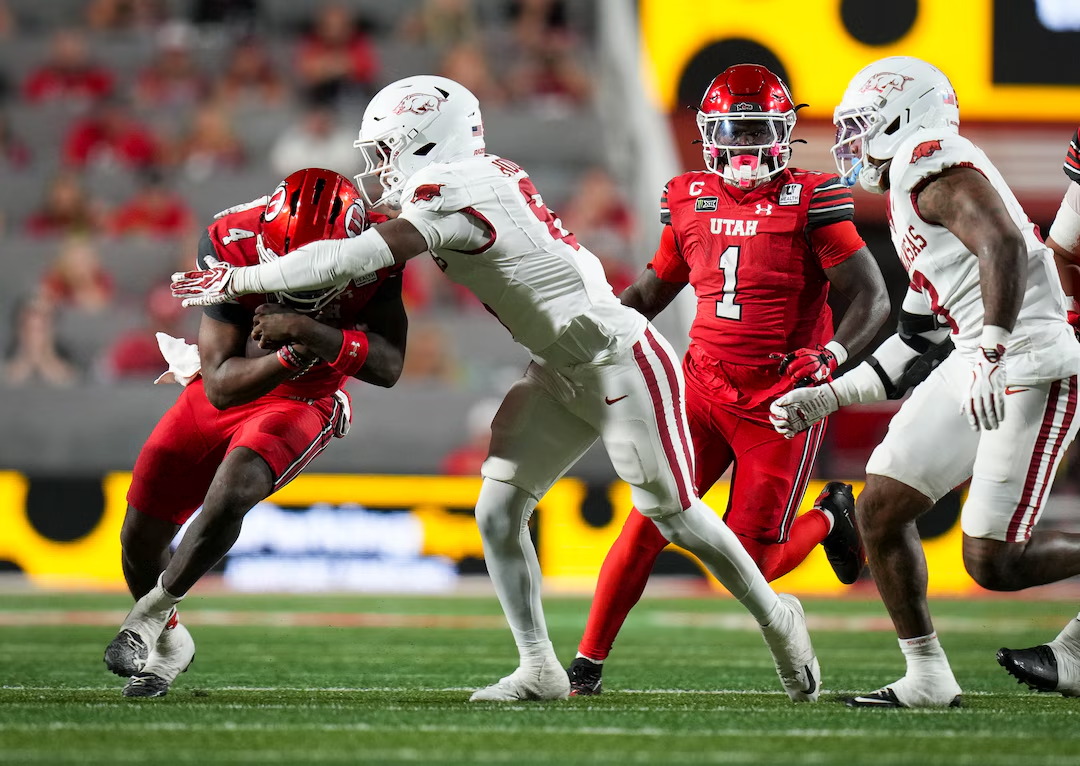
The pessimists feared the worst, but in this case, the pessimists may have had a point. Arkansas was never competitive in a 43-10 beatdown against Utah on Saturday, falling to 1-1 with very few winnable games left on the schedule.
After a strong scripted opening drive ended in a field goal, Utah rattled off the game’s next 43 points, pushing the lead to 29-3 at the half and 43-3 early in the fourth quarter before the Hogs got a garbage-time touchdown.
For Ryan Silverfield, he’s already at a pivotal point. Lots of folks – like me – were skeptical of this hire from the very beginning.
I’m always going to be willing to give a coach time, but this kind of performance will cost you fans that you likely never get back. Things are likely to get worse before they get better given the upcoming schedule. It’s fair to say that 2-10 is the most likely result for the season, but incredibly, 1-11 seems possible since Tulsa is hardly a guaranteed win. This was probably always going to be a long rebuild, but the transfer portal era does not have the patience for long rebuilds.
In order to maintain the necessary momentum, you have to show life and progress, and falling behind by 40 points against Utah is rock bottom. Silverfield’s Hogs cannot let that happen again. They will have to be much more competitive than they were on Saturday or this rebuild is going to go up in smoke before it gets anywhere.
The Razorbacks have all sorts of problems right now. Here are just a few.
Poor run blocking. After nine runs were stuffed for no gain or a loss against UNA, the Hogs only had three against Utah. Our preview of Tim Cramsey’s offense highlighted the zone-heavy run game’s ability to avoid negative runs even as it struggles to generate explosives. But the fear is that without explosives, it becomes a “three yards and a cloud of dust” attack. Or against Utah, it was closer to “two yards and a cloud of dust”. That’s just not going to cut it. This scheme just doesn’t work without a threat from the run game. While opponents are stacking the box because they don’t fear the pass, Utah’s defensive linemen were extremely disruptive and the Utes regularly contained the run with just six box defenders.
Poor quarterback play. KJ Jackson won the starting job, but he’s not showing much so far. His accuracy from a clean pocket isn’t bad, and he’s athletic enough to scramble when he has a lane, but that’s about it for the positives. His pocket presence has been very poor, making him sensitive to any pressure. Most of his bad throws have come when a defender was bearing down on him, and his footwork is a mess when he’s pressured, causing him to “fall away” on many of his throws. And his mechanics are not tight, so he tends to “wind up” before throwing down the field. Utah linemen knocked down a couple throws and he gives defenders too much time to hit him when he’s winding up.
No leader at receiver. Many of us saw this one coming. The Hogs signed some talented receivers, but none of them were proven number-one options at their previous schools. The result? Jackson’s first 10 completions against Utah went to nine different receivers. “Feed the studs” is usually a good strategy, particularly for teams with less talent, but Jackson is having to spread the ball around due to a lack of studs. The fast guys struggle with drops (Ismael Cisse) while multiple receivers are giving very poor effort on downfield blocking, which is a problem given that this offense is dependent on second-level blocks to create explosives.
What is this scheme? I was cautiously optimistic about Cramsey’s offense because I liked the idea of featuring a zone run game and properly utilizing speed at the receiver position (Isaiah Sategna is the latest example of a speedy receiver misused by Razorback coaches). But a lot of the offense doesn’t make much sense from an X’s and O’s perspective. The most obvious is having a left-handed quarterback roll to his right and throw across his body, but Arkansas isn’t doing a great job of testing defenses generally. They’re taking downfield shots (mostly just deep fades), but there’s not much else that’s going to create an explosive.
Defensively, the Hogs are not good, but I’m not really to call them horrible. This isn’t their fault. After the teams traded opening-possession scores, the defense got consecutive stops with the score 7-3 only for the offense to go three straight possessions without moving the football at all. The Utes finally cashed in a horrible KJ Jackson interception to go up 15-3 in the second quarter and the rout was on. The defense limited Utah’s dangerous run game and Quincy Rhodes is a great player, but the Razorback secondary struggled against Utah’s unorthodox offensive approach. It’s important to remember that Utah’s offense is really good and would certainly be in the top half of SEC offenses.
Among its many issues, the Razorback offense has been atrocious on early downs. Take a look at this:

Arkansas fell off schedule so often that the Hogs had to run 40 plays in passing downs, leaving them with just a 48% leverage rate. On those standard downs, they averaged just 3.6 yards per play with only two plays registering as explosives (runs 10+, passes 20+). Among all series (sequence starting with first down) where the Hogs converted (scored or created a new first down), only 26% of those series were successfully converted before reaching third down.
In short: bad, bad, bad. And that’s two straight weeks of that same type of badness: against North Alabama, the Hogs averaged just 4.0 yards per play on standard downs with only four explosives and a 38% early conversion rate. This is a huge problem, and there’s basically no hope of moving the ball against SEC defenses if the vast majority of your first downs reach third down two plays later.
Should the Hogs make a quarterback change?
AJ Hill finished the Utah game and led a garbage-time touchdown drive. Jackson pretty clearly beat out Hill in fall camp, so it’s hard to imagine that Hill is going to offer a serious upgrade. And given the lack of a run game and the struggles with the receivers, playing quarterback for the Hogs is a very tough job right now. As we saw with Nick Starkel replacing Ben Hicks in 2019, swapping quarterbacks when you have other issues rarely fixes anything.
With Georgia on deck, there’s no good reason to make a change right now. I think you have to let Jackson sink or swim for the next couple games. If the Hogs can’t move the ball against Tulsa in two weeks, then you could make a change. But this is a “buck stops here” moment for Silverfield and Cramsey, as they chose Jackson as their starter. He needs to be given every opportunity to turn this around, and benching him after two games probably isn’t the move. If there is a change, it should be to Hill, as throwing true freshman Hank Hendrix into this mess (as some have suggested) is likely to destroy his confidence.
Is the Silverfield era doomed?
Razorback fans were already in a fragile state after the last decade and a half, so this utter embarrassment is enough for many to jump off the bandwagon already. The unfortunate reality is that while the effort and preparation are bad, other factors well beyond Silverfield’s control mean he’s not really getting a good shot here. This is a rebuild that’s going to take time, and the Hogs may have to take the lumps of a 2-10 season and hope for a brighter future. There is absolutely zero benefit to talk about firing the head coach after two games, even though they’ve been ugly. Silverfield has said and done all the right things right up until the on-field performances the last two weeks. He’s earned time to get it right.
To give an example, fans have complained about in-state recruiting under Pittman. Within 24 hours of Silverfield’s hiring, four of the state’s top five players were committed to the Razorbacks. That probably required a sizeable NIL payout, and maybe one or two of those guys were overpaid just for the PR of landing in-state guys. But given that none of the four are playing significant snaps so far, maybe that money would have been better spent on a veteran quarterback? When everything in the program is broken, fixing one problem costs you a chance to fix a different problem.
Should the Hogs make an offensive coordinator change?
Cramsey may end up having to be the fall guy. That isn’t necessarily fair to Cramsey, who has a solid resume as a quarterback developer and productive play caller. But the offense these last two weeks has been unacceptable.
My biggest concern with Cramsey is that his scheme isn’t plug-and-play. The Hogs probably would have benefitted from a quick-fix offense that could instantly be better even if it’s not championship-level, but Cramsey’s offense requires patience and development. He needs a very smart quarterback and a solid offensive line. Those take time to develop and things will look really bad until they are in place.
Silverfield might have been better-served to hire an offensive coordinator who would install an offense that could provide instant results. The days of multi-year rebuilds are mostly over in college football, as the transfer portal creates the potential (and thus the expectation) of quick turnarounds. Programs that fail to show progress will never get the momentum they need to complete the rebuild.
In contrast to Silverfield, Sam Pittman installed a plug-and-play offense when he arrived in Fayetteville, and Kendal Briles delivered an exciting offense right from the start. Briles didn’t need an elite offensive line or a polished quarterback; he instead made do with great athletes at the quarterback and skill positions and focused on getting them in space. Pittman ultimately proved to be a poor program manager, but Briles’ offense for three seasons bought Pittman a ton of time to make the program his own. Silverfield’s not buying himself any time at all by marching this offense out on the field.
Is it too late to switch gears on offense? For this season, yes. Cramsey has to be aware that he’s coaching for his job for the rest of the year, but there’s no benefit to an in-season firing or anything like that. If there’s major improvement, maybe patience is the best idea. If there’s not, then I think Silverfield would benefit from an offensive identity reset this offseason.
Appreciate the level headed look at this. I think most level headed hog fans are just going through the motions and fatigued. Most likely understand this isn’t a quick fix, but a decade and a half of poor football has made it easy to let go of the rope.