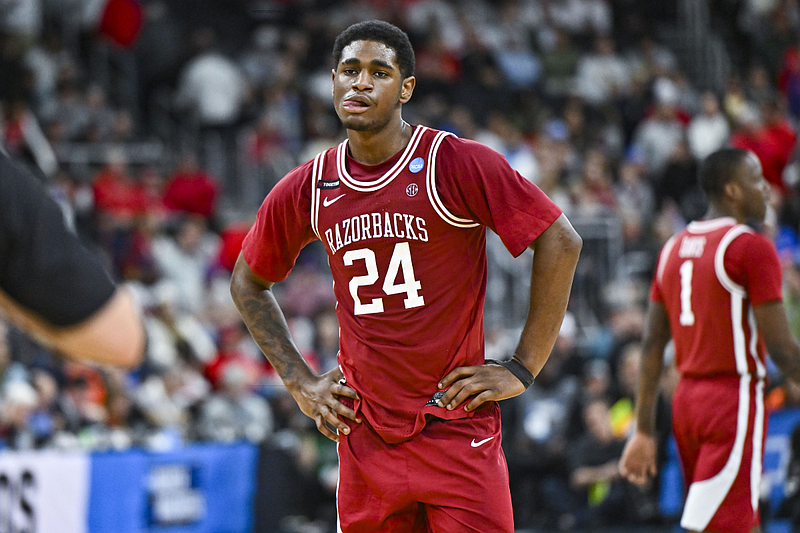
Several weeks ago, it became clear that Hog fans were going to be forced to wait to find out more about next year’s roster until the May 27th deadline for players to keep their names in the NBA Draft had come and gone. It’s not just roster math: NIL math was probably the biggest concern, as the Hogs probably wouldn’t be able to pay for an elite big if they were also paying to keep Meleek Thomas and Billy Richmond III in the fold as well.
The Hogs ended up earning a split: Thomas, as expected, is gone, while Richmond will return for his junior season in Fayetteville. Thomas is projected to be drafted late in the first round, while Richmond was usually seen as a mid-second-round pick. Interesting side note: I’m curious to see who actually gets picked in the second round of this draft, as a huge number of projected second-rounders are in fact returning to school, where they can make more money and improve their draft stock. It will probably be a lot of international guys who never wanted to play college and some seniors who were out of eligibility.
Arkansas’ roster still has a couple open spots, but what we have so far is pretty interesting. John Calipari has gone with a 3-3-3 roster over his first two years: three guards, three wings, and three bigs. That’s among active rotation players, obviously. The Hogs already have four bigs on the current roster, though at least one (and quite possibly two) of them won’t actually make the nine-man rotation this season. But I’m not sure the Hogs will look to replace Thomas in the portal, so they may enter the season with just two true guards in the rotation.
Here’s a look at where we stand.
Guards (2)
Incoming five-star freshman Jordan Smith Jr. and Georgia transfer Jeremiah Wilkinson are the two names here. I would expect both to average at least 30 minutes per game, barring injury of course. Neither have the true point guard skills of a Darius Acuff, but both are capable of being the lead guard.
Wilkinson is a pure volume scorer. He can create his own shot at all levels and is capable of working as the facilitator or off the ball. He will keep a lot of offensive pressure off the freshmen early in the season when they are still finding their roles and adjusting to the high-major college game. Defensively, he got a lot of steals last year at Georgia… but the Bulldog team defensive efficiency was awful with him on the floor. I would not count on him being an elite defender.
A lot is riding on JSJ, meanwhile, as the only other guard. He’s a bit stronger than Acuff and likely a much better defender right out of the gate, but with less offensive playmaking or true point guard skills, though he could potentially develop some of those. As with many other great Calipari guards, he’s an elite driver who will put a lot of pressure on the rim with the ball in his hands.
The big question is who fills in the other 16-20 minutes per game at the guard position. There are a couple of options among the wings.
Wings (4)
The four wings can be roughly divided into “wing guards” and “wing forwards”. I love the depth here – there’s almost too much – but the overall strength and physicality should be higher than the last two years. The two wing guards – Richmond and incoming five-star Abdou Toure – could offer some minutes at one of the guard spots. Toure could play the 2 in some lineups, and he’s likely to be a serviceable catch-and-shoot perimeter guy, while Richmond was actually the backup point guard after Boogie Fland went down in 2025 and is capable of running the offense with the ball in his hand.
I like Toure as a strong defender and explosive transition athlete who can offer minutes at the 2 or 3, although I’m tempering expectations for him in halfcourt offense, especially early in the year. Richmond obviously offers a lot more right out of the gate. He’s a strong individual defender, excellent in transition, and more polished with the ball in his hands. If he can just develop a consistent 3-point shot, he’ll be an elite player.
The other two wings are five-star freshman JJ Andrews and sophomore Isaiah Sealy. Andrews is a 3 who can play the 4 in smaller lineups. He’s got a lot of similarities to the departed Karter Knox: strong wing defender, good rebounder at both ends, physical slasher who will likely get to the free throw line regularly. If he can develop a 3-point shot he’ll be the total package. Like Knox, the biggest concern is that if his teammates don’t set him up, he can be prone to quiet stretches on offense.
Sealy looked like a deer in headlights after Knox went down during conference play, and the staff seemed to actively avoid playing him late in the season even with just seven healthy players. The fact that he’s back suggests that the staff still believes in his potential, and it’s easy to see why just from looking at the numbers: 60% true shooting, 11% total rebound rate, 12% assist rate, just a 10% turnover rate. All of those are actually very efficient for a small forward. The plus-minus numbers were awful and he looked unprepared against SEC opponents, but the potential is there.
In terms of minutes distribution, if we assume 200 total minutes per game for the team (40 minutes X five players), and the guards are getting 60 and the bigs are getting 64, that leaves 76 minutes for these four players. My guess would be Richmond 28, Andrews 20, Toure 20, Sealy 8. Between Andrews and Toure, there’s a chance that one of them “breaks out” and takes a lot of the other’s minutes.
Bigs (3)
The Hogs are at four bigs right now, but they probably aren’t done adding, and one or two of these guys aren’t going to crack the final rotation.
First, the rim protectors, because at least one of these guys will barely play next season, and quite possibly both. The one likely to redshirt is 7-footer Maper Maker of Australia. With a reported 7’7 wingspan, he could develop into an elite rim protector, but he has a lot of technical development to do, so it would be surprising if he’s able to contribute anything this year.
The wildcard is definitely going to be 7-footer Paulo Semedo, who redshirted last year. The fact that he didn’t hit the portal after his redshirt season suggests some degree of belief in his abilities, which are probably ahead of Maker right now. From what we know of Semedo, who played just one season of American high school ball, he projects as a lanky rim protector whose offensive game is very limited but does seem to include the ability to step out to the perimeter and knock down an open 3-pointer, allowing him to play the valuable “stretch and protect” role that could be key to cracking Gorilla Ball teams like Arizona and Florida, who will be forced to send their rim protector out to defend him (or switch and end up with a mismatch somewhere). If Semedo is good enough to contribute, that’s a big deal. I obviously would not count on him playing a ton of minutes even if he is able to contribute some.
The main guys at the 4 are five-star freshman Miikka Muurinen and Furman transfer Cooper Bowser. Murrinen appears to be a near-perfect replacement for Trevon Brazile: an explosive 6’10 athlete who runs the floor, is an elite dunker, and presents a 3-point threat. I have no idea what we’re getting from him in terms of defense. He’s also had much-publicized issues with various coaches and teams he’s been a part of, which have fueled some speculation about his character and coachability. Talent-wise, he’s widely believed to be a potential lottery pick, but he’ll have to put it all together for that to happen.
Bowser is a freak athlete who fits the “rim runner” role perfectly as either a 4 or a 5. He dunks everything and is a dangerous lob threat. Expect high efficiency and very low usage. Defensively, he’ll grab some boards and block some shots, but he’s been abused as an interior defender. I think he’ll be fun to watch against non-conference mid-majors, but I am a little worried about how he’ll hold up against SEC competition, especially as a defender.
The hole in the roster
All four bigs currently on the roster are very lanky athletes and none of them have much girth or experience as post defenders. Arkansas was bad last year as an interior defensive team, and that was with Nick Pringle, who had at least been a replacement-level interior defender for his entire career, and Trevon Brazile, who also had a ton of SEC experience. Now the Hogs have swapped that for guys with zero high-major college experience on top of a lack of size.
We’ve heard very little on the Malique Ewin front, so it’s possible he could come back, but Ewin is not going to add much as an interior defender, and I sort of suspect that Ewin would basically drop Bowser’s minutes to zero. There are still some European prospects who could decide to make the jump to college. I’m not a recruiting insider and I’m not just going to copy-paste stuff that’s behind paywalls, so if you’re interested in the rumors or potential names there are plenty of sites chasing down those leads.
With Thomas’ announcement official, the Hogs now know with certainty how much NIL they have left to spend. They may have known that already, but if they were holding out for a Thomas return, that money is now free to find a big. It’s a little late, but given how good the roster looks in other places, the Hogs don’t need a world-beater, just a better interior defender than they had in 2026.
In terms of facing Gorilla Ball – which is going to be on every Hog fan’s mind after the Florida and Arizona games – I do think Arkansas will improve in one key way that they didn’t have in 2026. One way to beat post offenses is to beat them at their own game, yes, by matching up with an elite post defender of your own. But that’s not the only way. The other way is ball pressure: attacking the ballhandler out on the perimeter and preventing the post entry pass from ever happening under ideal circumstances. This year’s Arkansas roster was simply not capable of doing that, especially with the guards. Eric Musselman’s best teams were generally pretty good at ball pressure, which is how the 2022 team with starters listed at 6’2, 6’5, 6’6, 6’6, and 6’9 upset a Gonzaga team that started a 7’0 and 6’10 guy in the frontcourt. That team was able to hound the point guard and front the post, and the Zags looked uncomfortable all game. Don’t expect a Calipari team to look like a Muss team anytime soon, but the Hogs should be a little better at actually using their athleticism to their advantage if they can give the Floridas and Arizonas of the world a little more ball pressure.
Thanks for reading! Be sure to follow us on X and Facebook for the latest posts.
The latest from Fayette Villains, straight to your inbox
Enter your email to subscribe and receive new post alerts and other updates. You can unsubscribe at any time.