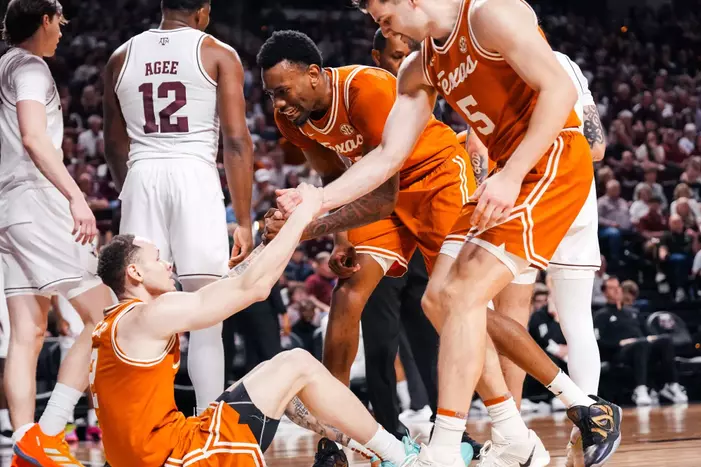
Wednesday is Senior Day for the Razorback basketball team as the Hogs take on the Texas Longhorns.
John Calipari wished two of his seniors all the best:
Not mentioned: Malique Ewin, who is technically a senior but has a very good chance to get another year if he applies, since he spent the 2023-24 season at a community college. Ewin would be a major retention for next year. We’ve seen his numbers, but he’s an extremely efficient scorer around the rim on good volume, a monster on the offensive glass, and although he’s not a good defender, he at least blocks some shots. He pairs very nicely with Calipari’s guard-heavy lineup construction. I would be curious to see if the Hogs try him at the 4 next year alongside a more defensive center who protects the paint. That’s probably not likely, as Ewin isn’t a perimeter player so spacing would be hurt, but he has that stretch-5 skillset that could be a good fit in a “twin towers” lineup, similar to what we just saw from Florida.
Meanwhile for this year, although I’ve seen arguments that the Hogs should rest Darius Acuff to get him healthy for the NCAA Tournament, that doesn’t seem wise. An 0-2 week would drop the Hogs to 11-7 in the SEC and knock them out of the double-bye, which would really be a disappointment given what we (or, rather, John Tyson and friends) are paying for. A 12-6 or 13-5 SEC record, especially accompanied by a double-bye in Nashville, would be preferable.
Ultimately, I think the Hogs really need to win this game. A win over Texas plus one more Kentucky loss (probably to Florida) locks the Hogs into a top-4 seed and double-bye in the SEC Tournament. A 2-0 week (or just a win over Missouri coupled with a UK loss) locks the Hogs into the 3-seed, which would be even better because the Hogs would avoid Florida until the finals.
- The real rebuild has now begun for Ryan Silverfield

- Box Score Breakdown: Utah 43, Arkansas 10
- What to watch for against North Alabama

Meet the Longhorns
Texas has had quite the ride on the coaching carousel over the years. A school with resources to be a powerhouse hasn’t quite been able to put it all together. Rick Barnes managed to reach a Final Four but a lack of postseason success caused his tenure to go stale, driving him to Knoxville. The Horns replaced him with up-and-coming VCU coach Shaka Smart, who struggled to balance the high expectations of the job with the underdog, blue-collar mentality he’d cultivated at VCU. His best team earned a 3-seed but was upset by Abilene Christian in the first round, and Smart got ahead of the mob and jumped to Marquette. Then came Chris Beard, an accomplished alum who seemed destined to turn Texas into a power. But a domestic violence arrest led to his firing. Interim coach Rodney Terry completed an Elite Eight season and won the full-time job, but two season of diminishing returns – including a 6-12 debut in the SEC last year – led to his firing.
Now Texas has turned to Sean Miller, who took Arizona to three Elite Eights before a decline (no NCAA Tournaments in his last three seasons) and a firing in scandal related to the 2017 FBI investigation into paying players. Miller rehabbed in a three-year stint at Xavier, and now is back at a major program.

Texas is a terrifying team to face because of their inconsistency. At their best, they are difficult to beat. They have road wins over Alabama, Texas A&M, and Missouri, and dominant home victories over Georgia (by 20) and Vanderbilt (by 16). On the flip side, their bad games are quite bad, including a home loss to Mississippi State and a neutral-floor loss to struggling Arizona State.

Model pick: Arkansas 89, Texas 82. Expect a slower pace than what we’ve seen in recent games, but Texas’s offense, while frustrating to watch, has been very efficient this year.
Personnel
The Texas roster lacks stars, but they have seven players who are net-positives on the floor and will use eight guys in their core rotation.

The clear leader is 6’8 Xavier transfer Dailyn Swain, who averages 17.7 points and 7.4 rebounds per game on high efficiency and high usage. He finishes well inside the arc (62%) and gets to the free throw line at a good rate, and he passes really well for a forward (14% assist rate). He’ll take a few 3-pointers but hits them at just a 33% clip. Defensively, he leads the team with an excellent 3.1% steal rate and grabs 23% of available defensive boards, which is strong for a non-center. His game has very few weaknesses, but the biggest is that he’s occasionally turnover-prone.
Joining Swain in the frontcourt is 7’0 sophomore Matas Vokietaitis, a Lithuanian who transferred from FAU. Vokietaitis is incredibly scary for an Arkansas frontcourt that has been unable to do anything with big centers. He averages 15.6 points and 6.9 rebounds per game on strong usage and efficiency numbers. He’s a foul-drawing machine who makes a living at the free throw line, taking a staggering eight attempts per game. And like Swain, he’s active on the boards, though he’s more of an offensive rebounding threat, grabbing 14% of available offensive rebounds. Defensively, he blocks shots at a good rate (3.3% of all two-point attempts while on the floor) but he also commits a lot of fouls and his minutes are often limited by foul trouble.
The backcourt duo features a pair of returning seniors, 6’1 Jordan Pope and 6’5 Tramon Mark. Both average just over 13 points per game. Pope is a 3-point threat, shooting 39% on six attempts per game (a little over half his total field goal attempts). He’s a poor passer for a guard and offers little beyond his jump shooting, since he doesn’t finish inside, rebound, or defend well. Mark, a sixth-year senior who of course played for the Razorbacks back in 2023-24, is all over the place. He’s very high-usage but his efficiency is middling and his impact is extremely matchup-dependent. He shoots just 31% from beyond the arc on about four attempts per game. However, he can create off the dribble and use his height and craftiness to finish well inside (58% on more than six attempts per game). Unlike most of his teammates, he does not get to the free throw line a ton. And similar to what we saw during his time at Arkansas, he is not a good defender at all.
The rest of the crew
The fifth starting spot has been shuffled a bit this year. You’ll see some of 6’7 junior Camden Heide, a transfer from Purdue who is a true sniper. He shoots 48% from beyond the arc on a microscopic 11% usage rate. When he’s hot, he’s hot: 6 of 9 from downtown against Rider, and 5 of 6 against Auburn. But in Texas’s last six games, he’s just 2 of 11, and his minutes have sharply declined.
In Heide’s place, the Horns have played more true guards, with 6’3 senior Chendall Weaver and 6’4 junior Simeon Wilcher picking up extra minutes in addition to being the backups for Pope and Mark. Weaver struggles to shoot but is extremely active on the offensive glass – particularly for a 6’3 guard – which boosts the offense. He is a terrible defender, however. Wilcher offers a 3-point threat at 36% on about three attempts per game and also leads the team with a 15% assist rate, acting as a point guard when he’s on the floor. He’s also a rare good defender on this team. However, his 17% turnover rate is high.
In the frontcourt, primary backup 6’8 Lassina Traore has been hurt, forcing Miller to give more minutes to 6’8 Nic Codie. Neither have been particularly good this year, but Traore is a much better player due to his excellent rebounding. Codie offers very little. Texas does not have a true center besides Vokietaitis.
Lineup analysis
This is a mixed bag. The combo of “7-foot center, productive power forward” has absolutely killed Arkansas’ defense all year long, and now we see it again. So that’s definitely concerning. But Duke and Florida paired that dangerous frontcourt duo with guards who are elite defensively and could control ball movement, and Texas is definitely not doing that. So while the Razorback defense will probably struggle in the paint once again, the Razorback offense should also be able to score with ease against this defense.
The big key will be stopping Swain, and I’m not sure how that’s going to work. High-usage power forwards, particularly stretch-4s who can handle the ball and step out to the perimeter, have eaten Trevon Brazile alive this season. If the Hogs try and help him, Vokietaitis is active in the post and Mark and Pope are active on the perimeter to exploit defenders leaving their man, and Swain has shown an ability to find them.
I mentioned it a few weeks ago and it remains interesting, especially after the Florida game, but I wonder if the Hogs should have tried to bring Elmir Dzafic along by giving him more minutes earlier in the year. He struggled against good competition in Bosnia, so it’s hard to expect much, but defense at the 5 position has been basically non-existent this season, so it’s hard to imagine much worse. Arkansas is going to head into this game without any sort of counter to what Texas is doing offensively. If the Hogs end up with a 5-seed as expected, it’s hard to imagine that the season advances past the Sweet 16, since all of the likely 1-seeds are built exactly like Florida.
When Arkansas has the rock
Texas’s defense has struggled this year.

The Horns do a decent job of preventing fast breaks and transition possessions, but they’ve been crushed in the halfcourt game. Arkansas is well-equipped to win a halfcourt game and they can take transition opportunities as they get them.

The Texas defense is handsy and in-your-face. That helps them limit shot attempts on the perimeter (30th) and limit ball movement and assists (26th), but it does not help them force turnovers (339th) and, most concerningly, it causes them to foul a lot (304th). There are probably going to be a lot of free throw attempts in this game, as Texas uses frequent fouls to mess up the flow of the game.
The Horns are decent in defending around the paint, but the 3-point looks they do allow are often wide open, so they rank just 283rd in 3-point defense. Their size and activity in the paint does scare opponents, who resort to a lot of midrange jumpers against them.
Ever since the Karter Knox injury (and Brazile’s falloff as a 3-point shooter), the Hogs have largely stopped taking 3-pointers and have exclusively attacked the paint. Although Texas can block a few shots, the Longhorns are not an elite paint defense, so the Hogs should have a better time on Wednesday than they did against Florida. The big key is that the Hogs need to be prepared for contact and be willing to draw fouls and take free throws if the Horns are fouling. Pulling up for a low-percentage shot to avoid a physical drive to the hoop is what Texas’s defense wants.
When Texas has the rock

The Horns are a bit lumbering (215th in average possession length) but they can get the job done, ranking 12th in adjusted offensive efficiency and 4th in scoring percentage. As you might expect, they are particularly strong in the halfcourt, where they can put their bigs to work. As mentioned, this is a tough matchup for a Razorback defense that simply cannot defend the paint.

The other side of the foulfest Texas creates with the fouls they commit is the foulfest they create with the fouls they draw, as they rank third in the nation in free throw rate. Few teams in the country get fewer assists than Texas (353rd) as their offense features a lot of isolation bullyball and stickbacks (18th in offensive rebounding).
This isn’t a fun matchup, but the Hogs may can be okay if they stay out of foul trouble and keep Texas from hitting many 3-pointers. If the Longhorns turn it over a few times that would be a nice bonus.
Keys to the game
Hit some 3-pointers. The Razorback 3-point offense has steadily declined after being one of the best in the nation earlier this year. Texas does not allow a ton of attempts, but the ones they do allow are generally open. It would help the Razorback offense immensely to knock down a few triples.
Stay out of foul trouble. Texas draws a lot of fouls and actively seeks contact. Officiating could unfortunately determine a lot about this game, but that’s a risk the Longhorns are willing to take. With only seven players in the main rotation, the Hogs need to avoid having guys forced to the bench because of fouls.
Find some hope on defense. Whether it’s changes in the way the Hogs handle screens, or how much they help, or even a different lineup combination, Arkansas needs to do something against Texas’s paint offense that keeps the Horns from scoring at will and gives everyone hope that the Hogs can survive a strong paint attack in the NCAA Tournament.
Thanks for reading! Be sure to follow us on X and Facebook for the latest posts.
The latest from Fayette Villains, straight to your inbox
Enter your email to subscribe and receive new post alerts and other updates. You can unsubscribe at any time.