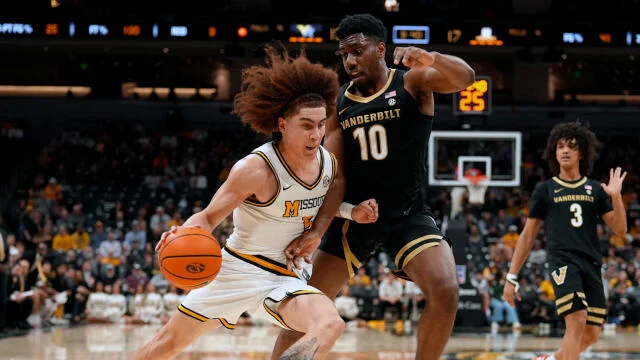
In the wake of the thrilling but crushing double-overtime loss to Alabama on Wednesday, the Hogs have to pull it together fast with two important home games coming up. Losing either one could put them at serious risk of falling off the double-bye line in the SEC Tournament.
Karter Knox is out – probably for the season, though that’s not official – and Isaiah Sealy is listed as Doubtful on the Friday injury report. That means the Hogs will once again just seven rotation players, and just three true forwards available. If the Hogs were playing one of the biggest teams in the SEC, and a team regularly puts opponents in foul trouble, I’d be worried.
Oh wait. They are.
Meet the Tigers
Now in his fourth season, we’re trying to figure out exactly how good of a coach Dennis Gates is. I thought he was a pretty good young up-and-comer when he came over from Cleveland State, and the results have been mostly positive but mixed overall. Gates led Mizzou to winning SEC records and NCAA Tournament appearances in his first and third seasons, and has a very good shot to do it again this year. On the flip side, his second team went 0-18 in the SEC, and his first-year 11-7 conference mark remains his best.
The Tigers have had some success plucking good players off mid-major rosters in the Midwest and Ohio Valley areas of the country, but they are still searching for a formula that will push them into the upper echelon of the SEC.
They are very much a bubble team this year. They’ve been pretty consistent: their highs are not super high, and their lows are not super low. Here’s how they’ve graded in each game this year.

That 91-48 thrashing at the hands of Illinois remains the low point, and they’ve taken brutal SEC losses to Alabama (90-64) and Texas (85-68) in recent games. Their best SEC performance was a 78-59 win over dismal South Carolina.

Model pick: Arkansas 90, Missouri 77. Injuries are not factored into this model, for those wondering. I’m working on building that in but haven’t gotten around to it.
In some ways, Missouri is the opposite of recent opponents like Alabama, Auburn, and even LSU, who had stronger predictive metrics (yes, LSU’s adjusted net efficiency is better than Missouri’s) but matched up horribly with Arkansas’ roster. This is closer to the opposite. Missouri appears much weaker on paper but their signature ultra-long zone defense is going to provide a much different look and could cause problems for the Razorback offense if they are not prepared.
- Matchup Analysis: Arkansas must match Texas A&M’s frantic energy

- Box Score Breakdown: Arkansas 94, Missouri 86

- Matchup Analysis: Do the shorthanded Hogs have enough length to tangle with the Tigers?

Personnel

This is not an ideal game to be without Karter Knox, as Missouri gets a ton of production from the small forward position. Their three best offensive players are all labeled as small forwards based on their stat profiles, although they are hardly “small”: three of the guys listed as SF in the table are 6’9, 6’10, and 6’8.
It starts with onetime Duke transfer Mark Mitchell, a 6’9 small forward who paces the team with 16.9 points and 5.5 rebounds per game. He doesn’t offer much of a 3-point threat (just under 30% on 1.4 attempts per game), but he’s a bully inside the arc. His finishing is merely decent, but he’ll make a living at the foul line, averaging 0.84 free throw attempts per 2-point field goal attempt, which is extremely high. Arkansas desperately needs Sealy, even if just for the use of his five fouls, as Mitchell is capable of putting opponents into foul trouble. He’s also a pretty good defender who uses his length well.
Mitchell’s volume pairs nicely with the efficiency of 6’4 Detroit transfer Jayden Stone, a 3-or-drive combo guard who averages 15.1 points per game. He’s the 3-point volume guy, hitting 41% on about five attempts per game (half his shots), and earning 0.80 free throws per 2-point field goal, which totals out to an elite 66% true shooting (1.32 points per shot chance). No wonder he has the highest Off-xRAPM on the team.
The backcourt
Point guard duties are split between 6’4 sophomore T.O. Barrett and 6’3 junior Anthony Robinson II. Robinson was the guy entering the season but Barrett has been starting more recently. Robinson’s problem is simple: he’s not a shooting threat. He’s hitting a measly 27% from beyond the arc and nearly half his shots are 3-pointers. His 17% turnover rate is also a bit high for a guy who really doesn’t dish out a lot of assists (3.1 per game). He’s pretty good defensively thanks to a team-high 3.6% steal rate (that’s really good), but he’s mostly been a drain on the offense.
Barrett also struggles to shoot (also 27% from 3), but he takes 3-pointers at a much lower volume than Robinson and is much craftier inside the arc, where most of his 8.2 points per game come from. The cost is high, however: a very bad 20% turnover rate, and much worse on defense (though he also gets a lot of steals).
Barrett and Robinson will play 8-10 minutes per game together, but otherwise they sub for each other at one position. Missouri has another true guard, 6’3 UCLA transfer Sebastian Mack, but he’s also struggled to shoot and has seen minutes decline to nearly zero in SEC play.
The frontcourt
Missouri’s paint defense is anchored by 7-foot Arizona State transfer Shawn Phillips. He averages 7.5 points and 5.1 rebounds per game, shooting 65% true shooting, all of it around the rim. He’s a bit of a shot block threat (1.5 per game), but he’s really more of a deterrent, as the Mizzou zone allows him to always be in the way of driving guards. Offensively, he’ll draw a few fouls but is just a 46% free throw shooter, and much of the good he does is undone by his monstrous 26% turnover rate.
Another “small” forward is 6’10 junior Trent Pierce, who averages 10.2 points per game, all in SEC play. Despite his size, Pierce is more of a 3-point shooter, taking 70% of his attempts from deep and hitting them at a rate of 40%. However, his usage is low and he’s not a great rebounder.
Off the bench you might see 6’11 junior Luke Northweather, an Oklahoma transfer, as the backup center. He doesn’t shoot a ton but he hits 41% from beyond the arc on a little more than one attempt per game, but he’s not nearly as good a defender as Phillips. And there’s 6’8 veteran small forward Jacob Crews, a 3-point shooter who’s hitting 46% from beyond the arc but struggles on defense.
If you’ve had enough of the tall guys… we haven’t even met the tallest. Not on the list above is 7’5 monster Trent Burns, who was +19 in 18 minutes against Vanderbilt on Wednesday. He’s a freshman who had only played 30 total minutes in SEC play until that game, but he had three points and seven rebounds. His extended playing time came with Phillips in foul trouble, but he was quite the revelation in that game, so it would not surprise me if the Hogs have to deal with him.
Lineup analysis
Gates loves to run a 1-3-1 zone with his point guard (Barrett/Robinson) at the top, his center (Phillips/Northweather/Burns) down low, and long wings (Mitchell on one side, Pierce/Crews on the other), with the remaining guy (mostly Stone) in the middle. They’ll also use plenty of 2-3 zone with a similar setup. Getting into the lane against all that length is a tall task, literally. But getting open 3-pointers is not particularly difficult, and most of Mizzou’s losses have seen them run out of the building from beyond the arc.
This game had Knox written all over it, as his corner 3-point shot will be wide open all game long when Hog guards drive inside, and his defense would be very helpful against Mitchell. Without him, Billy Richmond III does not offer the same 3-point shooting or defense, although he may offer more turnover-forcing and transition opportunities. Trevon Brazile, who was 0 of 4 from 3 against Alabama is shooting just 25% from 3 since mid-January, may can pick up the slack with open 3-point looks off kickouts.
It’s probably too late in the season for this, but I do wonder what would have happened if John Calipari had tried working Elmir Dzafic into the lineup earlier in the season so he was a little less “green” at this point. Nick Pringle’s struggles to protect the paint are well-documented, and this might actually be the kind of game that a player with Dzafic’s skillset could help win, especially if Sealy is indeed out again and the Hogs have just three true forwards, and Burns ends up getting extended minutes for Mizzou. As we’ll see, Missouri is likely to cause some foul trouble just like Alabama, so Cal might end up having to play Dzafic whether he wants to or not.
When Arkansas has the rock

You can see Missouri’s lone specialty: paint defense, where they rank 7th. The fight hard to prevent transition with their length, but teams that can run often have success, as they rank just 291st in transition efficiency (most shots in transition occur before they can get their zone set up). So I think the Hogs should really try to push all transition chances in this game.
Arkansas has been slicing zone looks to pieces this year, but I’m curious how they do against a more dedicated zone team, especially without a 3-point threat on the wing. My suspicion is that Acuff and Thomas have the NBA talent to dice it up just fine, but if their frontcourt teammates (mostly Brazile and Malique Ewin) aren’t in the right places at the right times, this could turn into a frustrating watch.

The Mizzou zone has one aim: keep you out of the paint. And they are quite good at that, ranking 15th in paint usage and 16th in paint field goal defense. They don’t however, do anything else well: they allow a high volume of 3-point looks (331st), struggle to defend the 3 (303rd), foul too often (186th), don’t force turnovers (225th, only the high guard in the 1-3-1 forces turnovers), and are below-average at rebounding (195th) despite a ton of size.
The fact that Mizzou can, for all its faults, prevent driving guards from eating them alive is concerning. We’ve tracked that for a while on this site, but Arkansas’ offense is elite against defenses that struggle to stay in front of driving point guard. The Hogs are merely pretty good against defenses that surrender the perimeter in order to protect the interior.
The two stats to watch for me are 3-point shooting and offensive rebounding. The Hogs will have opportunities to find and make open 3-pointers, so they have to hit them, especially at home. And the bigs need to be active on the offensive glass. That means Ewin and Pringle under the basket, but the zone struggles with boxout assignments, so rim runners (Brazile, Richmond) who fly in from the perimeter and grab rebounds are in great shape for this one.
When Mizzou has the rock

The Mizzou offense is all about getting the easy points. They want to go fast in transition and attack the paint. When confined to halfcourt, their offense can really struggle. Arkansas needs to rotate back on defense and keep the Tigers from getting easy paint points as often as possible.

In wins over Mississippi State, LSU, and Auburn, the Hogs suddenly defended the paint much better, as the Auburn and LSU games featured the two lowest paint field goal percentages allowed against them in power five games. As we noted in the Alabama preview, the Hogs’ paint FG% defense had improved from 265th to 200th in less than two weeks. However, the Hogs were thrashed in the paint against Alabama, and are now back at 244th.
So what happened? It appears that the sudden improvement was due to less switching on defense. The Hogs’ last three opponents were all poor 3-point shooting teams, so they decided to switch less so that the bigs could be in better position in the paint, despite this risking allowing some open 3-pointers. The Hogs blocked 20 shots across the LSU and Auburn games and allowed paint FG% of under 45% in both games. But against Alabama, you can’t not switch. The Tide had five 3-point threats on the floor at all times and will rain 3s on any team that doesn’t switch. The Hogs figured their best chance was to trade 2s-for-2s and smothered the perimeter with switches, which provided paths for Tide guards to penetrate into the paint. It almost worked, except… one of the downsides of letting the Tide into the paint so much was that the Hogs ended up committing a lot of fouls, something you can’t really afford to do with seven available players.
So what’s the application for this game? Missouri has a few solid 3-point threats, but they don’t take a lot of 3-pointers (241st) due to their preference for getting inside. Letting them inside unlocks their great finishing (36th in paint FG%), foul-drawing (26th in free throw rate), and offensive rebounding (28th). Compared to Alabama’s primary ballhandlers, Missouri’s are much poorer 3-point shooters, so they are not nearly as much of a threat to pull up from 3 if a defender goes under a ballscreen. Stone is really the only major threat to pull up and even he’s better on catch-and-shoot attempts. Arkansas can probably go back to less switching to keep their bigs ready to defend against all that length inside.
Keys to the game
No Alabama hangover. It’s definitely a threat here, but you don’t want the Tide beating you twice.
Hit some corner 3s. The zone is going to allow the drive-and-kick for open corner and wing 3s. The Hogs don’t have their corner specialist (Knox) but Brazile, Thomas, and even Wagner can get good looks from the corner.
Activity on the glass. If Pringle’s not going to grab a rebound, he’s got to get out of there. Mizzou has several guys who are active on the offensive glass, and their own lack of boxing out means that the Hogs will have plenty of opportunities to get their own offensive rebounds.
Get in position in the paint. Unlike the Alabama game, the Hogs can probably live with chasing guys around screens in order to protect the positioning of their bigs. If the nearest defender is chasing the ball into the paint, the Hogs are either going to allow a ton of paint points or they are going to commit a ton of fouls, neither of which are optimal.
Thanks for reading! Be sure to follow us on X and Facebook for the latest posts.
The latest from Fayette Villains, straight to your inbox
Enter your email to subscribe and receive new post alerts and other updates. You can unsubscribe at any time.
Great point about the switching. In my head, I thought Mizzou was a better outside shooting team than they actually are (though 99th in 3 pt eFG% isn’t awful). So I’m hopeful that the lack of switching can help the paint defense. The other part is that hopefully when Ewin blitzes the ball screen in Pick and Roll it doesn’t turn into an open runway like it did against Alabama. I could see Mark Mitchell take advantage of that depending on who he’s matched up with and depending on what lineup combo is used. Hopefully DJ’s shooting can revert to his early season form so he can hit those open corner 3s that Karter used to. That may allow for a small ball lineup to be successful for the Hogs against Mizzou’s length.