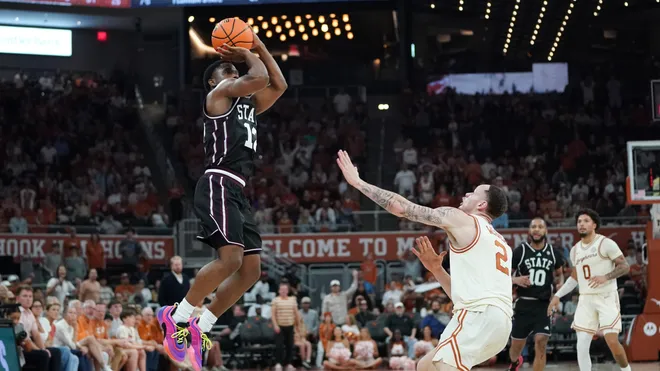
After a week off to digest Saturday’s 85-77 loss to Kentucky, the Razorbacks start a two-game road trip on Saturday against Mississippi State.
Both of these games feel like must-wins. We’ve said before that the Hogs needed to go at least 5-1 in their “middle six” games of the SEC schedule, and they are 2-1 so far. The remaining three are this one, LSU on the road, and Auburn at home. All very winnable. The Bulldogs in particular are 95th in the latest NET rankings, so this would be a Quad-2 loss if the Hogs cannot get it done. They’ve managed to avoid losses outside of Quad-1A so far.
Lineup math
As a follow-up to this week’s deep dive into Karter Knox and how he should be playing more minutes, not fewer, despite a scoreless outing against Kentucky, I pulled more data on lineup combinations this season and came up with this stat for the best lineup, that I posted on X:
Of course, Kentucky fans managed to find it. I assume they were just scrolling social media during the commercial breaks of the new episode of Kentucky-based reality show 1000-lb Sisters on TLC, but they started responding to me, helpfully letting me know that John Calipari does not, in fact, care about analytics or lineup math, and he’ll constantly use bad lineups. Thanks for that.
So I figured this was a great time to dive into some lineup math.
To start, here’s a list of all lineups that have played together at least 40 possessions in Arkansas’ 14 biggest games (all nine SEC games, plus the five big non-conference games):

There lineups have made up about 70% of all possessions in those games. The biggest thing that jumps out is that only two of them are positive. There are some lesser-used ones that are positive, but only two of the top eight lineups are actually outscoring opponents. Let’s look at them.
The best lineup is the one I mentioned in the X post: Darius Acuff, Meleek Thomas, Knox, Trevon Brazile, and Malique Ewin. That’s the starting lineup the Hogs should probably be using, because it includes the team’s five best players by xRAPM, and also its five best offensive players by a large margin. That lineup is plus-33 in 81 possessions, including a 144.4 offensive efficiency.
That lineup played just six possessions against Kentucky, but they were impactful. The first stint together came early in the second half with the Hogs down 45-39. The Hogs got a pair of Ewin buckets and a Brazile 3 to cut the lead to 51-48 when the stint ended with Billy Richmond III checking in. Richmond subbed back out shortly after, with the Hogs up 57-56, and the lineup’s second stint held Kentucky scoreless for a possession while Thomas made a couple free throws to extend the lead to 59-56. Then DJ Wagner came into the game and Arkansas’ best lineup this season never reassembled. Kentucky outscored the Hogs 29-18 after that point.
This lineup doesn’t see the floor often because it contains four starters, so when Ewin checks in for Nick Pringle, there’s usually at least one other substitution that prevents this exact five from forming. This could be resolved by just starting these five. You’ll notice that Arkansas’ current starting lineup – Acuff, Thomas, Knox, Brazile, Pringle – has also played 81 possessions, but is net-zero.
The other positive lineup is the “closer” lineup that is identical to the best one except with Richmond for Knox. It’s the most-played because Calipari likes to go to it late in close games. It’s been fine for the year (plus-14), but it let the Hogs down Saturday, going minus-seven (19-12) across the 13 possessions it played together. After playing a couple of early stints with mixed results, it entered a 72-69 game late and was promptly outscored 8-1 to seal the loss.
Here’s every two-man combination’s results in the 14 power conference games:

Thomas is Arkansas’ plus-minus king. He’s positive with everyone and has a strong case to be Arkansas’ total minutes leader moving forward, since it is clear that Arkansas has a pair of point guard options but no one who can reliably replace him in the lineup. Ewin should probably play even more at the expense of Pringle, who is the only negative Hog. And as we’ve discussed, Knox should be playing way more minutes than Richmond.
Okay, so what about the stragglers: Wagner, Richmond, Brazile, and Pringle? Pringle should probably be relegated to a pure backup role to Ewin, playing only when Ewin needs a breather or is in foul trouble. But the others are actually interesting:
- Brazile is great with Ewin and Thomas, so he fits nicely in what should be the predominant lineup. However, he’s very poor with both Richmond and Wagner, who come off the bench.
- As bad as Wagner is overall, note that he’s actually quite good when he subs in for Acuff and plays with Thomas. He is bad when he’s sharing point guard duties with Acuff.
- Richmond is very good with Knox, which is interesting because they mostly play the same position.
From that, we can figure out a good secondary lineup. Remember from our Knox piece that when Knox is on the bench, Wagner struggles. So Knox plays well with Wagner, and Knox plays well with Richmond. What if all three play together? Good things:

When Arkansas uses this trio together, they mostly pair it with Acuff at point guard and Ewin at center. Interestingly, that lineup is outscoring opponents 43-30 this year (including a 6-1 spurt in the first half against Kentucky), and it’s the only positive lineup with Acuff and Wagner playing together.
The other solid option has Wagner at point and Thomas in the game, with Acuff on the bench. That lineup is outscoring opponents 44-38 in 31 possessions. It did not play against Kentucky.
So let’s sum up this edition of lineup math:
Acuff-Thomas-Knox-Brazile-Ewin is by far the best lineup. This lineup is only averaging about seven possessions per game together and it usually doesn’t see the floor in the first half. That needs to change. It should start the game and be playing 15 possessions or more per game.
Knox should dominate minutes at the 3, but consider Knox-Richmond together more. Wagner-Knox-Richmond lineups in particular allow you do several things: replace Brazile, who does not play well with other backups, and give either Acuff or Thomas a breather. That’s an excellent choice for a secondary lineup.
- Matchup Analysis: Can the Hogs slow down High Point’s clutch shooting?

- Matchup Analysis: Hawaii’s unusual defense will challenge Arkansas’ preparation

- Box Score Breakdown: Arkansas 88, Missouri 84

Meet the Bulldogs
Chris Jans might have been close to being Arkansas’ coach. Arkansas was reportedly in contact with his agent when the Tyson-Calipari talks heated up in March 2024. He’s a fine coach, but that would not have been an impressive hire.
Jans has been around the block. He was a successful junior college coach who became a trusted assistant to former Wichita State head coach Gregg Marshall. In 2015, he was fired in his first season as Bowling Green’s head coach after being drunk and inappropriate at a local bar after a game. He relaunched his career at New Mexico State and promptly went 122-32, reaching three NCAA Tournaments in five years, and upsetting UConn in the 2022 NCAA Tournament before falling to JD Notae, Jaylin Williams, and the Razorbacks in a hideous game in the Round of 32.
He’s been the model of consistency so far in Starkville: 21-13, 21-14, and 21-13 in his first three seasons, with three straight 8-10 SEC records, and three straight NCAA Tournament appearances. That’s pretty impressive for one of the worst jobs in the conference. Unfortunately, if you don’t swim forward, the current eventually pulls you backward, and that’s what has happened this season.

The Bulldogs seem to start to pull it together in December, with wins over Utah (the worst team in the Big XII) and Memphis. They then started 2-0 in SEC play. But a blowout loss at Kentucky made the wheels fall off. Four of their six SEC losses have come by double digits, and struggling LSU is their only win in a month.

Model pick: Arkansas 87, Mississippi State 77.
They beat LSU and Oklahoma, but our model says this is the worst team in the SEC overall. Their offense in particular has struggled. The biggest concern is that Arkansas has historically been awful in Starkville:
Personnel
State’s been a mess this season as they’ve struggled to find consistent contributors on offense.

The stars
Everything for the Bulldogs starts with star point guard Josh Hubbard. He’s been the star for much of the Jans era, averaging 17.1 points per game as a freshman, 18.9 as a sophomore, and 20.8 this season, as a junior. He’s ultra-high usage (32%) and will dominate the ball when he’s in the game. Unfortunately, the efficiency just hasn’t been there this season. He shoots 32% from beyond the arc on extreme volume (8.4 attempts per game, most in the SEC). His 3.5 assists per game are a bit low for a ball-dominant point guard (Acuff, for example, leads the SEC at 6.2 per game). And he’s been quite bad on defense, doing nothing well.
The bigger concern for Hubbard is that his massive workload and the lack of success may be having a bad effect on him. After several monster games in non-conference play (29, 28, 27, 25, and 25 points), his production has massively tapered off in SEC play. He scored 38 points and attempted 31 field goals in the SEC opener against Texas, then scored 30 more against Oklahoma. But since then? He’s scored fewer than 20 in four of his last five and and is 15 of 58 (26%) from beyond the arc in the last seven games.
The Bulldogs gave him a little bit of scoring help this season in the form of 6’2 shooting guard Jayden Epps, a transfer from Georgetown who averages 15.3 points per game. Epps sometimes starts and sometimes comes off the bench, but he plays starter-level minutes. Epps is also very high-usage, and he’s also here to shoot 3-pointers. He’s sixth in the SEC with 6.9 3-point attempts per game, but he shoots just 31%. Like Hubbard, he’s a poor defender.
Hubbard and Epps can be a bit slippery if you can’t stay in front of them, but for the season, they are giving the Bulldogs extreme volume but at the cost of very low efficiency and a major hurt to the defense.
The supporting cast
The other shooter you’ll see is 6’2 senior guard Ja’Borri McGhee, who mostly comes off the bench but has a few starts. He’s more efficient at just under 40% from beyond the arc. However, he’s extremely efficient inside the arc and struggles with turnovers compared to Hubbard and Epps. On the wing you’ll see 6’6 senior Shawn Jones Jr., a rare four-year player at the same school. Jones is a career backup who, like Achor, often starts but doesn’t play a ton of minutes. He’s a career 26% 3-point shooter, although he is a solid defender.
The frontcourt is all over the place. The main center is sixth-year senior 7-footer Quincy Ballard, who played two seasons at Florida State, three at Wichita State, and is now in Starkville. Ballard is strong rebounder at both ends who is inefficient on very low volume as a scorer around the rim. He is a pretty good shot blocker as well whose biggest impact is dissuading teams from trying to get into the paint. That’s obviously very dangerous for Arkansas on the road in a gym where they historically do not shoot jumpers well.
When Ballard is out, you’ll see 6’10 freshman Jamarion Davis-Fleming, the backup center. He’s gotten better as the season has gone on and he stuffs the stat sheet with rebounds and shot blocking, but he’s a poor defensive rebounder who seems to often be out of position at both ends.
Joining Ballard in the starting lineup is 6’9 senior Achor Achor, who broke out under Bucky McMillan at Samford, but was dismissed from Kansas State after seven games last season. Achor is a monster rebounder, but he’s less of a shot-block threat, is a dreadfully inefficient scorer, and has proven to be pretty easy to manipulate out of position on defense. He often starts but doesn’t end up playing a ton of minutes. He’s mostly losing those minutes to 6’9 Slovenian national Sergej Macura. He does not offer much of a 3-point threat, but he’s a very good rebounder at both ends and is extremely efficient around the rim, albeit on low usage.
The matchup
With State, it’s all about staying in front of the small, slippery guards. Hubbard and Epps take about 60% of State’s shots when they are on the floor together. Teams that have dominated State have been able to force them into contested jumpers off the dribble, an ultra-inefficient shot that they seem to be okay with. Arkansas does not shut down the perimeter particularly well, so if those two get hot, there’s not going to be much the Razorbacks can do, which is scary.
The other danger is Ballard as a rim protector. For all its issues, State has been able to run opponents out of the paint this season. Relying on jump shots in a road game is always concerning.
However, the flip side of those matchups is that State’s guards are going to struggle to contain Acuff and Thomas for Arkansas, while the low-usage Bulldog frontcourt will struggle to punish Arkansas’ horrible paint defense.
When Arkansas has the rock
Jans teams usually play good defense. They usually are particularly good at disrupting transition, something they punished the Hogs with repeatedly in the 2022 NCAA Tournament.
Has that held up in 2026? Sort of.

So the Bulldogs are good at disrupting transition, ranking 56th in transition efficiency. But wow, they allow a lot of transition possessions. Opponents that want to push often can, and the average possession against them lasts just 16.4 seconds (that’s a bad thing). Arkansas is very good at getting in transition and generating fast breaks, so that could end up being a mismatch.

State defends shots just fine. Their 3-point defense is good, and their bigs do a good job of keeping opponents away from the paint area. Good stuff. But the shot volume is deadly. They are mediocre defensive rebounders, but the big issue is that they do not force turnovers. At all.
We’ve talked about different defense types several times this year. We noted that defenses like Ole Miss, Vanderbilt, and Oklahoma are “team defenses” that aim to disrupt ball movement but are vulnerable to driving guards, making them friendly matchups for the Hogs, who can drive right through them. On the other side is Kentucky, an “individual defense” whose roster is filled with long, athletic defenders who can hold their ground in a 1-on-1 but have been hurt in pick-and-roll situations all year. That was a bad matchup for the Hogs, who got poor ball movement on Saturday.
You can probably guess, but this is good news for this game: State is definitely in the former group. It shows up on film, but you can just look at the stats: the Bulldogs allow an assist on just 48% of made baskets against them, which means that 52% of the time, they gave up a bucket off the dribble. They allow a ton of midrange jumpers, which they are happy to live with – that’s usually what happens when a guard sees Ballard and decides to pull up instead of driving at him – but the shots that go in are often unassisted, and the high volume of attempts (due to the lack of turnovers) is a problem.
Overall, this is a game where “Acuff dribbles around and makes something happen” will probably work. Arkansas needs to figure something else out against opponents like Kentucky and Florida, but for this opponent, that should be fine.
When State has the rock
Jans teams are usually iffy on offense, often relying on one do-everything guard. Everyone remembers Teddy Allen erupting for 37 points in NMSU’s upset of UConn in 2022, and Hubbard has been the guy for the last three years.

Because of their veteran guards, State wants to go-go-go. Transition is their best hope of a good possession. When they are confined to halfcourt, bad things happen. That’s a big problem with Arkansas’ defense. The Hogs have not been very good at preventing transition possessions. It’s going to be critically important that the Razorbacks get back on defense, even if it means avoiding going for offensive rebounds.

State’s offense is something. No assists, no paint touches, no free throws, just Hubbard and Epps off the dribble, ranking 317th in team 3-point shooting percentage. Arkansas’ jump shooting defense is fine, but the Hogs do allow a high volume of 3-point attempts, which is a bit concerning is someone gets hot.
Defensively, I do think the Hogs must avoid allowing too many paint attempts, because the Bulldogs do finish well on the chances they do get, and several guys (Macua, Davis-Fleming, Ballard, Epps) are good at finishing in the paint if they can get there. If this game turns into a “both point guards just dribble around and pull up from 3”, I’ll take Acuff over Hubbard any day.
Keys to the game
Keep the ball in Hubbard’s hands. Arkansas doesn’t want some of State’s role players to get too involved. The Hogs need to prevent transition attempts and keep those role players sidelined on offense while Hubbard and Epps dribble around in the halfcourt.
Push, push, push. State has had issues keeping opponents from running on them, largely because their guards struggle to stop the man with the ball. Any chance Arkansas has, they need to get Acuff, Thomas, and Wagner going downhill toward the basket.
The latest from Fayette Villains, straight to your inbox
Enter your email to subscribe and receive new post alerts and other updates. You can unsubscribe at any time.