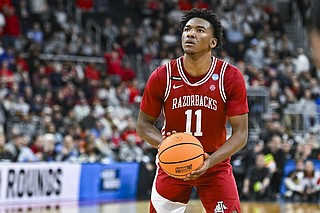
In the wake of Arkansas’ ugly 85-77 loss to Kentucky at home, fans are looking for someone to blame. Surely there’s a lineup tweak or attitude change that could fix everything.
One subject of ire is Nick Pringle, who has been a major disappointment this season. That seems justified. We will dive into that later in the post, but Pringle’s issues as a post defender and rebounder – things he was supposed to specialize in – have seriously lowered both the ceiling and the floor of this team. Did Arkansas try to contact other defensive bigs? Did they really think Pringle was going to be a good player? Who knows. But Arkansas’ paint defense got wrecked yet again on Saturday.
The main focus of this article is on a guy who was scoreless: Karter Knox, who played just 16 minutes. He seems to be in a sophomore slump of sorts. He’s averaging 8.4 points per game on increased shooting efficiency from last year, but so much of that came in the non-conference portion of the year, and he’s been eclipsed by Arkansas’ fabulous freshman in conference play. Going scoreless and grabbing just one rebound in 16 minutes in a rough look for a guy who was supposed to be an all-SEC contender.
And yet, Arkansas was plus-6 on the scoreboard with Knox in the game. He was the only positive player in that regard for the Razorbacks. It’s important to note that single-game plus-minus is notoriously unreliable. The sample size is much too small and there are too many factors that can influence that number. But this isn’t a single-game thing. For the entire season, Arkansas is 5.3 points per 100 possessions better with Knox on the floor versus off, third-best on the team. And Knox and Meleek Thomas are the only two players that have positive On-Offs both offensively and defensively (Arkansas gets better at both ends with them in the game).
In this post, I’ll try to make the case that there’s a reason for that. I did the same thing with Jordan Walsh back in 2023 when Walsh was struggling to make shots but still very clearly making the Razorback offense better. Knox makes Arkansas better at both ends even when he doesn’t do much on the stat sheet. That even includes the scoreless effort against Kentucky. In fact, a strong case can be made that taking Knox out in a 59-59 game with just under 10 minutes to go was a major mistake that played a role in the Hogs losing.
- Matchup Analysis: Can the Hogs slow down High Point’s clutch shooting?

- Matchup Analysis: Hawaii’s unusual defense will challenge Arkansas’ preparation

- Box Score Breakdown: Arkansas 88, Missouri 84

Arkansas is much better with Knox
Let’s start with the basics. I only looked at 14 games: all nine SEC games, plus the five big non-conference games (Michigan State, Duke, Louisville, Texas Tech, Houston). Here is how Arkansas has performed as a team with Knox on the floor versus on the bench:

Arkansas is about 16.6 points better per 100 possessions with Knox on the floor. That equates to 65 points across 14 games, or 4.6 points per game better with Knox. That’s pretty significant!
Knox seems to make the team better across the board. About two-thirds of that 65-point gap is offensive, and about one-third is defensive. Of the two-thirds offensive, it seems to be split evenly between Shot Volume (shots generated per 100 possessions) and Shot Efficiency (true shooting).
The Shot Volume part is easy enough to resolve: Arkansas’ turnover rate is 11.96% with Knox in the game and 16.62% with him on the bench. Out of 365 Division I teams, the Hogs’ turnover rate with Knox on the bench would rank 202nd in the country. The rate with Knox in the game? That would actually be the best in the country. And remember, this is all power conference games, so no stat padding. Given Arkansas’ normal shot efficiency, the rise in turnover rate when Knox goes to the bench has cost Arkansas about 26 points across 14 games, almost two points per game on one stat alone.
The gap cannot be attributed to the individual turnover rates of Knox and Richmond. Knox has a turnover rate of 12.7% this season, while Richmond is at 13.8%. That’s slightly higher, but it doesn’t explain the difference.
However, finding clips of Arkansas turning it over when Richmond is in for Knox is not hard. I found this one after less than five minutes of searching:

This turnover is charged to Nick Pringle – as it should be – but this is a mess of a play and I’m not sure what was supposed to be happening here. Wagner almost runs into Richmond, who then attempts a basket cut despite three Oklahoma defenders in the passing lane.
One consistent theme of Arkansas’ turnovers when Knox is out is spacing. Richmond seems to frequently find himself in odd positions that interrupt team spacing. It’s not always clear that it is his fault. Sometimes he’s too close to a teammate, as in the clip above. Sometimes his defender can sag off of him and help guard someone else (we’ll see an example of that from the Kentucky game in a minute).
That second point is actually related to the other issue: shot efficiency. With Richmond in for Knox, Arkansas gets to the rim more and gets more trips to the free throw line. Richmond himself rarely gets to the line, but the “bunching” effect that tends to follow him around leads to more contact and more broken plays that end in layups.
But when Knox is in the game, Arkansas takes 3-pointers at a higher rate and makes them at a higher rate as well. In fact, no single player correlates with improved 3-point shooting for Arkansas more than Knox. The chart below shows Arkansas’ 3-pointers made per 100 possessions for all of Knox’s teammates based on whether he’s on the floor:

Ok, so Darius Acuff is slightly less productive from 3, but Meleek Thomas and Trevon Brazile significantly improve their volume of made 3-pointers when Knox is in the game, and…. wait. What is happening on the right? What is DJ Wagner up to over there?
One of the more fascinating dynamics of Arkansas’ offense is that Wagner and Knox appear to be highly dependent on each other. Wagner seeing a decline in minutes and then losing his starting job has correlated with Knox’s production dropping. And Knox being out of the game has correlated with Wagner’s production falling off a cliff. In the 14 power conference games, Wagner is 10 of 24 from beyond the arc when Knox is in the game. Take him out, and Wagner is just 1 of 14. That’s a major difference.
Knox offers better spacing that Richmond because he’s a better 3-point shooter, so his defender cannot get away with sagging off of him when he’s away from the ball. That’s the same argument I made for Walsh three years ago. Analytics say spacing is good, and this is where it shows up.
But while positioning on the perimeter is horizontal spacing, there’s also something called vertical spacing, where players can create space out from the basket. In this play, Knox and Richmond are in the game together. See if you can notice the difference in how they react to a missed shot:

Richmond did nothing wrong here. He put his hand up to alert Thomas that he needed to shoot before the shot clock expired, but then he retreated back on defense. Knox was playing much deeper to try and give Thomas room to work (that’s horizontal spacing). But his defender stayed deep, meaning that Knox could afford to risk trying to get the offensive rebound. That’s vertical spacing.
And not only does Knox get the offensive rebound, he makes an excellent pass to set up his buddy, Wagner, for a wide open 3. Wagner misses, but Knox is there again and once again makes an excellent kickout to the perimeter, this time setting up a 3-point shot that goes in:

The box score shows Knox with two offensive rebounds on that sequence, but no points or assists. The reality is that he had a potential assist (the first kickout to Wagner) and he had a hockey assist (the second kickout to Thomas). Richmond offers a lot to this team, but he does not offer that on a regular basis.
The fact that Wagner and Knox maintain almost perfect spacing together is a theme I see in watching clips. We can back this out and look at total scoring volume when Knox is on or off:

Notice that everyone except Pringle improves their scoring rate when they share the floor with Knox. Acuff, Wagner, and Malique Ewin appear to be the biggest beneficiaries of playing with Knox. Acuff, Ewin, and Wagner take more shots, while Thomas and Brazile both take fewer shots that are generally more open and go in at a higher rate.
But Kentucky…
Okay, so the basic case for Knox making the offense better is clear. His horizontal spacing and movement without the ball helps reduce turnovers and generate more open 3-point looks, especially for Wagner but also for other scorers like Acuff, Thomas, and Ewin.
But he had zero points against Kentucky. And not only did he have zero points, but Richmond had 14 points and five rebounds on six of eight from the floor. So to really make the case, we have to demonstrate that Knox did something that doesn’t show up in the box score in order to earn that plus-six.
Let’s start by clarifying again that criticizing Richmond isn’t the goal here. He offers tremendous energy off the bench with a more chaotic style of play. Hog Stats has been tracking how long it takes him to score when he enters the game, as he has a tendency to make noise immediately:
Here was his first contribution against Kentucky, coming on the first possession after he checked into the game:

That’s a pretty straightforward sequence: a non-shooter goes to the opposite corner, so the defense ignores him, leaving no one to box him out on the rebound. His high energy and general rim pressure explain why when he enters the game, Arkansas’ percentage of shots at the rim rises (from 39% to 45%), the offensive rebound rate rises (from 34% to 38%), and the free throw per field goal rate rises (from 0.30 to 0.44). When you are stuck in a chaotic, physical paint game – like the St. John’s game last year – you want Richmond on the floor. It’s no coincidence that he was the Hogs’ leading scorer in that one.
The problem is, Arkansas really doesn’t want too many of those chaotic, physical paint games. Last year’s team at least had Jonas Aidoo; this year’s team is defending the paint with Pringle. Arkansas has vastly superior shooters to Kentucky, so the game ending up playing out the way it did is a failure of Arkansas to dictate the game’s flow. Yes, the physicality and skill of Kentucky’s defense caused the Razorbacks some serious problems, but the Razorbacks needed to find a way to play their game, not Kentucky’s.
Here are Knox’s stints in the game. After a bad start, he was plus-11 in about 10 minutes over the rest of the game. He exited a 59-59 game with just under 10 minutes to play and didn’t return until it was basically out of hand.

We’ve got several clips from that stretch Knox was on the bench coming up.
A few examples of Knox doing little things that help with team spacing still show up in a game where he didn’t play all that well. In this example, Arkansas pushes the ball after a defensive rebound. Kentucky star defender Otega Oweh is unable to pick up Acuff, so he has to stick with Knox. Watch Knox stay away from Acuff, preventing the switch as Arkansas goes to an empty side isolation:

Arkansas runs plays like this all the time, but I like that Knox never gives Oweh a chance to switch over to Acuff, who in turn is able to get a good drive on Collin Chandler. Then to top it off, watch Knox loop back around into the paint. Had Acuff’s shot rolled off the front of the rim, Knox was there for the stickback.
Here’s another one. Watch him use Thomas to break free of his man. If Brazile misses this shot, he’s there for a stickback:

At the end of the day, none of these worked out for Knox to do anything that contributes to the box score. But sometimes that’s how it works. He’s helping the team with this stuff.
Shortly after the sequence of those two plays above, Knox subbed out and Richmond subbed in. Now watch Richmond’s impact on horizontal space by watching his man, Denzel Aberdeen (#1):

Richmond probably comes too far up the wing (staying in the corner would keep his man away from Acuff), but because Aberdeen does not respect him as a shooter, he has no trouble leaving him to help contest Acuff.
We hinted at it above, but about one-third of the gap between Knox On and Knox Off this year is due to defense. Knox is a better defender than Richmond. That was true again Saturday. You can see in the chart above that when Knox entered the game for his second and third stints, Kentucky immediately had a stretch of one or zero baskets.
And for the game, Kentucky’s defense did most of its damage when Knox was on the bench:

That 144.4 efficiency is a big number for a struggling offense like Kentucky’s, as we’re going to see in this sequence, Richmond was right in the middle of most of the defensive breakdowns.
There’s not a lot of terrible play from Richmond, but there are plenty of examples like this one, where he tries to go over a screen (even though Ewin had basically switched) and ends up being unable to stay with his man, Aberdeen:

It sure looks like if he goes under that screen, he’d stay in front. Ewin was in position to contest a pull-up 3 should Aberdeen (a poor pull-up shooter) try that.
Right after Richmond’s exciting dunk to give Arkansas its first lead, he promptly loses Oweh in a scrum and the Hogs give the lead right back:

Knox came back in shortly after this, but was removed after a bad pass turnover led to an Oweh fast break bucket. But Kentucky’s finishing run came with Richmond at the center, this time he and Pringle flubbing a pick-and-roll:

Arkansas cut it to three, but then this happened. Brazile is fronting Malachi Moreno in the post, so Richmond, as the low defender, should probably get a body on Kentucky’s best rebounder. But he doesn’t:

I’m posting all of these not knowing exactly what the coaching points are. It’s possible that putback by Moreno is actually Brazile’s fault and Richmond wasn’t supposed to try to box Moreno out. The previous one might be completely the fault of Pringle, who switched when he might not have needed to. Regardless, all of Kentucky’s critical buckets that sealed the game came with Knox on the bench and Richmond in the center of the action.
Here’s another one. This doesn’t look like Richmond’s fault, but it’s his man. Richmond goes over a dribble handoff and can’t stay with Oweh, who gets a back-breaking and-one:

Again, not a huge breakdown, but Richmond isn’t an elite defensive player. He’ll make energy and effort plays, but he was not able to keep his man in front of him.
You may be wondering: how often was Knox the primary or nearest defender to a Kentucky scorer? Well, there’s this play:

That’s sort of a weird play. It should have been a turnover and I’m not sure how Pringle didn’t come up with that ball.
Knox later fouled Oweh on a 3-point attempt, and then were was that bad pass turnover where Knox ended up chasing Oweh on a fast break dunk. And that’s it. I did not see any other plays where Knox was the primary or nearest defender and he allowed a basket. Compare that to the five I just listed above that came on guys Richmond was guarding while he was in for Knox.
No, Knox can’t keep going scoreless. But he’s Arkansas’ best option at wing and he should continue to get starting minutes even when he struggles on offense. I think the Kentucky game exposed Arkansas’ overreliance on the “Acuff dribbles around and makes something happen” offense. Arkansas was unable to attack Kentucky’s iffy ballscreen defense, and the Wildcat defenders were good enough in isolation that they didn’t have to help on Acuff’s drives, which is part of the reason why Knox ended up with no open looks (he loves corner 3s from kickouts after his man helps against dribble penetration). He needs to be more involved and have more intentional sets run for him. Giving more of his minutes to Richmond is probably not the solution.
The case for Malique Ewin
This part is short, because the “case” is obvious. Ewin is a much better option than Pringle. Neither have been great defenders in big games, but Pringle is a defensive specialist, or at least he was supposed to be.
The proof is in the numbers, using these same 14 games:

The two players are basically producing identical defensive impact, but Ewin, unsurprisingly, is a much better offensive player. Arkansas’ offensive rebound rates jumps from 29% to 40% with him in the game, and the Hogs’ rate of shots at the rim (39% to 45%) and free throws per field goal (0.29 to 0.42) also make notable jumps when Ewin enters. In addition to having an arsenal of moves to actually score, Ewin is much more active in moving around under the rim, which means he sets teammates up for layups and offensive rebounds.
John Calipari and staff need to deal with the team’s slow starts before they get burned again. Starting the five best players is a great way to give yourself the best chance. I understand why he’s hesitant to give up on Pringle – any chance of a deep run in March probably depends on Pringle figuring something out and being much better down the stretch, like Aidoo was last season – but the Hogs can still give him plenty of minutes while playing their best five out of the gate.
Concluding thoughts
Summing up a long post, I think Arkansas is a very good team with several holes, the biggest of which is probably unfixable. I think Karter Knox is a very good player who should play more than 16 minutes, not fewer. I do think more needs to be done to get him going offensively so opponents continue to respect his offensive skill. I like Billy Richmond too, but I think he’s best in spurts off the bench. And I do think that Malique Ewin should start and play more, but I don’t think the Hogs gain much by totally giving up on Nick Pringle, who has, despite his issues this season, shown that he’s at least capable of being a better interior defender.
Agree? Disagree? Let me hear about it!
The latest from Fayette Villains, straight to your inbox
Enter your email to subscribe and receive new post alerts and other updates. You can unsubscribe at any time.