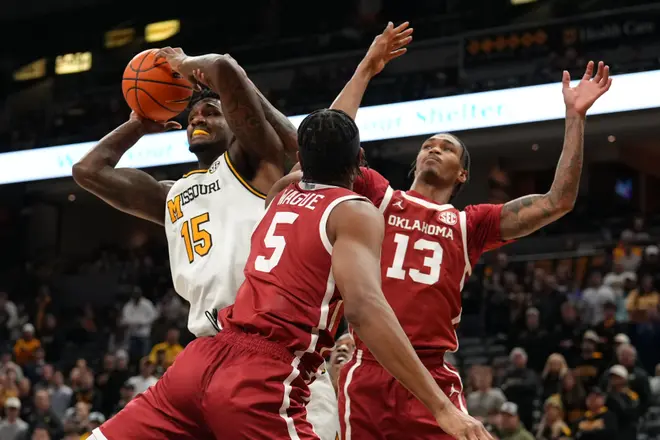
Arkansas sits in a tie for second place in the SEC as they travel to Norman to take on struggling Oklahoma.
It’s a big week, with Kentucky – also 5-2 in conference play – coming to Fayetteville on Saturday. But the Hogs cannot overlook the Sooners, especially with how their last two road games turned out. The Selection Committee doesn’t like it when you can’t win away from home, and Arkansas as a team is just 2-5 outside of the state. Oklahoma is a borderline Quad-2 game, even on the road, so the Hogs do not want to drop it.
- Matchup Analysis: Can the Hogs slow down High Point’s clutch shooting?

- Matchup Analysis: Hawaii’s unusual defense will challenge Arkansas’ preparation

- Box Score Breakdown: Arkansas 88, Missouri 84

Meet the Sooners
Porter Moser was a big name when Oklahoma hired him back in 2021. He coached at Little Rock in the early 2000s, but after bouncing around for several years, he’d done a phenomenal job at Loyola Chicago, taking the Ramblers to the 2018 Final Four and the 2021 Sweet Sixteen. He seemed like a no-brainer hire.
There was, however, something missing. Despite reaching some impressive heights at Loyola, Moser was not really able to build a consistent winner. Those two tournament runs were his only two NCAA Tournament bids in eight seasons, and he finished his time there just 89-89 in conference play.
That has, unfortunately, continued in Norman. It’s the same story for the Sooners every year. In his first season (2021-22), Oklahoma upset Florida and crushed Arkansas in Tulsa. They even upset Iowa State early in Big 12 play. Then they went 2-10 over their next 12 games and ended up in the NIT. The next year, they won the ESPN Events Invitational and later beat Florida again. Then in the middle of conference play, sitting as a bubble team, they lost seven straight Big 12 games. In 2023-24, same story. Moser’s best team beat Iowa, USC, Arkansas, and Providence in non-conference play and cracked the top-25. After starting conference play 3-2, they went 5-9 over their final 14 games.
The move to the SEC didn’t change much. Last year’s team started 13-0 and reached a ranking of 12th in the AP poll, beating Providence, Arizona, Louisville, Georgia Tech, Oklahoma State, and Michigan. Then they opened SEC play with four straight losses, finished 6-12, and lost in the first round of the NCAA Tournament.
The Moser Momentum may have finally fizzled, after star guard Jeremiah Fears went to the NBA and fellow guard Duke Miles transferred to Vanderbilt. The Sooners brought in an uninspiring class of recruits and transfers, and the result has been a program that hasn’t looked like an NCAA Tournament team at any point this season.

Arizona State, Wake Forest, Oklahoma State, and Marquette are all power conference teams, but they are not very good. So there’s not really much to this resume, and at six straight losses, Oklahoma is at risk of a last-place finish in the SEC, which might be enough to cause the Sooners to move on from their fifth-year coach.

The Sooners can score a little bit, but their defense is awful. The Razorbacks, meanwhile, are up to third in Offensive Efficiency, second in Strength of Record, and sixth in Strength of Schedule.
Second in Strength of Record means that if the NCAA Tournament started today, the Hogs should be a 1-seed. It’s still January, but last year, this same Strength of Record metric on Selection Sunday correctly placed all of the 1- and 2-seeds. Arkansas is mostly predicted as a five-seed right now, but if they keep winning the games they should, I think they can get much higher.
Model pick: Arkansas 93, Oklahoma 84.
Personnel
Forced to replace Fears and Miles in the backcourt, the Sooners gambled on a couple of transfers. Unfortunately for them, it has not paid off.

The Sooners don’t go deep into their bench: only six guys have played at least 30% of team minutes this year, compared to eight for Arkansas.
The backcourt: A little bit of O, no D at all
The backcourt duo is a pair of veteran transfers: 6’2 Xzayvier Brown and 5’10 Nijel Pack. Brown, a transfer from Saint Francis, paces the team in both points (16.5 per game) and minutes (31.8 per game). The volume scoring is there, but the efficiency is so-so. His 3-point shot isn’t decent but not a huge threat (he shoots 34% on about five attempts per game), but he manages about 57% inside the arc. He doesn’t get to the line much, doesn’t grab a lot of rebounds, and his assist-to-turnover ratio is only decent.
Pack has been playing college basketball forever. He’s in his sixth season overall: two at Kansas State, three at Miami, and this year at Oklahoma. He was fantastic as a sophomore at Kansas State, averaging 17.4 points per game (he scored 14 against Arkansas in a 72-64 Razorback win in which the Hogs were led in scoring by Connor Vanover and Chris Lykes), however, his three seasons at Miami were not as great. His 3-point shooting dropped and his turnover rate rose. He missed just about all of last year – including Arkansas’ win in the SEC-ACC Challenge – with an injury. Now in his final season, he’s looking more like old K-State Pack on offense. He averages 15.7 points per game and is shooting above 40% from beyond the arc.
Brown and Pack are formidable on offense, but they have struggled on defense. They don’t rebound well, get almost no steals, and struggle to defend the perimeter. Each averages a pitiful 0.4 stocks (steals plus blocks) per personal foul. The Sooners’ team defense gets significantly better when either of them comes out of the game, but because of their offense, they can’t keep them out for too long.
You’ll also see the team’s sixth man, 6’5 Long Beach State transfer Jadon Jones, who will play the 2 or the 3. He has the highest xRAPM on the team and is the only really good defender. Offensively, he mostly shoots 3-pointers, but hits just 29% of them. He does manage to draw shooting fouls frequently when he gets inside the arc. However, he’s a very good defender, leading the team with a monster 3.6% steal rate. He’s really the only major threat to get a live-ball steal for the Sooners.
The frontcourt: plenty of length, minimal production
The most productive frontcourt man is 6’9 Tae Davis, a transfer from Notre Dame. He average 13.0 points and 6.8 rebounds per game. He’s not a dangerous shooter (just 52% eFG%, almost no 3-point threat), but he’s an excellent offensive rebounder and rim runner. Like Brown and Pack, however, he struggles on defense.
The two other starters are 6’10 Mohamed Wague and 6’8 Derrion Reid, both transfers from Alabama in different years. Wague (6.7 points, 6.6 rebounds) is a monster on the offensive glass and presents a decent shot-block threat on defense. Overall, he’s Oklahoma’s second-best player by xRAPM. Reid (11.8 points) grades as the weakest starter. He has a decent true shooting of 60%, but his lack of 3-point shooting (34% on low volume) badly hurts Oklahoma’s spacing.
Off the bench, the Sooners have been using 6’11 Russian-born big man Kirill Elatontsev. He struggles with fouls but has hit 7 of his 11 3-point attempts so far. You may also see 6’6 senior Jeff Nwankwo, who mostly attempts 3-pointers on offense (shooting 26%) but grades as a decent defender thanks to a 2% steal rate and solid defensive rebounding.
The matchup
On personnel alone, this is probably the friendliest matchup the Hogs have seen so far in SEC play. The Sooner guards are terrible defenders who will have all kinds of issues staying in front of Darius Acuff and Meleek Thomas. And despite decent frontcourt size, the Sooner forwards don’t rebound all that well defensively.
On the other side, the Sooners do have a pair of statistically-productive guards, but the only real 3-point shooting threat is Pack at 42%. Contain him, and Oklahoma is going to need a really good day from someone else to have a chance. And again, despite the size of the frontcourt, they don’t have much of a post presence.
When Arkansas has the rock
Oklahoma’s defense is the weakest Arkansas has seen in SEC play so far.

For their many faults, Porter Moser’s teams do play disciplined defense. They get back well and rarely allow fast break points. In fact, they are pretty good at avoiding easy points generally, ranking 22nd in points off turnovers allowed, 21st in fast break points allowed, 133rd in paint points allowed.
They want to make opponents earn their points, but unfortunately for them, teams just keeping earning them.

Oklahoma’s actual biggest problem is shot volume. Because they don’t force turnovers (282nd) and don’t rebound well defensively (203rd), opponents can put up too many shots against them (315th). And while they are decent at things like not fouling (138th), preventing paint attempts (128th), and defending paint attempts (116th), they don’t defend on the perimeter well at all, ranking 192nd in 3-point defense.
Moser comes from the Rick Majerus coaching tree, which emphasizes never leaving perimeter shooters. Although strong 3-point defense an emphasis on forcing “tough twos” was a feature of Moser’s teams at Loyola and his first couple years at Oklahoma, the Sooners don’t do that anymore, at least as far as I can see. This sequence is more typical, where they allow two open 3-point looks and two offensive rebounds:

If the Hogs can maintain good spacing and crash the offensive glass, they should be able to generate open looks even if they struggle to hit 3-pointers.
When Oklahoma has the rock

Oklahoma can score some points, and as you’d expect for a team with two senior guards, they are always looking to push the pace. They don’t actual get a lot of true fast break opportunities (214th), but they will play fast and shoot quick off a change of possession.
Unlike their defense, which aims to allow no easy points, their offense gets no easy points. They aren’t a fast break team, they don’t get much off turnovers (because their defense doesn’t force them), and they don’t do a lot of damage in the paint. For Oklahoma, the 3-point shot simply has to fall or they have no chance.

Oklahoma gets a good volume of shots (24th) because they rebound well and don’t turn it over. But they don’t get to the line (196th) or get into the paint at all (342nd), so it’s all jump shots. About 45% of their field goal attempts will be 3-pointers. If they get hot, they can beat just about anyone. If they struggle, they have no Plan B.
Arkansas has defended the 3-point line well as a whole this season, but they allowed Houston, Auburn, and Georgia to each hit 10 or more from beyond the arc. If that happens again away from home, the Hogs could be in trouble.
Keys to the game
Defend the 3-point line. This is the most obvious key for any game this season. Oklahoma’s strength is its offense and the Sooners rely on 3-point shooting. If the Sooners can’t get to 10 made triples, the Hogs will probably leave Norman with a win.
Rain 3s on offense. Arkansas has several paths to victory. They could crash the offensive glass. They could dominate the transition battle. But the most straightforward way to win is to neutralize Oklahoma’s own offense by punishing their struggling perimeter defense. Good spacing and movement will lead to open 3-point looks, and even if you miss, long misses mean long rebounds, which has been a problem for the Sooners.
The latest from Fayette Villains, straight to your inbox
Enter your email to subscribe and receive new post alerts and other updates. You can unsubscribe at any time.