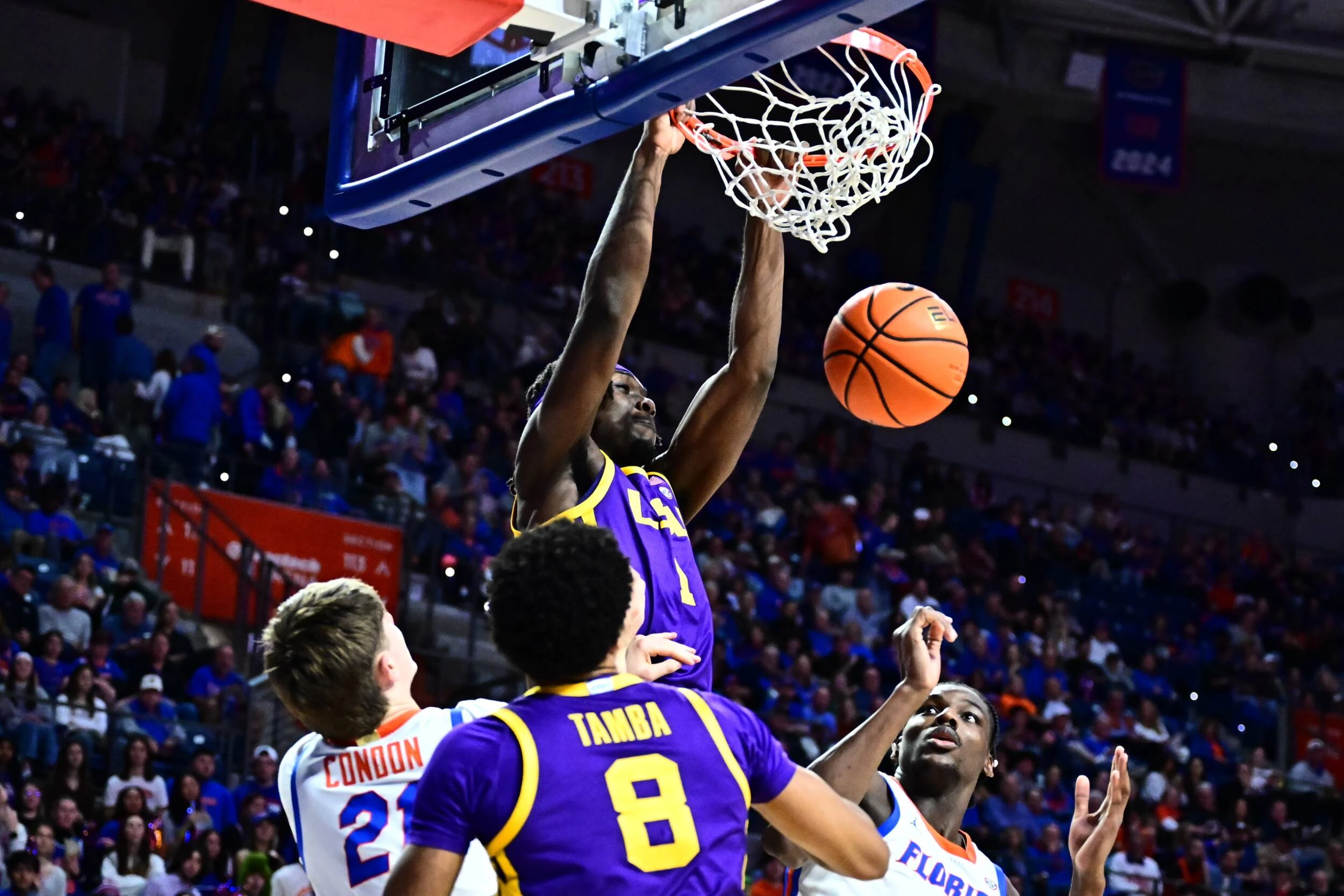
Arkansas and LSU seem to get together in bad winter weather every few years. Three years ago to the day from Saturday – January 24th, 2023 – the Hogs crushed the Tigers 60-40 in a snowy midweek game in Fayetteville.
The Hogs would love another 20-point victory, but I would expect more total points to be scored, as this game features two strong offenses and two iffy defenses. This is the first of six very winnable games for the Hogs. Three are on the road, so going 6-0 would be tough, but a 5-1 stretch over these games would set the Hogs up at 9-3 in SEC play heading into the final stretch run:
- Home: LSU, Kentucky, Auburn
- Road: Oklahoma, Mississippi State, LSU
I think next week – at Oklahoma and then home against Kentucky – is the tricky part. The Sooners aren’t bad and beating them in Norman will be tough, and then the Hogs have to turn around and take on a Wildcat team that’s won four straight SEC games and may be coming together at last.
Meanwhile, most eyes on Saturday won’t be on Fayetteville, but instead on Tuscaloosa, where Alabama coach Nate Oats apparently plans to play Charles Bediako against Tennessee.
Alabama has been using a very small lineup after injuries decimated their frontcourt, so Bediako could theoretically make a major impact.
If you’ve missed this absolutely insane story this week, I wrote a long post on Thursday on why the Bediako case is different from other major changes in the sport (like NIL and international players) and in fact threatens to undo everything that makes college sports unique. Be sure to check that out.
And for those wondering: yes, the court’s TRO prevents the NCAA from vacating (or threatening to vacate) any Alabama wins if they play Bediako, but like the rest of the order, all of it could be dismissed by a higher court, so there’s at least some risk for the Tide in playing the big man.
- Matchup Analysis: Can the Hogs slow down High Point’s clutch shooting?

- Matchup Analysis: Hawaii’s unusual defense will challenge Arkansas’ preparation

- Box Score Breakdown: Arkansas 88, Missouri 84

Meet the Tigers
Matt McMahon is a perfectly fine coach, but it was never going to be easy following up the mess that Will Wade left behind. Now in his fourth season, McMahon sits perched on what is probably the conference’s hottest seat. LSU has a lot of money, but everything they just spent to fire Brian Kelly and hire Lane Kiffin means they may not want to be quick to make a change in basketball.
That’s probably McMahon’s best shot to remain employed, because the product on the court likely isn’t going to save him. He’s 15-45 in SEC play over his three-plus years. This year’s team is very competitive and ran up scores against a weak non-conference slate, but the improved metrics haven’t translated to wins.

The wins over SMU and Missouri are decent, but they lost by 24 to Texas Tech and needed overtime to escape Boston College (probably the worst power conference program). That Kentucky game was their best chance to salvage things, but they blew a 38-22 halftime lead at home and lost on a Malachi Moreno jumper as time expired.

Model pick: Arkansas 91, LSU 82. I wouldn’t count on a 60-40 final score again, as both of these offenses can score and both of these defenses have had issues.
Personnel

The trio: a strong offensive punch
We have to start with the biggest news item for LSU’s roster: point guard Dedan Thomas Jr. is back. The 6’1 junior transfer from UNLV is averaging 15.1 points per game and ranks second on the team in xRAPM, but he missed the first five games of SEC play with a foot injury. He scored two points in 17 minutes in his debut against Florida. He’s generally high-usage, and though not an elite shooter (just 50% eFG%), he protects the ball (11% turnover rate) and activates the offense, averaging 6.8 assists per game. He also grades as a solid defender. LSU is a much better team with him on the floor.
The other two guys whose names you’ll hear a lot are 6’6 senior guard Max Mackinnon, an Aussie transfer from Portland, and 6’8 senior power forward Marquel Sutton, who averaged 18 points per game at Omaha last year. Mackinnon (14.6 points per game) is mostly a 3-point threat, shooting 43% from beyond the arc on 5.6 attempts per game (about half of his field goal attempts). He passes well and avoids turnovers, but as a perimeter player, he does not rebound particularly well for his size. He offers more to the offense than the defense.
Sutton (13.6 points per game) is more versatile on offense, offering perimeter skills as a stretch-4. He takes a lot of 3-pointers but shoots just 30% on them. However, his 3-point game sets up his skills inside the arc, where he shoots 60% and gets to the line regularly, making 3.5 free throws per game and shooting 82% at the stripe. Like Mackinnon, he’s not a very good defender, although he does rebound well at both ends.
The MVP: a low-usage stud
LSU’s actual best player per our player metrics is actually 6’7 small forward Pablo Tamba, a Spanish transfer from UC Davis. The numbers don’t jump out (7.0 points, 7.1 rebounds), but his plus-minus has been off the charts in every lineup combination and against opponents good and bad. Tamba is extremely low-usage (just 11%), but he shoots 46% from beyond the arc and nearly 70% inside of it, on a very low volume of attempts (just 3.8 field goal attempts per game). He’s an active rebounder, grading well at both ends (including grabbing 35% of LSU’s team offensive rebounds while on the floor, which is very good for a wing). And he’s the team’s highest-graded defender, thanks to a team-high 2.3% steal rate and the best Defensive On-Off of everyone except Thomas, who missed five conference games.
The rest: not much depth, not much defense
Tamba’s low usage can occasionally hurt LSU when the offense is stagnant, so his minutes are somewhat limited. The rest of LSU’s lineup is much weaker, though Thomas coming back certainly helps.
The final starter is 6’10 center Mike Nwoko, a transfer from Mississippi State. He’s a high volume scorer at 14.1 points per game on an eye-opening 70% true shooting (mostly right around the rim). He’s a strong rebounder, especially offensively, and his only real offensive weakness is that he doesn’t draw a lot of fouls. His weakness is defense, where he’s not a great rim protector, and LSU’s 107.1 defensive efficiency with him on the floor is quite bad, and his minutes are limited by the fact that he fouls frequently.
The main sub for Nwoko is 6’10 sophomore Robert Miller III, a low-usage chaos player. He shoots 75% true shooting (all 2-pointers) and, unlike Nwoko, gets to the free throw line at a good rate. He’s also a solid offensive rebounder. However, his 24% turnover rate undoes almost all the good things he does offensively. And defensively, although he’s better than Nwoko, it’s not by much.
Everyone else on the roster has a negative xRAPM, namely the guard duo of 6’0 freshman Jalen Reece and 6’6 senior Rashad King, a transfer from Northeastern. Both earned extra minutes trying to replace Thomas, with poor results. Both are poor shooters, with Reece shooting a dismal 38% eFG% and struggling with a high turnover rate. King is slightly better, but he still shoots just 30% from beyond the arc. Neither are good rebounders or defenders. The last guy in the normal rotation is 6’4 senior guard PJ Carter, who exclusively shoots 3-pointers (he’s at 33% on the year on moderate volume) but does not defend or rebound well.
The matchup
As you can guess, this is not an overwhelming LSU roster and it’s not really built to punish Arkansas’ weaknesses. Offensively, the Tigers do best when they crash the offensive boards and get Sutton and Mackinnon going on an inside-outside game. Sutton had 26 points in the big win over Mizzou, while Mackinnon had 20 points on 4 of 10 from beyond the arc in that game. LSU as a team had 16 offensive rebounds, including four by Sutton and five by Nwoko.
Against the Arkansas roster, an off-ball shooter like Mackinnon doesn’t worry me as much, as Meleek Thomas should be able to handle him. The key will be defending the dangerous duo of Sutton and Nwoko, which means the Hogs need the good version of Trevon Brazile to show up. Either Malique Ewin or Nick Pringle could shine, so John Calipari will probably go with the hot hand there.
Defensively, LSU is weak all over, so the Hogs can attack in several ways. As we’ll see in the stats below, LSU collapses everything when the ball gets inside the arc, so paint work is tough, but kickout 3-pointers are open all day, and the Tigers don’t rebound very well.
When Arkansas has the rock

LSU’s transition defense is fine, but they’ve been chewed up in the halfcourt this season. They aren’t getting killed in the easy buckets department, but opponents are earning points against them at a high rate.

LSU’s first-shot defense is fine (46th in true shooting, 62nd in eFG%), but the shot volume is the problem. The Tigers rank 303rd in forcing turnovers and 130th in defensive rebounding, so they keep giving opponents chances to score.
As we’ve seen with several opponents, Vanderbilt as the latest, the Tigers really want to stop the sort of pace-and-space, catch-and-shoot type offenses that are proliferating in college basketball, so they attack the ball and allow assists on just 46% of made baskets against them. And as we saw against Vanderbilt, that’s exactly what Arkansas wants to see, as that defense is vulnerable to guards that can penetrate off the dribble. I haven’t seen anything in the stats or in watching LSU this year that suggests they can stop Darius Acuff and Meleek Thomas on the drive.
LSU aims to prevent easy paint looks, so they’ll collapse on everything inside the arc. That leaves the kickout 3-pointer open, but it allows them to rank 31st in Paint eFG% defense and 79th in Paint Usage%. On the flip side of that, they foul a lot (193rd) and can struggle to defend the 3-point arc (188th). The Tigers will mix man and zone looks, and Acuff and Thomas will need to be crafty to finish once they find their way into the paint.
Here’s an example of how LSU plays paint touches. Watch Rashad King (#4) leave his man to try and “dig” the ball out against Florida star Alex Condon:

Arkansas doesn’t have a post player like Condon, but they can have success by kicking that ball back out to the guard and then attacking before LSU can reset defensively.
When LSU has the rock

As you can see, LSU struggles to crank up the tempo, but they are decent in halfcourt. In particular, they want to attack the paint, so their offense is an inverse of their defense (which aims to limit paint scoring).

Here’s the scary part of the matchup. LSU is very good at getting into the paint (52nd), finishing there (25th), and then getting to the free throw line (42nd). They are also decent on the offensive glass (88th). Defending the paint has been a serious issue for the Hogs, as Pringle has not been the interior defender that I think many were expecting, and Ewin and Brazile have never been great interior defenders. If Arkansas loses this game, it will almost certainly be because Sutton and Nwoko made a living in the paint and the Hogs had no answer.
The good news is that if the Hogs can even just slow that duo down, the rest of the job is not hard. LSU seriously lacks 3-point weapons, with Mackinnon really being the only one who can score at volume from downtown. The Tigers are also occasionally turnover-prone, and as we saw above, they are not a great fast break or transition team.
Keys to the game
Crisp ball movement. LSU doesn’t force turnovers at all, and the Tigers are vulnerable to inside-out passing or quick reversals due to the tendency of one-pass-away defenders to leave their man to help when the ball goes inside the arc. The Hogs can generate open 3-point looks and lanes for the guards to drive through if they are crisp with their passing. If they are sloppy, any turnovers are a total gift to the Tigers.
Weather the storm on the interior. LSU’s offense mostly goes through their two bigs and will relentlessly attack the paint. The Hogs don’t have to totally shut down Sutton and Nwoko, but they have to at least offer a fight in the paint. Those two can even hit plenty of shots if the Hogs just rebound well and don’t foul. A total breakdown of interior defense is the biggest threat for the Hogs in this game.
The latest from Fayette Villains, straight to your inbox
Enter your email to subscribe and receive new post alerts and other updates. You can unsubscribe at any time.