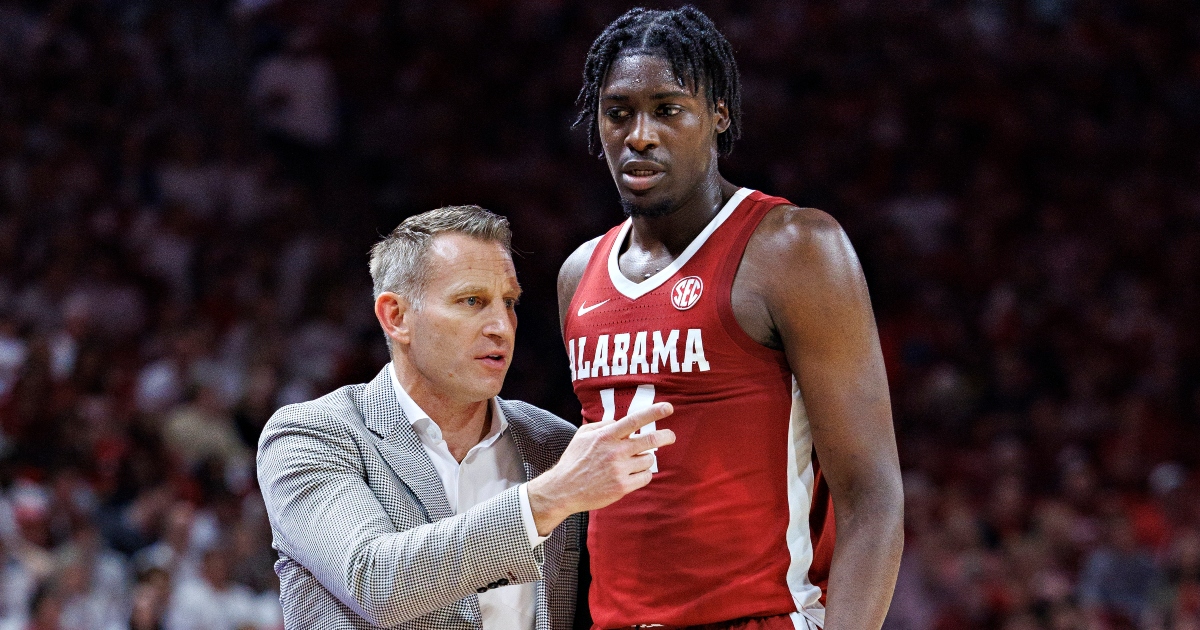
It was a matter of time. Weeks after the NCAA granted eligibility to former NBA draftee and G League player James Nnaji at Baylor, an even wilder situation emerged:
Yes, that Charles Bediako, who played against JD Notae and Jaylin Williams at Arkansas. After two seasons with the Alabama Crimson Tide, he declared for the draft. He went undrafted but signed a deal with the Spurs that was later converted into a two-way deal. He was injured before he could actually play in an NBA game, but he later signed deals with the Magic and the Nuggets, playing the NBA Summer League and the G League for two-plus seasons (including this season).
Now, thanks to an temporary order from a Tuscaloosa County Circuit Court judge, he’s eligible to suit up for the Crimson Tide for the first time since a March 2023 loss to San Diego State in the Sweet Sixteen. The judge, a paid lecturer at the University of Alabama and possibly a donor to the university, has set a court date for Tuesday, but will allow Bediako to play as soon as Saturday and has enjoined the NCAA from threatening to vacate any future Tide wins that involve Bediako.
This is, obviously, insane. And Alabama fans who were against this madness with Nnaji until the news broke on Tuesday are now suddenly in favor, as I’ve seen in my social media mentions. Kudos to the handful of Tide fans who have noted that they are happy about only because it may finally lead to clearer guardrails in the eligibility space for the NCAA.
The student-athlete model
My thoughts on this are complex, and social media arguments aren’t going to solve anything. So here’s a long post with my thoughts. To start, we need to understand what the NCAA is trying to be. Keyword is trying, because they’ve fouled up basically every issue they’ve involved themselves in, and that’s part of the reason why they are in a legal pickle so bad that someone called a “Tuscaloosa County Circuit Court judge” is bossing them around over who gets to play in an Alabama basketball games.
As bad as the praxis has been, the concept is good. For decades now, the NCAA has fought to avoid becoming a “minor league” to any of the pro sports. Instead, they’ve sought to settle into a niche as an amateur-prep league. The best players can go pro eventually, but everyone gets a chance to work towards a college degree like a normal 18- to 22-year-old. Fans are watching young men and women who represent a specific university, probably a university that the fans have a personal connection to. Those players are students and athletes. Student-athletes.
The NCAA has fought to protect this idea and has collaborated when it can with the pro leagues. The best example is the 1965 agreement with the MLB that requires young baseball players to either sign with the pros (closing the door to college ball) or commit to three years in college. That offers roster continuity to college baseball teams while still allowing the absolute best to shine in the pros. College baseball would be in a much worse state if that rule didn’t exist (like, if a Tuscaloosa County Circuit Court judge enjoined its enforcement).
Amateurism is what holds the whole system up
If you want to see the main reason why the NCAA wants to maintain the student-athlete model, just take a quick gander at average per-game television viewership numbers for nationally-televised games over the past three seasons:

The implication is fairly obvious: minor leagues cannot compete with college sports in terms of viewership. More than 99% of all viewers of non-NBA basketball are watching college hoops, and more than 99% of non-MLB baseball viewers are watching college baseball.
Baseball is a particularly scary case study when you consider what the G League could become. In basketball, where the G League is tiny, lower-level hoops gets around 76% of the per-game viewership of the NBA on national networks. Not bad! But college baseball is relatively gutted in terms of 18- to 22-year-old talent due to the existence of a large minor league network that acts as a competitor. The fact that minor league baseball has significantly more talent is totally meaningless to its own viewership, which is miniscule. But the fact that it swipes talent from college baseball probably hurts the college game, and the result is lower-level baseball getting only 40% of the viewership of MLB games.
You may think those viewership numbers for baseball are justified since you’re getting a great product at Baum-Walker Stadium. I hate to burst your bubble, but the Razorbacks aren’t even the best baseball outfit in Washington County. That would be the team that plays its home games off Gene George Boulevard in Springdale: the NWA Naturals, a AA affiliate of the Royals. Scouts and analysts are in broad agreement that AAA teams are significantly better than any college team, and AA teams generally are as well. College baseball is generally assumed to be around the level of High-A ball. (For the record, ChatGPT said it would take the Naturals in a true seven-game series with the Hogs, 4-2.)
The reality is that you’re better off not reminding people that they are watching a worse product, or they’ll stop watching. This is, in a single sentence, the NCAA’s reason for fighting to maintain its unique student-athlete model against efforts to turn it into a minor league. When you watch the Naturals, you know you’re just watching a worse version of the Royals. When you watch the Razorbacks, you aren’t watching a privately-owned organization, but the representatives of a university that means a lot to you, your state, and possibly your family. Some of us (me included) have our names on the sidewalks of campus, lived in the dorms, ate in the dining halls, got tickets in the Stadium Drive parking garage, sat in the student section, and got a degree when it was all said and done. Others reading this know that a grandparent, or a parent, or they were the first in their family to get a college degree, changing the course of a family tree forever. Others have benefitted from research or grants or small-business development programs through the university.
Sorry to get all sappy, but the student-athlete model is actually really cool. It’s a good thing, and it’s worth defending. It get viewers because it reaches people in ways that pro sports can’t. It’s unique and developed separately from the pros, entirely organically. That’s why the NCAA has fought to protect its uniqueness. If you do away with those eligibility protections, and convert every sport to a true majors-minors system, the pro sports will gain some viewers, but the former college game will lose so many more.
Charles Bediako is a majors-minors player. He’s not a student-athlete. He’s treating the college game like his personal minor league, which is exactly what the NCAA wants to avoid, and for good reason. He played two seasons at Alabama, got “called up” to the pros, signed three NBA contracts, couldn’t cut it, and now is trying to get called back down to the college game. Why? So he can make more money. Why would a lower-level league offer more money? Because it spent decades telling people like Charles Bediako to kick rocks.
The international problem
As passionately as I’ve tried to argue for the NCAA model above, I recognize the reality that courts do not care much for passion. They care for law. And the law is proving to be a problem for the NCAA in this case and others.

The uniqueness of college sports is a problem here. Namely, Europe has no equivalent to the American major college sports system (U-S-A! U-S-A! U-S-A!). Talented European basketball players who finish formal schooling have to join pro leagues or quit playing the game competitively. American college coaches aren’t jumping all over themselves to recruit 18-year-olds from Croatia: evaluation is very difficult, and travel costs are high.
The intersecting issue is that America is a major cultural exporter, and one of our biggest cultural exports of the last 30-plus year is basketball, which is rapidly growing in popularity all over the world, and especially in Europe (U-S-A! U-S-A! U-S-A!).
The money still isn’t great in Euro leagues, and most of the players in those leagues don’t have the equivalent of an American bachelor’s degree. So they have plenty of reasons to want to come to the United States. The best ones jump straight to the NBA, like Victor Wembanyama and Giannis Antetokounmpo. But for every Wemby and Giannis, there are several guys in Euro leagues who want to come to America but aren’t even close to being NBA players. Many of them don’t even have NBA dreams: they want a degree and a chance to become an American, and basketball is their shot.
The NCAA could reject them on the grounds that they are professionals. But check out those baseball viewership numbers again. Rejecting international players creates an opening for the NBA to expand its developmental league, taking on those international athletes. The risk is a minor league system for basketball that looks like the baseball one, creating teams that would crush good college teams. That might not hurt March Madness viewership in the short run (if you’re rooting for a 15-seed to spring an upset, you probably don’t care about cheering for a worse product), but in the long run, it will probably lead to less interest in the sport. Besides, with no college sports system in their home country, these guys had no alternative. A pro contract in Bosnia is not exactly the same thing as a pro contract in the NBA. The NCAA ultimately determined that most of these international athletes pose no threat to the student-athlete model, and so they opened the floodgates to allow them in.
I think the NCAA’s logic was correct from an “integrity of the game” standpoint, but their legal ground is shakier. Courts are increasingly finding that the NCAA’s efforts to protect its model are based on arbitrary legal arguments. A pro contract in Bosnia just might be, legally as it turns out, the same thing as a pro contract in the NBA. That may defy common sense, but a lot of things are defying common sense right now.
Don’t take down a fence…
John F. Kennedy once famously cautioned, “Don’t take down a fence until you know why it was put up.” This principle, known as Chesterton’s Fence, is a paraphrase from early 20th-century British writer G.K. Chesterton.
The “fence” here is the student-athlete model. It’s amateurism in name only at this point, but fans have mostly adjusted to the NIL aspect. In fact, the biggest fear about paying student-athletes was not that they didn’t deserve more of the revenue from their sport but rather that paying them would allow the rich to get richer and further dominate. Basketball still needs to show that last year’s tournament result with four 1-seeds in the Final Four was just a fluke, but football has proven that to be a non-concern: Vanderbilt went 10-2 and Indiana just won the national title. I don’t think the rich are getting richer there.
But the eligibility issue with guys like Bediako and Nnaji threatens to actually destroy the model entirely, converting college sports into a full minor league where players move back and forth, maybe even in-season. If you think the court rulings will stop at letting a guy leave college after two years, sign multiple NBA contracts, play in the G League, and then come back and rejoin his old college team midseason… then I’ve got a bridge to sell you. The four-year eligibility requirement is likely the next thing to go, then all academic requirements will follow. After that, a separate legal issue could arise: most major schools are public universities, founded with charters that dictate what they can and cannot do. Operating an on-campus program that uses the name and image of the university but is unrelated to its academic mission could be found by a court to be ultra vires, a legal term for acts that exceed the constitution, mission, or authority of a corporation.
To get around that, universities would have to “spin off” their athletic program. We aren’t talking Razorback Foundation – a 501(c)(3) organization – we’re talking a full LLC, which means your tax breaks for donations are gone, as are tax breaks for any NIL-related things like revenue sharing. The university would then be licensing its name to an LLC over which it has very little control. That seems like an extreme risk for a public university whose reputation is essential, so then you run the risk of the spinoff corporations having to use different names.

The end result? Try this: how many people do you think are heading to the gym to watch the Tuscaloosa Elephants, a AA affiliate of the New Orleans Pelicans, host the Fayetteville War Pigs, a AA affiliate of the Oklahoma City Thunder? I’ll put the over-under at 500.
You may think that’s an extreme example, but look at how far we’ve come in just a few short years. The point of Chesterton’s Fence is that you don’t know what happens when you take it down. But given that the unique appeal of American college sports is a direct outgrowth of the model the NCAA is trying to uphold, maybe we should consider trying to work around it?
And look, it’s hard to defend the NCAA. They fought player compensation way too hard, which cost them their anti-trust protections. Instead of finding a proactive solution, they’ve waited for Congress to legislate and courts to rule. Some of their international player admissions created the legal loophole that Bediako is trying to bull through. There was no coherent vision, only angry statements and a bevy of defeats in court. They may prevail on the Bediako case, but this is a wakeup call that college sports are in imminent danger.
And yes, I’ll be an Arkansas homer here and link to John Calipari’s article in the Washington Post about how to fix the eligibility issue. His solution would work, protecting the student-athlete model, making sure athletes are properly compensated, and maintaining everything we love about college sports. There are other solutions that don’t even have to go that far that would work.
The latest from Fayette Villains, straight to your inbox
Enter your email to subscribe and receive new post alerts and other updates. You can unsubscribe at any time.