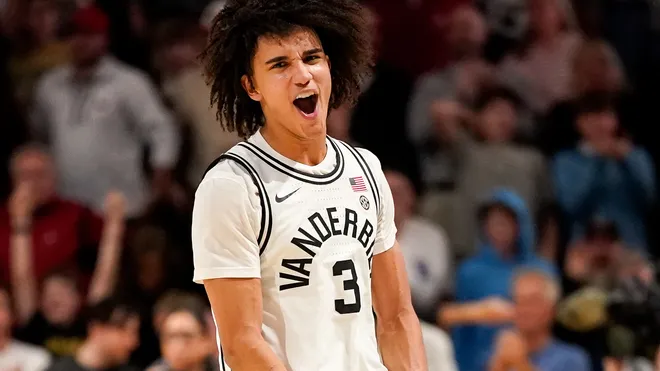
After ugly losses in their last two outings on the road, the Hogs will be back in the friendly confines for a game that feels sort of like a must-win.
We’ve tracked this out before: the 18-game SEC season can be divided into three six-game parts for the Hogs: a medium-difficulty first six, a low-difficulty second six, and a high-difficulty last six. Those final six games include a home-and-home with surging Mizzou and road trips to Florida and Alabama. If Arkansas somehow enters that stretch on the bubble, they might be in trouble.
This game marks the end of the “moderate” six-game stretch, and getting to 4-2 with a true road win would be a significant, given that winning each of the next six is very doable. All is not lost if the Hogs are 3-3, but confidence would not be as high.
- Matchup Analysis: Can the Hogs slow down High Point’s clutch shooting?

- Matchup Analysis: Hawaii’s unusual defense will challenge Arkansas’ preparation

- Box Score Breakdown: Arkansas 88, Missouri 84

Meet the Commodores
The last couple of athletic seasons have been kind to the Vanderbilt athletic program. Baseball has always been good, but football and men’s and women’s basketball are all enjoying a stunning run of success. That this success has lined up with the floodgates of unregulated NIL opening (and that as a private school, Vanderbilt’s athletic finance situation is a relative mystery) is definitely something that makes you go hmmm.
But to be clear, none of this success is possible without the Commodores making the exact right hires. And they’ve done just that. Mark Byington was a fairly mediocre coach until his third season at James Madison, when he and then-football coach Curt Cignetti had massive breakouts in the same athletic year, 2022-23. Cignetti’s two-year run with Indiana football is well-known, but Byington’s two-year run in Nashville has also been wildly impressive. The Dores reached the NCAA Tournament last year and are back for more this season.

Their 16-0 start didn’t really include any signature non-conference wins, although UCF, Saint Mary’s, and SMU are all decent. Two of their SEC wins are against bottom-dwellers LSU and South Carolina. But that win over Alabama was their arrival party and serves as a clear signature victory.
However, as you can see, they’ve lost two straight, including a 98-94 thriller against surging Florida in their last outing. So they’ve come back down to Earth, although this is still a really good team.

Model pick: Vanderbilt 90, Arkansas 89. The Dores would be about four-and-a-half points better on a neutral floor, and homecourt advantage in my model is three-and-a-half points, although the Bud Walton crowd is capable of providing much more than that.
Notably, despite three extra losses, the Hogs have a stronger resume (strength of record). That’s because Arkansas’ three best victories of Louisville, Texas Tech, and Tennessee are much stronger than Vanderbilt’s best three of Alabama, Saint Mary’s, and UCF, and three of Arkansas’ losses (Houston, Duke, Michigan State) are to teams better than any Vanderbilt has played.
Personnel
Part of the help for Vandy has been limited roster turnover, as its top three guys in terms of total minutes played were on the team last year, although only one of them had a major role.
The Commodore lineup is small but extremely quick. Their offense spaces you out, plays fast, and threatens 3-pointers, and everyone finishes really well inside the arc. Their defense uses smarts and quickness to put tremendous pressure on the ball, allowing them to smother the perimeter and prevent good ball movement.

As you can see from the minutes and the WAR, the Commodores have as good a leading trio as any in college basketball. Overall, they have five clear starters and a couple other rotational pieces in the frontcourt. But the depth isn’t great: quality starts to fall off after the top trio and drops significantly after the seventh man.
The backcourt: As good as it gets
For Vanderbilt, it all starts with 6-foot sophomore Tyler Tanner, who has established himself as one of the best point guards in the game. He was just a role player on last year’s team, coming off the bench to average 5.7 points per game as a backup point guard, but everything has clicked for him this season. He averages a team-best 17.4 points per game and dishes out 5.2 assists. He shoots 40% from downtown on about four attempts per game (just under 40% of his attempts will be trips) and he’s at 55% inside the arc. He gets to the line at a decent rate and shoots 87% there. That all adds up to 64% true shooting, which is insanely good for a high-usage guard. His high assist rate pairs nicely with his extremely low turnover rate of just 11%.
And as good as he is offensively… he’s even better on defense. His D-xRAPM value of plus-7.2 (he makes Vanderbilt’s defense 7.2 points per 100 possessions better than the average team with his contributions alone) is double that of Arkansas’ best defender (Meleek Thomas at plus-3.5). He gets a steal on 4.4% of his defensive possessions, tops among Vandy starters and higher than any Hog.
Tanner is joined in the backcourt by 6’2 super-super-senior Duke Miles. How long has Miles played college basketball? Well, he was in his third season at Troy when the Trojans came to Fayetteville and allowed 27 points to Ricky Council IV in a 74-61 Razorback win that also marked the college debut of Nick Smith Jr. That was in November 2022. Miles was injured for most of that season: he’s since spent one season at High Point, one season at Oklahoma, and now one-plus seasons at Vanderbilt.
Miles is another offensive engine at 17.3 points per game. He’s shooting 36% from beyond the arc on very high volume (five attempts per game), and the threat of the 3-pointer is what makes him so good inside the arc (53%) and at the free throw line (88% on six attempts per game). Like Tanner, he won’t turn the ball over much (10%).
With Tanner and Miles creating a devastating one-two punch of ultra-quick shoot-or-drive scorers, the rest of the lineup plays smaller roles on offense. That starts with 6’7 senior Tyler Nickel, a returning starter. He averages 14.7 points per game. The volume of shots is much lower than Tanner or Miles, but his efficiency is extreme: about three-fourths of his field goal attempts are triples, and he’s shooting 46% on them this year. His 3.4 made 3-pointers per game are tied for 14th nationally among Division I players this year. (Fun fact: he’s tied in that stat with USF’s Joseph Pinion, the Morrilton product and former Hog).
Nickel doesn’t do much else, but his extreme 3-point threat contributes significantly to team spacing, which boosts the offense. He also never turns it over: just 5% on the year.
The frontcourt: Some defensive vulnerabilities
That trio of guys has absolutely carried Vanderbilt this season. The frontcourt’s job is simply to help out, and for that task, they’ll rotate four guys.
The starters are a pair of 6’7 seniors: Devin McGlockton and AK Okereke. McGlockton is a returning starter who averages about 10 points and seven boards per game. He shoots more than 60% inside the arc on moderate volume and is the team’s best rebounder by a pretty large margin, making him a strong offensive contributor. On defense, the Commodore ball pressure aims to prevent the ball from getting into the paint, but if it does, McGlockton is the primary on-ball defender against forwards, and he struggles with that task, mostly because of his lack of size. Vandy will understandably help a ton inside the arc, but any forward that can beat him one-on-one despite helpers can abuse him.
Okereke is another dangerous offensive threat, although he’s the lowest-usage guy in the rotation. He’ll step out for a couple 3-point attempts per game and he shoots 38% on those. Like everyone else, he’s an elite finisher in the paint, so his true shooting is an excellent 64% on low volume. Like McGlockton, he is a poor interior defender who doesn’t get many rebounds.
A couple guys come off the bench and play regularly. For height, the Commodores like 6’10 North Carolina transfer Jalen Washington. Washington is a better interior defender than McGlockton, but he doesn’t play as much because he doesn’t offer a 3-point threat, and thus doesn’t help spacing. He’s 6 of 21 from beyond the arc this season. He’s grades as the team’s second-best rebounder, closely behind McGlockton, and is the team’s leading shot-blocker with 24 this year.
An X Factor for me might be the last forward, 6’7 Washington transfer Tyler Harris. He’s probably the worst offensive player in the seven-man rotation, but he’s only forward on the roster that’s actually a good defender. On offense, he’s sitting at just 50% true shooting, and his 23% usage is much too high for the efficiency he’s providing. But if he’s able to have a productive offensive game, Vanderbilt will keep him out there, because his defense is worth a lot. He’s a good help defender, blocking shots at a decent rate, rebounding better than Okereke, and overall contributing to defensive stops at a higher rate than any other forward.
Depth pieces
Minutes drop off quickly after those seven guys. Reserve point guard Frankie Collins was lost for the season last month, so the only other guards are 6’5 freshman Chandler Bing (who says he has never watched Friends) and 6’5 junior Louisville transfer Mike James, who was expected to play a bigger role. Both guys have struggled to score and the Commodores would rather leave them over on the bench.
Lineup math
On paper, there are pros and cons to this personnel matchup. The Razorbacks have a significant height advantage that will allow them to play a three-guard lineup (Acuff, Wagner, and Thomas together) if they want. That might allow the Hogs to put Wagner on Tanner, allowing a better defender to take the Commodore point guard and give Acuff a little bit of rest at that end of the floor. And on offense, it would be very difficult to keep all three guards out of the lane, which is what Vanderbilt desperately has to try to do.
There are some concerns, though. We talked after the Georgia game that Arkansas’ defense is getting gashed when Acuff defends a high-usage point guard, and now Vanderbilt shows up with two high-usage point guards, so the Hogs can’t simply slide him over to the shooting guard. If they want to put Wagner on Tanner, then Acuff might end up defending Miles, which isn’t much better. I don’t see why the Hogs couldn’t slide Acuff all the way to the wing and have him defend Nickel, who will mostly be hunting 3-point looks, and have Thomas and Wagner take the guards. The only way that could backfire is that you’re burning minutes for all three guards at once and you have no backups.
The other option is to lean into the height advantage and start an all-offense lineup (Acuff, Thomas, Knox, Brazile, Ewin), which would have multiple inches at every position except the 3, and dare the Commodores to keep that group out of the paint and off the offensive glass without giving up a ton of kickout 3-point looks. Florida’s elite frontcourt of Reuben Chinyelu, Thomas Haugh, and Alex Condon combined to score 54 points on 17 of 31 from the field, 17 of 19 from the line, and 26 rebounds (eight offensive). Florida was plus-14 on the boards and plus-8 in free throw attempts in a four-point game. Arkansas is built to do this because the Hogs have a 6’11 power forward in Brazile. That lineup gets Pringle and Wagner – who as starters may be contributing to the slow starts – off the floor to start the game.
Here are the total numbers on different guard lineups in Arkansas’ 10 power conference games (five non-conference, five SEC):

The biggest note is that the starting lineup of Acuff and Wagner together is the worst, and Arkansas should consider moving away from it. The three-guard lineup is notable because the Hogs can afford to use it against Vanderbilt’s lack of size and it’s done well. Otherwise, the Hogs should consider sticking with the better offensive battery of Acuff and Thomas together.
Acuff’s struggles on defense are evident when you take him out and the Wagner-Thomas lineup does much better defensively, although it does struggle a bit on offense.
Here’s the frontcourt situation:

Pringle dominated the weaker non-conference games, but against good opponents, he’s clearly worse than Ewin. I think Arkansas should consider going with Ewin as the starting center and treating Pringle as a backup.
One potential change could be letting Brazile play more 5 against Vanderbilt. The Dores have no true post presence, so there’s not much need for Pringle to see the floor. Brazile is a hurt defensively because he struggles as an on-ball defender in the post, but he’ll have four inches on McGlockton. The offensive numbers in Brazile’s 21 minutes at the 5 are no fluke: he is a major contributor to offensive spacing. In those 21 minutes, 18 of Arkansas’ 39 field goal attempts have been dunks, layups, or tip-ins, with 13 makes. The Hogs also have nine offensive rebounds in 17 missed shots (53% offensive rebound rate).
In short, I think I’d like to see more from these lineups against Vanderbilt
- Acuff + Thomas + Knox + Brazile + Ewin (the best offensive lineup)
- Acuff + Wagner + Thomas + Knox + Brazile (the guard-centric spacing lineup)
That second lineup is plus-6 in seven minutes across the 10 big games. You could alter it by subbing in Richmond for Knox (minus-7 in three minutes, yikes), or by taking out a guard and playing Knox and Richmond together (plus-2 in 11 minutes).
When Arkansas has the rock
As mentioned, Vanderbilt’s defense is all about swarming to keep you from getting any easy looks. The Commodores are very good at preventing fast break points. They allow a low assist rate and overhelp every time the ball gets inside the arc.

Vanderbilt’s defense can be taken advantage of early in the shot clock, but true fast breaks against an out-of-position defense will be pretty rare. Vanderbilt’s own offense protects the ball and they focus on getting back defensively after a missed shot.

To this point, we’ve sort of concealed Vanderbilt’s biggest statistical weakness, but it’s consistent with the weaknesses we discussed above. There it is: Vanderbilt will put you on the free throw line. Their aggressive philosophy means they would rather foul you than allow you an easy path to the bucket or a layup. That’s part of how they keep their field goal percentage defense so shiny (31st in eFG%, compared to 76th in true shooting).
The Commodores allow assists on only 46% of made baskets against them, a product of their pestering the ball to prevent good movement. Note that they don’t actually force turnovers at a high rate (88th), although it’s worth noting that an outsized number of the turnovers they do force are live-ball steals which fuel their transition offense. They want to see an offense like Kentucky’s (or, to a lesser extent, Alabama’s), where ball movement protected by good spacing leads to assisted jump shots, because they can interrupt that ball movement and prevent the catch-and-shoot guys from ever getting set up. They really would prefer not to see an offense like Arkansas’, where elite ballhandlers can create off the dribble, often without even needing a screen.
Serious concerns still abound, however. Despite the Hogs’ low turnover rate on the season, Georgia, another ball pressure defense, just had 12 live-ball steals against the Razorback offense. Vanderbilt is built to do the same thing if the Hogs are lazy with the ball or shy away from physicality. If they lean into the physicality of the Commodores instead, they can make the living at the free throw line and keep the Vandy lineup in constant foul trouble.
When Vanderbilt has the rock
The Commodores enter this game with one of the nation’s elite offenses.

Vanderbilt will play at a good pace and get in transition as often as possible, although they are very good in their halfcourt offense. Arkansas’ defense isn’t really good at anything. If there’s a bright side, it’s that Vanderbilt might be less equipped to punish the Hogs in the paint than some other opponents.

Lots to be scared of here. The Dores rarely turn the ball over (6th) and are an elite shooting team (15th in eFG%). They shoot well from beyond the arc (41st), but above all they are absolutely elite paint finishers (8th) on a relatively low volume of shots in the paint (265th).
Arkansas does a few things well. They defend jump shots well, especially at home (that hasn’t really been the case on the road). Their biggest strength is that they don’t foul (29th). But if they can’t keep opponents out of the paint area (140th), their 269th-ranked paint field goal defense is going to let them down. The Hogs expected a lot more out of Pringle in terms of interior defense this year.
Since both defenses allow a lot of 3-point attempts, I think Arkansas wants this to turn into a jump-shooting contest. The home team is definitely at an advantage in a game like that. The Hogs should be able to win free throw attempts and rebounds in order to counteract any shooting advantages from the Vandy side.
Keys to the game
Find the right five. Coaches seem to be very superstitious about their starting five. Most won’t change it if the team is winning, even if it’s clear a move needs to be made. But Arkansas isn’t winning with its current five. The Hogs are starting each game with two poor offensive players on the floor and the offense repeatedly struggles out of the gate. Ewin should be starting over Pringle and Wagner should only start in a three-guard lineup. I’d also like to see Brazile play the 5 some, perhaps at part of a smaller lineup.
Make them foul. Vanderbilt will use pressure to keep the ball from getting into the paint, where their lack of size becomes a liability. The Hogs cannot be afraid of physicality and need to lean into it, forcing Vanderbilt to foul to keep them out of the lane. Settling for too many jump shots in order to avoid collisions is a quick way to get beat.
The latest from Fayette Villains, straight to your inbox
Enter your email to subscribe and receive new post alerts and other updates. You can unsubscribe at any time.