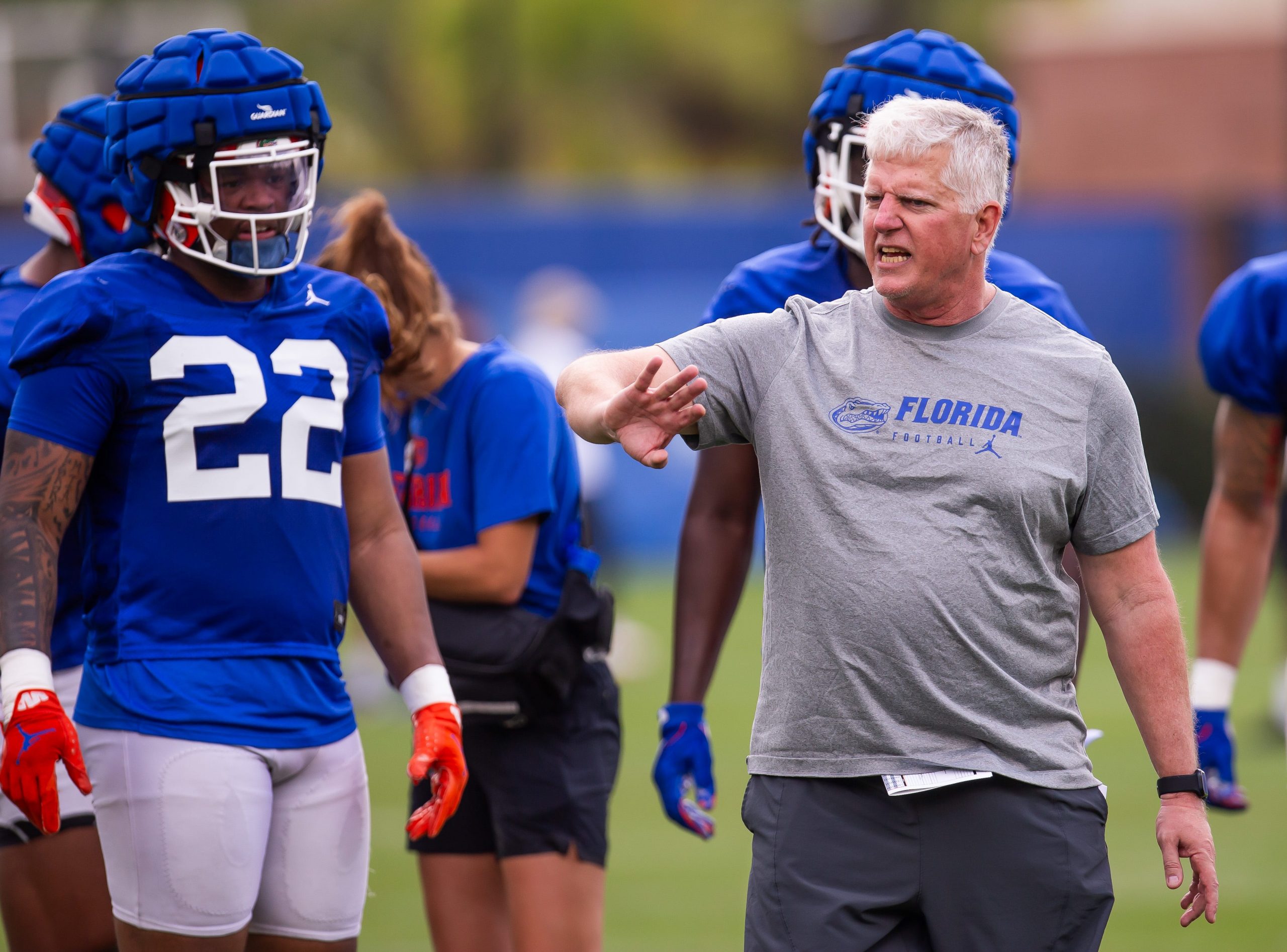
Both coordinators are now in place with the hiring of Florida defensive coordinator Ron Roberts to the same role at Arkansas. Ryan Silverfield promised SEC experience and he delivered it in this hire. Roberts has spent the last two seasons at Florida and before that was Auburn’s defensive coordinator in 2023.
The news of Roberts follows closely on the heels of the news that Silverfield is bringing over his Memphis offensive coordinator, Tim Cramsey. Be sure to check out our in-depth preview of the Cramsey offense, which traces its roots to the razzle-dazzle offense of Gary Crowton and the Oregon “Blur” offense of Chip Kelly.
Fan reaction has been mixed because, like the hire of Silverfield himself, this is not a sexy hire at all. Roberts’ three SEC defenses, while certainly not bad, were not elite either. He’s 58 and doesn’t have much of a reputation as a recruiter. Arkansas is hiring him off from the sinking ship that is Florida’s staff.
But I’ll be honest, this one was pretty easy to understand and talk myself into. Arkansas just fielded one of the worst major college defenses we’ve ever seen in 2025. Unfortunately, that’s not even an anomaly for Razorback football. Here’s a list of Razorback defenses since 2012 that have ranked in the bottom-fourth of all power conference defenses, per Defense SP+: 2013, 2015, 2016, 2017, 2018, 2019, 2020, 2022, 2023, and 2025. Over the last 14 years, Arkansas pretty much only has a non-awful defense when they have a ton of veterans. The 2014 defense had Trey Flowers, Darius Philon, and Martrell Spaight. The 2021 defense had Grant Morgan, Bumper Pool, Montaric Brown, Greg Brooks, Joe Foucha, and Jalen Catalon. Last year’s defense had Landon Jackson and Eric Gregory. None of those teams could maintain any momentum after the key players left: the 2015, 2022, and 2025 defenses were three of the worst on this list, despite all three having the same coordinator as the year prior.
What Arkansas needs more than anything is stability. The Hogs need to produce a competitive defense two years in a row before we start worrying about whether Roberts can get Arkansas into the playoff. That’s why this hire makes sense. Roberts has done nothing but produce competitive defenses for his entire career. His teams are rarely penalized. They are strong in the red zone. They are generally pretty good against the run. They force turnovers at a decent rate. They don’t allow a ton of explosive plays.
On the other hand, they tend to be a bit bend-don’t-break. They cede a lot of yards and rarely completely shut an opponent down. They are probably not good enough to overcome a bad offense. If you wanted a huge name that the Hogs stunningly swiped from an elite team, you’re probably disappointed right now. But that wasn’t realistic, and this hire, while pretty conservative, contributes to Silverfield’s vision of raising the overall level of play of the Razorback football program.
Roberts is extremely well-liked in the coaching industry. He is, in many ways, a “coaches’ coach”. He’s a major innovator in college football and he’s mentored several big-name defensive guys, like Dave Aranda and Pete Golding.
This piece is part of another article I helped co-write over at Best of Arkansas Sports. A link to that article is below.
- Arkansas’ clear top target at center is now in the transfer portal

- Arkansas’ kryptonite beats them one last time in season-ending loss to Arizona

- Matchup Analysis: The Hogs need a perfect game to take down powerful Arizona

The Ron Roberts defense
Ron Roberts has been coaching defense for a long time. He was 38 years old when he got a breakthrough job as the defensive coordinator at Division II Delta State in 2005. He coordinated the defense and had a senior player on that team named Pete Golding. Golding joined the DSU staff as a grad assistant in 2006.
Roberts was named Delta State’s head coach in 2007. His first defensive coordinator was a young up-and-comer named Dave Aranda, who learned Roberts’ approach to defense. He would go on to become defensive coordinator at Wisconsin (2013-2015) and LSU (2016-2019) before being hired as Baylor’s head coach. Roberts would later hire Golding as defensive coordinator while he was head coach at DSU (2010-2011) and Southeastern Louisiana (2012-2013). Golding, of course, later worked for Nick Saban and was recently named the new head coach at Ole Miss.
While the young coaches under his tutelage moved up quickly, Roberts took his time, remaining head coach at SELA through the 2017 season. Finally, he decided to go back to coordinating defense, so he spent two seasons at Louisiana (2018-2019) before Aranda hired him on at Baylor. Things initially went well, as Baylor’s 2021 defense was elite, ranking among the nation’s leaders in scoring defense and paving the way for a Big 12 title in Aranda and Roberts’ second season. The defense regressed in 2022 and, in a stunning move, Aranda fired his mentor.
It didn’t take long for Roberts to find a job: he’s worked at Auburn (2023) and Florida (2024-2025) since then, producing solid-but-not-elite defenses in all three seasons.
So what is this system that Roberts created and Aranda copied, that is so highly-respected in the coaching community? MatchQuarters even made this note on his defense:
The Aranda/Roberts scheme is arguably the second most popular tree in college football behind the Saban/Kirby system.
The “Aranda/Roberts scheme” has a few components, but it is primarily defined by the use of simulated pressures, or sims. Simply put, a simulated pressure is when the defense appears to be sending extra rushers but is in fact only rushing four. One of the most common is a replacement pressure, also known as a Creeper, where the defense sends an extra rusher from one side of the field but drops a defensive lineman in coverage to the other side.
Creepers can cause problems for the offense, especially when it comes to figuring out run blocking assignments. This is the main reason defenses in this system are typically very good against the run. Arkansas’ first encounter with Aranda was in 2016, when LSU crushed the Hogs 38-10, holding SEC-leading rusher Rawleigh Williams III to just 49 yards on 13 carries. Arkansas’ only game against Roberts came in 2023 against Auburn, when the Tiger defense did this to the Razorbacks in Kenny Guiton’s second game as interim offensive coordinator:

Arkansas’ running backs combined for 11 carries for six yards with a long of three. A 60-yard run by Jacolby Criswell in garbage time provided half of the Razorbacks’ rushing output in that 48-10 loss.
Creepers are also excellent on third downs where the offense must pass. The defense knows that it can drop seven coverage guys against a maximum of five receivers, for a plus-two advantage. But most teams have the running back check for a blitz. When he sees the extra rusher, he’ll stay in rather than run a route, not realizing that the defense is only rushing four because a backside end dropped into coverage. That makes the advantage plus-three for the coverage, which is very hard to convert against.
Here’s a good video of Roberts himself breaking down a field-side replacement pressure from the Baylor defense:
Is this a good hire?
More stats can be found at the link below, but Florida’s defense was the least-penalized in the SEC this year (Arkansas, unsurprisingly, was flagged the most). That’s the kind of stuff you’re fixing by hiring a veteran coach like Roberts.
If you thought Arkansas should go full do-or-die, go-for-broke with every single hire – that is, if you’re the type of person who thought Jon Gruden would be an excellent head coaching hire – then you’re probably not loving this hire at all. And you may end up being right! It’s not hard to see the parallels between this hire and Chad Morris hiring John Chavis in 2018. In both cases, an up-and-coming head coach hired an older veteran coordinator to try and bring stability to the Arkansas defense after years of bad football. With Chavis, it was a nightmare, as the Chief had pretty clearly mailed it in.
But I don’t think Roberts has mailed it in, and I also think that Morris’s own leadership had a lot to do with Chavis’s performance. Despite a ton of experience generally and all sorts of respect from the broader coaching community, he’s only been a power conference defensive coordinator for six years, and his three years in the SEC have been at very unstable programs, programs that had issues before his arrival, and programs where his defense was not the problem.
So while it’s a very conservative hire, I like it. As with Cramsey, I’ll give it a solid grade of B. I think Arkansas will have a competitive defense starting immediately, and all eyes will turn to Cramsey’s offense to see what the Razorbacks’ ceiling is.
Be sure to check out the full article at Best of Arkansas Sports.