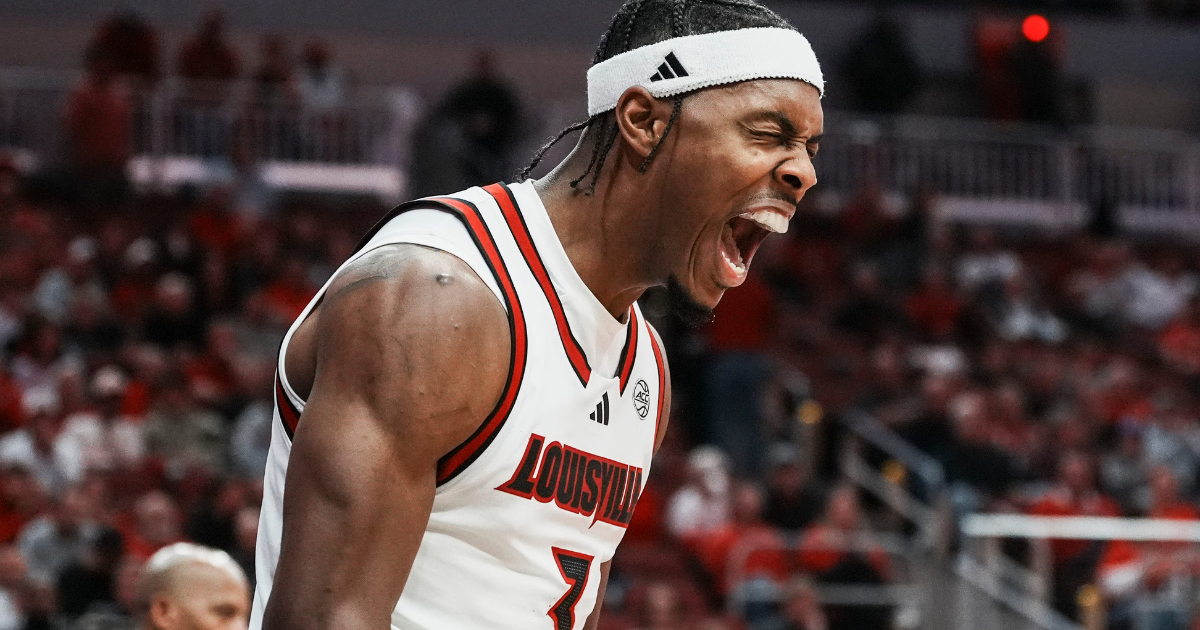
After losing both of its November Quad-1 games, Arkansas’ matchup with sixth-ranked Louisville feels like a must-win if the Hogs really think they’ve arrived as a big-time program. The Cardinals have to come to Fayetteville for their part in the SEC-ACC Challenge.
Meet the Cardinals
The two-year Kenny Payne experiment was a disaster, so Louisville fans would love to get a victory against their former coach, who now sits on the Razorback bench. Louisville hired Charleston coach Pat Kelsey and poured a ton of NIL money into the program, and the result has been an instant turnaround. The Cardinals earned an 8-seed in last year’s NCAA Tournament, but Kelsey how has a well-funded lineup that’s expected to do even more this year.

It took just a couple years after John Calipari left Lexington for Kentucky to lose control of the state. Kelsey’s Cardinals led Mark Pope’s Wildcats by as many as 20 in their game before holding on to win, 96-88. That’s been the only big game for Louisville, and the Cardinals had some issues in a 74-64 win over Cincinnati a couple weeks ago (the same Cincinnati team that Arkansas destroyed in an exhibition and that also has a “real” loss to Eastern Michigan).

Louisville leads the nation in game control, which makes sense given that they carried a big lead for most of their lone Q1 game and have dominated their weaker buy games.
Model pick: Louisville 81, Arkansas 72. Despite a promising performance against Duke, the model still isn’t high on the Hogs. The sample size is still a bit small, so like Arkansas’ poor NET ranking, there’s no reason to start sweating yet.
Personnel

The key guy for Louisville is 6’5 freshman point guard Mikel Brown Jr., who averages 17 points per game and leads the team in total minutes. He’s been all over the place this year, but he scored 29 points against Kentucky and 22 against Cincinnati, so the volume is there in the biggest games. He’s not an overly efficient shooter (49% eFG%), but draws a lot fouls when he drives and shoots 86% at the line, so that bails out his numbers a bit. He’s the primary ballhandler and the offensive initiator for the Cardinals.
The other high-volume guy on offense is 6’4 Xavier transfer Ryan Conwell, who is sitting on 20 points per game. Unlike Brown, the advanced stats love this guy, and it’s easy to see why: he’s shooting 45% from beyond the arc on very high volume, boosting his true shooting to an eye-popping 68% (that’s 1.36 points per shot chance). He never turns the ball over (just 6% turnover rate), and he rebounds pretty well for his size. His consistency in shooting is remarkable: he was just 1 of 5 from downtown against Eastern Michigan, but he’s made at least 40% of his 3-point attempts in every other game, including 4 of 10 against Kentucky and 5 of 10 against Cincinnati.
The rest of the roster mostly plays a supporting role to those two. But there are still plenty of major shooting threats. Start with 6’4 Virginia transfer Isaac McKneeley, who attempts eight 3-pointers per game (and one 2-pointer). He’s shooting 42% on those for 12.3 points per game. He offers little else and is a poor rebounder. The fun continues with 6’4 Kennesaw State transfer Adrian Wooley, who averages 9.1 points per game. He’s only shooting 30% from beyond the arc, but he shoots 60% inside the arc (three attempts per game) and 90% at the free throw line. Wooley also offers some offensive rebounding.
All of these shooters surround the two frontcourt guys, 6’7 senior J’Vonne Hadley and 6’11 center Sananda Fru. Hadley avoids turnovers and rebounds pretty well while offering efficient scoring at low volume, though he struggles defensively. Fru (9.9 points, 5.9 rebounds) is a wildcard against the Razorbacks. He’s the only non-jump-shooter who will play regularly, but he’s an absolute beast on the offensive boards. Fru makes me pretty nervous, because if Arkansas cannot box him out, Louisville is going to get tons of second chances.
Other guys off the bench include 6’10 Khani Rooths, who is a strong defensive rebounder, 6’3 Kobe Rodgers, an efficient shooter and steal specialist who turns the ball over way too much, 7’0 center Aly Khalifa, a former BYU transfer who has battled injuries and whose shot is not falling, and 6’10 Kasean Pryor, another exciting former transfer who has struggled with injuries, playing just 32 minutes this season. He’s been in concussion protocol but could play against the Hogs.
Right now, Louisville only has three reliable guys 6’6 or taller. They were counting on Khalifa and Pryor to be a bigger factor this season. If they continue to struggle, rebounding will continue to be an issue for Louisville.
When Louisville has the rock
As you can probably guess from those 3-point percentages, Louisville’s offense is very good.

The Cardinals will play at a blistering pace, averaging just 14.5 seconds per offensive possession (8th-fastest), with 34% of their possessions coming in transition (1st). Their preferred way to get in transition is off a turnover (27.2 points off turnovers per 100 possessions, 8th), but they are solid in halfcourt as well.

Buckle up: the Cardinals are going to launch 3-pointers at an extreme. Just about half of their field goal attempts come from beyond the arc (12th), and they shoot 54% eFG% (that’s 36% raw), good for 76th nationally. Their 3-point shooting leaves them not trying a ton of shots in the paint (47%, 270th), but they are very good at making the shots they do attempt (64%, 10th). Like Duke, they have successfully employed the analytics-favored strategy of never taking midrange jumpers.
There are no real weaknesses with this offense, except for mediocre offensive rebounding. Arkansas is going to have to defend the perimeter really well and force an off-night for the Cardinals from 3, and then secure defensive rebounds to limit them to one shot per trip.
When Arkansas has the rock
Louisville’s defense isn’t bad at all, but it’s not elite so far.

The biggest concern is the very bottom stat: Arkansas has struggled a bit in halfcourt and is highly dependent on fast break points (8th), but no team in college basketball is better than Louisville at preventing fast break points. The good news is that Arkansas’ iffy halfcourt offense is going to get a shot at an iffy halfcourt defense. Maybe this will be the game that leads to the breakthrough.

At an event level, Louisville has two weaknesses: their 3-point defense is very susceptible, especially to a team playing at home (Louisville has yet to play a true road game), and their defensive rebounding is poor.
For rebounding, Arkansas has a bit of a size advantage, especially at the 4, where 6’7 Hadley will have to match up with 6’10 Trevon Brazile, and then the 6’10 Pryor – who might not clear concussion protocol and has been limited anyway – is the only other player with any size who can hang with Brazile. Arkansas really needs to punish Louisville on the offensive boards. If they lose this game, failure to dominate the offensive glass might end up being a reason.
Three-point shooting is going to be another huge factor. Arkansas’ young guards aren’t doing a good job of getting the offense good paint looks against stronger defenses (Duke and Michigan State), so the Hogs are launching a bunch of 3-pointers. In years past, that would be a catastrophe, but this team at least some capable shooters, even if the overall numbers aren’t amazing. Louisville isn’t doing a great job of defending the perimeter so far, so this could be a big game if Hog shooters get hot.
This will continue to be the case each game, but Arkansas really needs the Karter Knox we expected to see. He offers so much in terms of catch-and-shoot 3-pointers, and also driving and drawing contact. Turf toe injuries take time to fully recover, and he’s figuring out his role on a team with lots more scoring pop than a year ago, but he needs to get into midseason form quickly or this offense is going to continue to struggle.