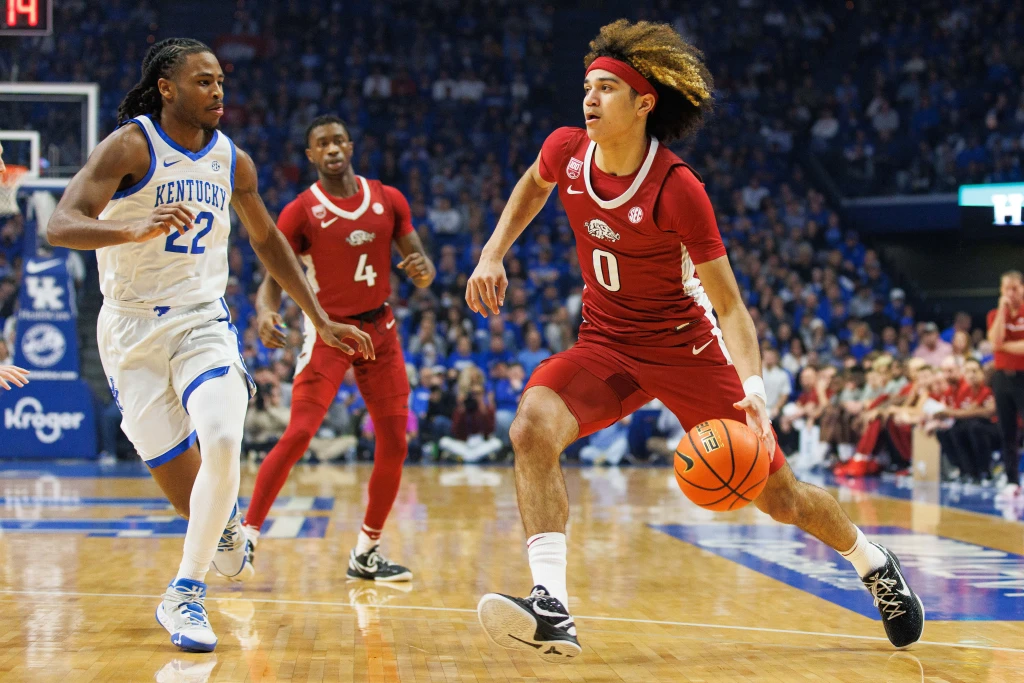
With Arkansas’ 2023 season coming to an end, the focus now turns to the offseason, as Arkansas looks to rebuild for a run. As always, a lot of the hype will come down to who decides to return to Fayetteville, as several names could be in or could be out.
Last year, the Hogs got Anthony Black’s commitment just days after the Duke loss, which really shifted the momentum back into the Hogs’ favor. It will be interesting to see if the Hogs get any big news during the next week as current players decide on their future and portal prospects make decisions.
The purpose of this post is to look at who Arkansas is contacting in the portal, and what holes they will fill. Everything is taken from Ben Brandon’s running list of players Arkansas has contacted. The list is enormous, so it is not necessarily comprehensive, although guys that specifically list Arkansas as making the cut will be in this post. Assuming no more high school recruits, the Hogs are likely looking at four to six players in the portal, and these guys will really swing Arkansas’ 2024 fortunes.
Arkansas’ 2024 roster
When looking at who is coming back and who is going, three guys are gone for sure: Nick Smith and Anthony Black to the NBA, and Kamani Johnson, who is out of eligibility.
Beyond that, a lot is unknown, so Arkansas probably won’t jump headfirst into collecting portal commits until they know what spots they need to fill.
Here’s probably where things stand:
- Jordan Walsh. Definitely could return, but probably gone. His upside is too good for the NBA to resist.
- Ricky Council IV. Also could return, but he doesn’t have much more to prove as a college player. Probably better than 50% chance that he’s gone.
- Trevon Brazile. Has high upside, but NBA scouts only got to see him play nine games this year. He could make a lot of money if he had a breakout season in a Hog uniform this year. I feel like he has a higher chance to return than either Walsh or Council.
- Devo Davis. Probably back. He doesn’t really have high pro prospects, and it’s hard to see him wanting to play anywhere else. If he was buried in the bench, I could see him going for more playing time, but he will likely be a major player next year.
- Joseph Pinion and Derrian Ford. I think at least one is back, and probably both. Pinion actually got some critical minutes this year, and if his defense improves, he could be due for a bigger role. Ford’s still pretty rough on offense. If he thinks Muss’s “build for now” mentality isn’t conducive to his development, I could see him looking elsewhere.
- Barry Dunning. Not sure on this one. Unlike Pinion and Ford, he really didn’t see the floor at all outside of major blowouts. He’s not a native Arkansan and he’s not likely to crack the rotation next year unless his offense takes a major step forward. I would lean toward him departing unless the coaches have given him confidence that he’s close to seeing the floor.
- Makhi and Makhel Mitchell. My first impulse is that they leave. But they’ve already transferred twice and have not been overly productive at any of their career stops. How many schools will want thrice-transferred players who come as a package deal? Would the grass be greener for them anywhere else? But even if they want to come back, does Arkansas want to spend two more scholarships on guys who mostly struggled in SEC play? If the staff likes their upside – and isn’t confident in their portal prospects – they could return just to provide more depth next year. The Hogs know what they’re getting, which is an improvement over the crapshoot that is the portal.
- Jalen Graham. Here’s the issue: Arkansas desperately needed production at his position, and he had a hard time seeing the floor. That should tell you what you need to know. Again, the staff might have some kind of developmental plan that could give him a chance, but he’s not a freshman like Pinion, Ford, or Dunning. He would be a fifth-year senior. He is what he is, and what he is is a high-volume scorer who struggles with turnovers, poor defense, and poor passing. I think he moves on.
Let’s assume that Devo, Pinion, Ford, Dunning and one of Council, Walsh, and Brazile return. With two high school players coming, that gives Arkansas seven players, leaving six spots open for the portal. That’s probably on the upper end of the number of spots. If the Mitchells come back, that leaves four spots, all of which would likely go to guards and wings. If the Mitchells are gone, Arkansas needs at least one more big man in addition to a few scoring guards.
Avoiding Shaka Smart syndrome
“Shaka Smart syndrome” is a name I saw applied to coaches who focus on collecting talent over collecting guys that fit their scheme. Shaka Smart was a great coach at VCU with a very specific system, called “Havoc”. It mostly used small, quick guards to create a lot of turnovers and fast breaks. Those guards were typically not highly-recruited. When he was hired at Texas, Smart got stars in his eyes, and rather than recruit the same type of player, he focused on the 4- and 5-stars that the Longhorns were able to sign. His Texas teams were much more talented, but they were much more traditional scheme-wise and ultimately not very successful, leading to him being run out of town after only a few years.
Smart’s fate at Texas isn’t likely to befall Musselman at Arkansas – again, Arkansas just made the Sweet 16 in a down year – but there are some good lessons on recruiting priorities, especially when dealing with players with high NBA ceilings.
Arkansas had an extremely talented team, but that talent was not evenly distributed across all parts of the game. The Hogs had length and athleticism in spades. They defended well, and were great at offensive rebounding and driving to the basket to draw fouls. But that talent was pretty raw. Anthony Black and Jordan Walsh were really good and really valuable, but their best basketball is years ahead of them, and it won’t come in a Razorback jersey.
Arkansas had three main issues this season that are ideally addressed through roster management:
- Jump shooting
- A lead guard who can get the offense in transition
- A rim protector
Muss and staff can’t really be blamed for the last one, since the injury to Trevon Brazile eliminated the best rim protector on the roster. Brazile likely would have been third or fourth on the team in minutes this year, so that was a huge loss. But let’s look at the others.
Jump shooting. Some analysts cautioned before the season that as talented as the Hogs were, a lack of jump shooters could be a problem. And that was before Nick Smith got hurt. The Hogs were loaded with tall guards who could attack the rim, but the best lineups the Hogs could field simply didn’t have good shooting. Arkansas wants to space the floor and create driving lanes for tall guards who can create their own shot. That’s a great scheme, but if the opponent doesn’t respect the jumper, they’re just going to sink back into the lane and take away those paths to the basket. That’s what UConn did, but we had plenty of warning that would happen: it’s the same thing that Texas A&M did (twice), and even lowly LSU, South Carolina, and UNC Greensboro caused Arkansas’ offense all kinds of problems by focusing on removing driving lanes while risking pull-up 3s.
Simply put: Arkansas isn’t going to win a championship without better shooting. They probably won’t even make a Final Four. By the time you get deep into the tournament, all the Rick Barneses are gone and you’re left with good coaches who will mercilessly adjust to your weaknesses. If you have a weakness so obvious as “we can’t hit jumpers”, then there’s not a lot you can do. Arkansas doesn’t have to be a great shooting team, but they need at least one great shooter, or at least they need most of their main ballhandlers to be decent.
The lack of shooting was the biggest “talent over fit” point for this team. The Hogs took Black, Walsh, and Council while knowing that they lacked shooters. Among the top 8 Hogs in minutes played, Devo led the team in 3-point percentage… at 35%. That’s not going to cut it.
A transition initiator. Muss likes fairly position-less basketball so he doesn’t need a pure point guard, at least in theory. All four main guards on this team regularly ran the halfcourt offense, but this team was uniquely bad in transition offense, and a lack of one reliable guy to get things moving in quick-change situations was the main reason why. The Hogs ranked 152nd out of 363 teams in transition scoring rate, which is really bad for a team that plays as fast as Arkansas does and has the all-around athleticism that the Hogs do. The main problem was that the Hogs didn’t have any single person who could get them going. Council was good for dunks, but Devo lacks the court vision and Black does his best work in halfcourt when he can dissect the defense. The Hogs broke off too many fast break chances this year because they didn’t feel confident that they could get a bucket. Opponents who prioritized getting back on D could stop the Hogs from running, and Arkansas was outscored in transition in all three NCAA Tournament games, including 31-15 by UConn.
What holes can we see for next year?
We’ll soon sort out exactly who is coming back, but the Hogs have signed two 5-star recruits for next year: Layden Blocker and Baye Fall. Blocker is a perfect fit for the “transition initiator” role. He’s a go-go point guard who likes to run and has good lead guard instincts. Fall is a 6’10 center whose calling card is defense. He’ll fill the rim protector role nicely and is athletic enough to defend the perimeter while still recovering to the rim.
But both of these guys have the same drawback: jump shooting. Fall isn’t a jump shooter at all, but his overall offense needs a lot of work. He’s not going to be a post-up threat and he turns it over too much right now. Blocker’s only real drawback right now is shooting. He probably won’t take a lot of 3s, preferring to drive instead.
So shooting has to be Arkansas’ top priority in the portal. Pinion might be ready for a bigger role as a low-usage “3-and-D” sniper, but relying on one guy is not a good strategy. The Hogs need at least a couple more guys who can hit at least 35% from beyond the arc on moderate volume, or higher.
How do we evaluate transfer portal contacts?
We used RAPM in the initial run-through of this post, but we have since changed it. This section will explain why.
A commentor noted that last year, we graded transfers and projected their contribution using a proprietary measure that I called “FV Score”. It was a normalized (on a 0-100) output that combined Box Plus Minus (BPM) with possession-by-possession adjustments aimed at accounting for contributions that cannot be measured in the box score. Basically, the sum total of all their measurable contributions, with an adjustment for how good their team was when they were on the floor.
As we noted in that piece, that score is remarkably effective at projecting how good players will be at their new locations. Most are the same player, even if they go from a bad team to a good one. In that post, we noted that Ricky Council IV was the highest-graded transfer of the Musselman era, and the Mitchell twins plus Jalen Graham seemed slightly underwhelming as pickups. A year later, those predictions seemed to have held up well.
Why we dropped FV Score
However, FV Score had some minor issues, which is why we dropped it during this season in favor of RAPM, or Regularized Adjusted Plus Minus. FV Score had two problems:
- Calculations of FV Score for all players on all 363 Division I teams required more than 24 hours to run on my computer, which is not practical for next-day analysis
- The calculation was done at a total score level, so there no breakouts for offensive and defensive components. We can only know how good a player was overall, not how good they were specifically on offense or defense
Enter RAPM
Regularized Adjusted Plus Minus, or RAPM, is the gold standard of individual basketball analytics. It a ridge regression performed on every possession of the entire season, and definitely answers the question, how much better does an individual player make his team when he’s on the floor, regardless of who else is on the floor with him. It is superior to raw plus-minus because its calculation better accounts for outliers and collinearity – when multiple players frequently play together but only one is really making the team good.
We’ve used RAPM and its offensive and defensive components – ORAPM and DRAPM – for most of the season in our previews. And our initial run of this post used it too.
All of that is fine, but RAPM has one big problem: it’s not very predictive. It tells you how valuable a player is to his team, but what if he’s looking for a new team? Does RAPM transfer well from team to team? The answer is no. RAPMs often reflect things like fit and role, and those change from year to year. The ultimate example is Phoenix Suns star Devin Booker. He put up great stats in 2019 and 2020, but his RAPMs were terrible both years. Did that make him a bad player? No. RAPM judged him harshly because he couldn’t carry the Suns on his own, but everyone knew the potential was there. After the 2020 season, the Suns signed Chris Paul and the rest is history. Booker’s RAPMs have been fantastic ever since. So RAPM didn’t tell the Suns that Booker wasn’t good; it merely told them that he wasn’t good enough to carry them.
Lots of advanced stats aim to approximate RAPM. That means they try to take box score inputs (and other inputs) and predict future RAPM. Box Plus Minus, which formed the basis of our FV Score, is one such stat. Box score stats alone have issues, because not every contribution shows up in the box score, but they are a good start.
Return of FV Score
All of that is to say that FV Score is back. We’ve recalculated it so it now has offensive and defensive components – OFV Score and DFV Score – but it is still the same basic formula: a cumulative box score input, called BPM, combined with luck-adjusted team plus-minus (RAPM).
Over a full season, players who repeatedly generate adjustments that are larger than we’d expect for their BPMs must be making contributions to the team that are not getting picked up in the box score. That’s the theory, anyway.
So all players in this list are ordered by FV Score now. As mentioned above, this score is pretty accurate at predicting how good they’ll be at their next stop. Versus the old RAPM, the new FV Score gives a nice boost to good players on bad teams, like UCA’s Camren Hunter, whose FV Score is much better than his old RAPM grade. Essentially, he’s a good player who couldn’t make UCA better, but he could thrive in another situation.
We’ll use other box score stats to supplement our findings.
Bigs
For the second straight NCAA Tournament, Arkansas exited after getting manhandled in the post. Eric Musselman prioritizes length, athleticism, and versatility over size, which makes it tough for him to find guys who strike a balance between being able to compete with teams like UConn but also be able to play in Arkansas’ base defensive scheme.
The Mitchell twins were recruited to offer that low-post fight, but this was a portal miss. To be fair, Trevon Brazile’s injury forced them into a larger role than anticipated, but they failed to thrive. Makhi really struggled on defense against driving guards and pick-and-rolls, while Makhel was only a little bit better while also being a major liability on offense.
The main newcomer at the 5 position is Fall, discussed above. Fall projects as an elite defender who fits Muss’s scheme. He’s a serious shot-blocking threat, but he’s athletic enough to come out to the perimeter and perhaps even switch on ballscreens in certain situations. However, he’s barely 200 pounds, and is likely to get bumped around a bit against girthier forwards. Plus he has a long way to go on offense.
With Brazile potentially also returning, Arkansas’ contacts at this position seem focused on offensive-minded guys, likely to complement Fall (and possibly Brazile).
Jamarion Sharp (95)
78 offense, 100 defense
While most of the bigs on the Hogs’ target list are offensive-minded, the highest-graded one is a defensive specialist. And Sharp, a 7’5 transfer from Western Kentucky, is certainly special.
Given his height, you might compare him to Connor Vanover. But Sharp isn’t really like Vanover. He’s of limited utility on offense. He finishes well (65% eFG%) and gets fouled a lot (33% free throw usage), but unsurprisingly, his court vision and spacing are not beneficial to an offense.
But defense is his specialty. His 7.6 defensive boards per 40 is pretty good, as is his 1.4 steals per 40. And his 5.4 blocks per 40 makes him one of the best shot-blockers in the country. But I think the most impressive part has to be his insane 1.99 kills per personal foul. He collects two blocks, steals, or drawn charges for every one foul he’s whistled for. If you can figure out how to fit him into your offense, he’s worth a flyer, because that defense will almost certainly translate to high-major college basketball.
Josh Cohen (95)
99 offense, 20 defense
How good can a player be if he’s the best player on a really bad team? That’s the question with Cohen, a 6’10 senior from Saint Francis (PA). The Red Flash are truly abysmal, but Cohen put up 21 and 8 this year. The RAPM numbers are unimpressed, saying that he’s not even the MVP of his own team. But his stats are so good that his FV Score suggests that he’d thrive in a new situation: decent finishing (58% eFG%), good ability to get to the line (20% free throw usage), and fantastic assist-to-turnover ratio (above 1). His defense is rough – his DFV Score is just 20, lowest of all bigs the Hogs are looking at – but he’s an elite offensive center.
Kel’el Ware (94)
91 offense, 87 defense
The former 5-star and McDonald’s all-American from North Little Rock is in the portal and could leave Oregon. If I say, “athletic 7-footer who can shoot from 3”, you’re probably interested, and potential is the name of the game for Ware, who still has three years of eligibility.
The good news: his 1.81 kills per foul is fantastic and indicative of high-end athletic potential as a defender. He’s a very good rebounder, and of course, he will shoot from 3. About one-third of his shots this season were 3-pointers.
The bad news: that 3-point shot isn’t really falling. Ware hit just 27% from beyond the arc and wasn’t a great finisher inside of it. He also had the lowest assists per 40 (1.2) and lowest steals per 40 (0.8) among all of Oregon’s forwards this year. His general lack of defensive activity isn’t ideal: even his 3.2 blocks per 40 isn’t amazing for a 7-footer (Makhel Mitchell had 4.7 this year).
Bringing in Ware would give you some insurance in case Baye Fall struggles, but I’m not sure how many scholarships Arkansas’ staff will want to use on non-switchable centers.
Jordan Minor (94)
83 offense, 98 defense
This 6’8 center from Merrimack is intriguing option as a defensive center who can still score at high volume.
Offensively, he was a high volume scorer for Merrimack, and his 2.6 assists per 40 is pretty good. He might could be coached up to be better on offense, but his very poor finishing is a concern, as he shot just 52% eFG% despite taking almost all his shots around the rim.
Defensively, though, he’s got a lot going for him. His defensive grade of 98 is the best among all centers the Hogs have contacted. He rebounds well (11.5 total boards per 40), gets a lot of steals (2.0), and blocks shot at a regular rate (3.4). Best of all, his 1.76 kills per foul is truly incredible: this stat is great at approximating defensive playmaking skill (as opposed to mere aggressiveness), and Minor has it in spades.
Graham Ike (89*)
Ike’s numbers are from the 2022 season
This 6’9 forward from Wyoming is one of the portal’s most sought-after players. He missed the entire 2023 season with an injury. The 19.5 points and 9.6 rebounds per game is obviously fantastic, the red flag is that he’s not a great scorer or defender. His 51% eFG% isn’t ideal for a guy who takes a lot of high-percentage shots. Instead, he relied on getting fouled and getting to the line to score.
There’s a reason many big teams want him, but he’ll need the right fit in order to thrive.
Jamille Reynolds (89)
87 offense, 78 defense
This 6’10 sophomore from Temple is a bit riskier than other prospects, due to his very high 3.4 turnovers per 40 minutes. He finishes well (61% eFG%), but grades as merely decent at both ends. He is a very good overall rebounder (10.8 rebounds per 40, including 7.3 on defense), but his kill-to-foul ratio is below 1. I don’t see a high ceiling with this one, especially since he grades below both Mitchell twins while being a similar type of player.
Kenny Hunter (72)
62 offense, 79 defense
This 6’10 sophomore out of Louisiana Tech sports a dismal RAPM grade of… 14. Stay away, right? Well, probably. Hunter is a good finisher (63% eFG%), but he’s been low usage (14%), and his very low 0.4 assists per 40 hints at a general lack of floor vision and spacing. Additionally, his 5.8 defensive rebounds per 40 is pretty bad for a 6’10 guy. Arkansas probably isn’t looking for developmental prospects in the portal, so it’s hard to see this guy being the best option.
Small Forwards
With Jordan Walsh seemingly off to the NBA, the Hogs are interested in a floor-spacing forward to mostly play the 4 (or the 3 in bigger lineups). Analytics love tall guys who can shoot 3-pointers, and that seems to be the type of player Arkansas is targeting here: guys 6’6 to 6’8 who can shoot from 3 but also defend at the 4 position.
Chris Ledlum (99)
96 offense, 97 defense
Ledlum is the most sought-after guy in the portal for good reason.
This 6’6 Harvard transfer could play the 3 or the 4. He defends the perimeter exceptionally well and gets his share of steals (2.2) and defensive rebounds (7.7, great for a 6’6 guy). And he does it all without fouling (excellent 1.33 kills per foul).
Offensively, Ledlum will take about one-third of his shots from beyond the arc. He’s not a great 3-point shooter – just 29% this year – which is the biggest drawback with him. But he’s a good passer (2.0 assists per 40) and significantly improved his 2-point shooting this season.
Mustapha Amzil (93)
89 offense, 97 defense
This 6’9 shooting threat is a recent addition to the list, but he’s worth taking seriously. About half his shots are 3-pointers, and he’s just over 36% on those. When he chooses to drive, he has an excellent free throw usage (26%). That combination of height and scoring ability is absolutely fantastic. His assist rate (2.8 per 40) is very good for a 6’9 forward.
Defensively, he can defend on the perimeter, although he isn’t overly active, not recording many rebounds, steals, or blocks. Still, his DRAPM grade is over 90, so there’s obviously some skill there.
Bonus points for Amzil that he plays in Anthony Grant’s high-octane Dayton offense that is built to reward athleticism. This seems like a potential home run.
BJ Mack (92) – Listed Arkansas in top 10
99 offense, 7 defense
This 6’8 Wofford transfer is a career 35% 3-point shooter on very high volume for the Terriers. His offensive grades are awesome because analytics love 6’8 guys that can space the floor and shoot. And he doesn’t turn it over to boot (just 2.0 turnovers per 40).
Ready for the bad news? He’s really bad on defense. His length would theoretically be an asset, but he’s not very active and Wofford’s defense was noticeably worse when he was in the game. Could he be coached up by Arkansas’ staff?
Zach Austin (87)
91 offense, 48 defense
This 6’5 freshman from High Point accumulated a lot of volume but grades poorly as a rebounder and shooter. His lack of size would be a pretty big concern, because his shooting and all-around perimeter play didn’t really come along this year. He still has three years of eligibility, so this would be more of a long-term developmental pickup.
Clarence Daniels (77)
76 offense, 66 defense
This 6’6 transfer from New Hampshire is a beast on the defensive boards but offers virtually nothing on offense that suggests that his 15 points per game is remotely translatable to the SEC.
Messiah Jones (76)
84 offense, 38 defense
Here’s another Wofford transfer, a 6’6 small forward who is the only small forward the Hogs have looked at who isn’t a 3-point threat. Jones is a dominant offensive rebounder (4.1), but much of his game likely does not translate to the SEC. Not sure what the strategy is with this one.
Myles Stute (57)
75 offense, 17 defense
Stute is a 6’7 Vanderbilt transfer who shot 36% from downtown on extremely high volume a year after shooting 44% on much more moderate volume. He’ll help you space the floor, but he struggles to get to the rim (most of his shots inside the arc are low-percentage midrange jumpers).
Defensively, though, he’s not very good, and his 0.42 kills per foul is almost embarrassingly-bad. It’s hard to imagine him making a big enough leap as a defender to justify playing serious minutes.
John Hugley IV (56)
56 offense, 54 defense
This 6’8 Pitt transfer has been injury-prone and played just eight games this past season. He’s a good offensive rebounder but is undone by a monstrous 4.2 turnovers per 40. Due to the lack of sample size, it’s hard to get a good read on him, but the analytics didn’t think much of his upside.
Wings/Jumbo Guards
Even though Arkansas somewhat overinvested in tall guards this year, Eric Musselman has had a lot of success with tall guards who can drive to the basket. The problem with this year’s team was that most of those tall guards couldn’t shoot.
If Council returns, the Hogs will have limited need for more jumbo guards and can focus remaining scholarships on finding more pure shooters. Barry Dunning could also eventually step up to a more defensive-focused, lower-usage role. But if Council is gone, the Hogs will really need a high-volume scorer who can use his height at both ends to create shots and defend the perimeter.
Only four guys fit this bill so far, which either means that the Hogs are confident that Council will be back, or they are confident that one or more of these guys will sign.
Brice Williams (95)
98 offense, 50 defense
This 6’7 combo guard from Charlotte is a recent contact that vaults to #1 jumbo guard. Williams is a total package for what the Hogs need. Just under half his shots are 3-pointers, and he hit 40% this season. He’s also above-average at getting to the line when he decides to drive. He doesn’t really struggle with turnovers and he rebounds decently. His defense isn’t great but it’s not a major red flag like some other options.
He’s the only tall guard the Hogs are after that is a really good shooter, so that alone makes him a great option.
Freddy Hicks (89)
92 offense, 58 defense
The pride of Searcy, this 6’6 combo guard paced Tarleton in scoring with 16 points per game. His RAPM isn’t great, but his box score stats are intriguing. About a quarter of his shots are 3-pointers. He’s not a great finisher, but he hit 34% from beyond the arc and posted a massive 32% free throw usage rate, giving him strong “3-or-drive” potential on the wing. He also grades as a very good rebounder at both ends and even gets steals at a good rate.
Given that he’s an Arkansas native, this one could actually have some potential.
TJ Bamba (76)
80 offense, 53 defense
This 6’5 senior from Washington State projects as another “3-or-drive” option. About one-third of his shots are 3-pointers, and he shot an excellent 37% on those. He also has an excellent 26% free throw usage when he decides to drive. He is slightly turnover-prone and does not rebound well for a 6’5 guard who could be playing the 3 in a Hog lineup. His defense is also a drawback, as he’s much more likely to commit a foul than make a play on the ball.
Kowacie Reeves (62)
65 offense, 49 defense
A 6’6 combo guard transferring from Florida, Reeves could potentially replace Council if he departs. Is he as good as Council? Not this year. Reeves does some things well: low turnover rate, decent rebounding and all-around defense, but his shot is stinky. He shot just 26% from 3 this year despite half his shots being triples. At best, he could be lower-risk, lower-reward than some of these more productive mid-major options.
Reese Dixon-Waters (58)
66 offense, 35 defense
This 6’5 USC transfer could play the 2 or the 3. Arkansas’ interest would likely be based on potential alone, as there’s very little in the numbers to justify targeting Dixon-Waters. He’s a 30% 3-point shooter on moderate volume, is below-average at getting to the line, turns it over on a horrid 25% of possessions, is a very poor rebounder for his size, and averages a ghastly 0.65 kills per foul. He’s just a sophomore, but I’m not sure about this one.
Jamison Battle (38)
56 offense, 14 defense
I’m not feeling this one. Battle is 6’7 Minnesota transfer whose 3-point shot isn’t falling (31%), who struggles to get to the line (very bad 9% free throw usage), and who has low-end potential on defense (0.76 kills per foul). There’s not really anything about his game that is attractive other than his height and ability to play on the perimeter. He would be a major development project.
Small Guards
Absent some roster turnover beyond what is expected, the Hogs already have options for the 1 and 2 positions. Blocker figures to be the main guy at point guard, while Devo can play either point or 2. If Pinion is ready to take on a larger role as a 3-and-D specialist, then the Hogs will have less pressure to find a pure shooter in this class. And Ford could play either backcourt spot.
The main thing I’ve seen is that Arkansas is willing to move away from the “all tall guards” strategy, as just about all of these guys are under 6’5. The Hogs want shooters who can play fast, and most of these guys fit the bill.
Javon Small (94)
94 offense, 70 defense
Small is an aggressive, drive-and-kick 6’2 point guard from East Carolina who would be a good fit for an offense like Alabama’s, where his stat profile looks very similar to Jahvon Quinerly. Small takes about half his shots from beyond the arc, shooting 33%. If he’s not shooting a 3, then he’s either dishing out an assist (very good 26% assist rate) or attacking the rim (elite 29% free throw usage).
His 33% shooting from 3 is a bit low, and if it drops much then it could become a liability. And his aggressiveness often costs him to the tune of a 26% turnover rate, which is high. It’s worth noting that he’s 89 of 103 (86%) from the free throw line in his career, so he could end up in a Chris Lykes-type role where he gives the main point guard a breather during the game and then finishes off close ones with free throws.
Nicholas Timberlake (93)
96 offense, 57 defense
This 6’4 Towson transfer is the most productive 3-point shooter the Hogs have contacted. He’s at a consistent 41% over the last two seasons on an extremely-high volume of shots, so his 57% eFG% is the best of all players the Hogs have contacted.
Curiously, he grades as only the third-best offensive player on his own team, per ORAPM. His 23% turnover rate probably has something to do with that. And then there’s the fact that while he’s not awful, he’s not a good defender.
Ishmael Leggett (90)
90 offense, 70 defense
This 6’3 transfer from Rhode Island is physical and a potential asset on defense. Leggett is really strong as a perimeter defender and rebounds really well for a 6’3 guard. He can also get to the free throw line (24% free throw usage). Unfortunately, he’s not great as a 3-point shooter (33%) and is really inefficient inside the arc, where he finishes poorly and takes too many midrange shots.
Denver Jones (90)
97 offense, 28 defense
The main argument for Jones, a 6’4 sophomore from Florida International, is that his 62% True Shooting is the best of all guards the Hogs are looking at. He shoots 37% from 3, over 50% from 2, and 84% from the line. He gets to the line at a good rate (23% free throw usage). He turns it over too much (24%) and doesn’t rebound well, but his excellent 1.69 kills per foul suggests some room for improvement as a defender.
Charles Pride (88)
92 offense, 49 defense
Another pure shooting guard, Pride is a 6’4 senior from Bryant (the university, not the Arkansas town) who shot 37% from beyond the arc on high volume. He’s also a decent passer on the perimeter (10% assist rate) and only turned it over on 15% of possessions. He crashed the offensive glass pretty well for a shooting guard (7% offensive rebound rate), but his defense likely leaves a lot to be desired.
DJ Horne (87)
82 offense, 82 defense
A 6’1 transfer from Arizona State, Horne is a very good perimeter defender who will offer free throw shooting and ballhandling to the offense. He’s a career 88% free throw shooter and his 14% turnover rate is excellent. He’s up-and-down as a shooter: 36% from 3 on moderate volume is excellent, but he’s an awful 2-point shooter, below average at both finishing and settling for midrange shots. He’s not a great rebounder either.
His DRAPM grade of 93 is very good, and he’s really the only elite defender the Hogs are looking at for small guards. If the need is improving 3-point shooting while maintaining good defense, here’s your guy.
Keyon Menifield (81)
89 offense, 38 defense
Another go-go offensive initiator, Menifield graded as Washington’s best offensive player despite lackluster shooting. He’s a 6’1 point guard who dished out 4.1 assists per 40 against just 2.2 turnovers per 40. Shooting is a concern: just 33% from beyond the arc and only 15% free throw usage. He’s also a poor rebounder and poor defender, though his 1.05 kills per foul suggests potential to improve.
Dayvion McKnight (79)
79 offense, 64 defense
This 6’1 transfer from Western Kentucky did everything for the Hilltoppers. He dishes a lot of assists, rebounds well for his size, and led his team with 2.1 steals per 40 minutes. But his 16.5 points per game came the hard way, as he didn’t take a lot of 3-pointers (only 15% of his shots were triples and he shot 34% on them) and isn’t great at getting to the line (16% free throw usage). His overall 48% eFG% and 54% TS% aren’t amazing, so he’d need to take a step forward as a shooter to make the leap to high-major ball.
Camren Hunter (77) – Listed Arkansas in top 5
93 offense, 10 defense
A 6’3 sophomore from UCA who is from Bryant, Hunter would be a fun in-state prospect. The numbers here aren’t great though. His RAPM is very bad, but so are his box score stats: just 31% from 3, below-average at getting to the line, and a 20% turnover rate. His 2.03 kills per foul are great, but he’s a pretty passive defender. It would be cool to add him if there’s an extra scholarship left, but he’d likely not see a ton of minutes next year.
Jesse Zarzuela (76)
79 offense, 54 defense
A Houston native, this 6’3 junior is looking to get out of Central Michigan. His 3-point shot is his calling card. About half his shots are 3-pointers and he shot just over 35% this year. He’s had injury issues and was lost for the season for the Chippewas in January.
He’s not a good scorer inside the arc due to his propensity for midrange jumpers, and he doesn’t grade all that well as a defender.
Taran Armstrong (75)
78 offense, 53 defense
Armstrong is one of the more extreme players the Hogs have contacted. A 6’6 sophomore from Tasmania who is transferring from Cal Baptist, Armstrong can initiate your offense. His 27% assist rate is the best of all players the Hogs have contacted… but his 29% turnover rate is among the worst. He’s only a 33% 3-point shooter on moderate volume, but he can get to the line and draw fouls (22% free throw usage). Unsurprisingly for his height, he’s a pretty good rebounder to boot.
Unfortunately, he doesn’t grade well on defense, and that turnover rate isn’t ideal. But if Arkansas’ staff likes tall guards, he fits the bill.
Quincy Olivari (65)
88 offense, 7 defense
There appears to be some serious interest between the Hogs and this 6’3 transfer from Rice, though the numbers are not overly optimistic. To be fair, there’s a lot of potential upside here: Olivari is a 36% 3-point shooter on extremely high volume, so there’s a good chance that would translate to high major play. He also posted an excellent 24% free throw usage, so like some other options, the potential for a “3-or-drive” scorer is there. For a 6’3 guard, Olivari is also a very good defensive rebounder (18%).
Unfortunately, it’s mostly bad news other than that. Olivari is a very poor finisher inside the arc, shooting under 50%. His 10% assist rate isn’t bad, but his 20% turnover rate is a bit high. And his 0.85 kills per foul (and DRAPM grade of 10, second-worst on his team) suggests a general lack of defensive upside.
Olivari is intriguing because there is a potential role for him as a volume 3-point shooter. Asking him to be your main scorer all-around is really risky, though.
Primo Spears (41)
75 offense, 2 defense
There appears to be mutual interest between the Hogs and this 6’3 point guard who is transferring from Georgetown. He averaged 16 points per game, and given the pitiful state of Georgetown’s roster this season, it’s entirely possible that he thrives with a better supporting cast.
But the numbers aren’t amazing, especially if the Hogs are prioritizing shooters. Spears is a very low-volume 3-point shooter – just one-tenth of his attempts are 3-pointers – and he shot just 30% this past year. He’s also under 45% inside the arc thanks to a ton of midrange attempts, so his free throw usage rate of 12% is extremely low. He does have an excellent 22% assist rate, though his 23% turnover rate is a bit high. Defensively, there’s not much happening here, as he has a poor DRAPM and does not do much statistically either.
He’s a former 4-star recruit who has a ton of athleticism. As a transition initiator, this might not be a bad pickup. But if the Hogs land Spears and don’t also land a shooting guard who is actually a threat from 3, that would be a bit disappointing.
Recap
There are a lot of names here, and our list will only grow. So let’s recap the highest-potential guys:
- Bigs. Kel’el Ware is the new name to watch here. He’s a 7-footer with range and very high upside, although his freshman season at Oregon was up-and-down. In the right situation, he likely thrives. Jamarion Sharp is a 7’5 shot-block specialist with limited offensive skill who is the highest-graded overall. Beyond those, Josh Cohen is a risky high-volume scorer, while Jordan Minor is a tough defender. Jamille Reynolds might be a lower-risk balance between those two. Graham Ike is a monster name that is being contacted by all the bluebloods, but he’s coming off an injury and his subpar finishing is a bit of a concern.
- Small Forwards. Harvard’s Chris Ledlum grades as the best all-around, with a nice combination of 3-point shooting and perimeter defense. If shooting is what the Hogs want from this position, then 6’8 BJ Mack is a dangerous 3-point shooter with a ton of offensive upside. For defense, consider Mustapha Amzil, who can also shoot from 3 while defending well.
- Jumbo Guards. Brice Williams is the best overall, as a 6’7 tall guard who can shoot and take it to the rim. Searcy native Freddy Hicks has a ton of upside as a wing who can hit from 3 and get to the rim, but he played at a small school and struggles on defense. Power-5 transfers Kowacie Reeves and Reese Dixon-Waters might be lower risk, but their games have serious drawbacks. If Ricky Council returns, the Hogs might not sign anyone in this group.
- Small Guards. Tons of options here. UCA’s Camren Hunter can score at high volume, but he’s not very efficient and struggles on defense. Javon Small is the highest-graded overall, and he’d likely be a strong offensive initiator. For pure shooters who can work off the ball, consider Nicholas Timberlake or Charles Pride. If defense is also a priority, DJ Horne can defend and shoot, though he’s not elite at either. Denver Jones is an extremely efficient shooter who can play with the ball in his hands. And while Qunicy Olivari appears to be high on the Hogs’ radar, our model isn’t so sure about his upside outside of decent 3-point shooting, especially on defense.
We’ll continue to follow what Arkansas is up to in the portal, and we’re likely learn more soon as current players announce their future plans.
Thanks for reading! Be sure to follow us on Twitter and on Facebook.
The latest from Fayette Villains, straight to your inbox
Enter your email to subscribe and receive new post alerts and other updates. You can unsubscribe at any time.